


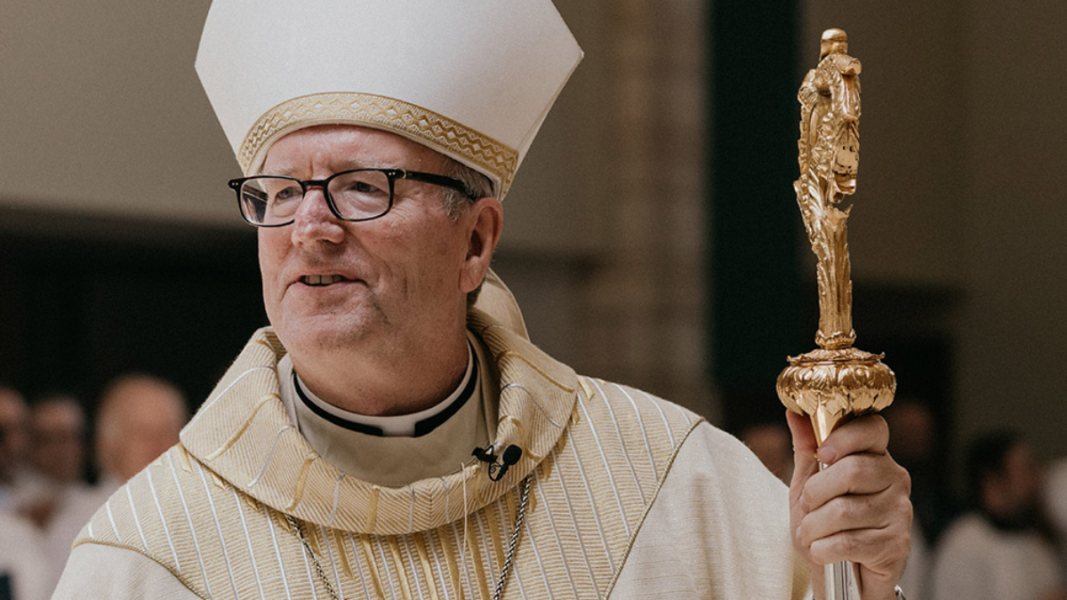
The Bishop of Winona-Rochester (United States), Robert Barron, has publicly warned about the risks of a misunderstood synodality that, instead of serving the Church’s mission, ends up becoming a space for doctrinal debate and theological relativism. His statements come in the context of the Cardinals’ Consistory works, where synodality is among the topics under consideration and, as we have already begun to see after the first day, it is also the modus operandi of the event.
Barron, who has actively participated in synodal processes both at the local level and in Rome, emphasized that synods can be useful instruments for defining practical pastoral strategies, but they should not become forums for questioning already established teachings of the Magisterium.
When doctrine is subjected to a vote, the Church enters into crisis
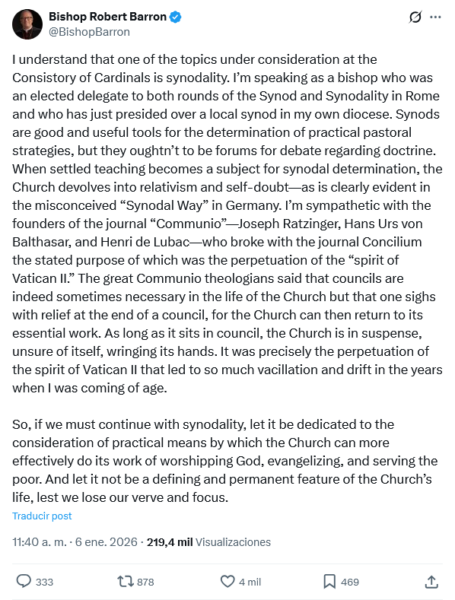
In a message posted on the social network X, the bishop recalled his experience as an elected delegate in both phases of the Synod and as president of a diocesan synod. From that authority, he maintained that when doctrinal teaching becomes the object of “synodal determination,” the Church falls into relativism and self-complacency, a dynamic that—as he stated—is already clearly observed in the so-called German Synodal Way.
Barron pointed out that this type of process generates doctrinal insecurity and a permanent sense of provisionality that ends up paralyzing ecclesial life.
The reference to Ratzinger and the theology of Communio
The bishop evoked the founders of the magazine Communio —Joseph Ratzinger, Hans Urs von Balthasar, and Henri de Lubac—, who distanced themselves from the publication Concilium precisely because of its commitment to perpetuating the so-called “spirit of Vatican II.” According to Barron, these great theologians recognized that councils can be necessary at certain historical moments, but they also warned that the Church cannot remain indefinitely in a conciliar state.
“At the end of a council, one sighs with relief,” Barron recalled, because the Church can then resume its essential work. Keeping it in a continuous process of deliberation generates confusion, hesitation, and pastoral drift, as happened in the decades following the Second Vatican Council.
A synodality at the service of the mission, not as an end in itself
The American bishop concluded by emphasizing that if synodality is to continue, it must be oriented exclusively toward practical means so that the Church can better fulfill its mission: worshiping God, evangelizing, and serving the poor. Additionally, he warned against the danger of turning it into a permanent and defining feature of ecclesial life.
Otherwise—as he affirmed—the Church runs the risk of losing clarity, vigor, and sense of its own mission.