


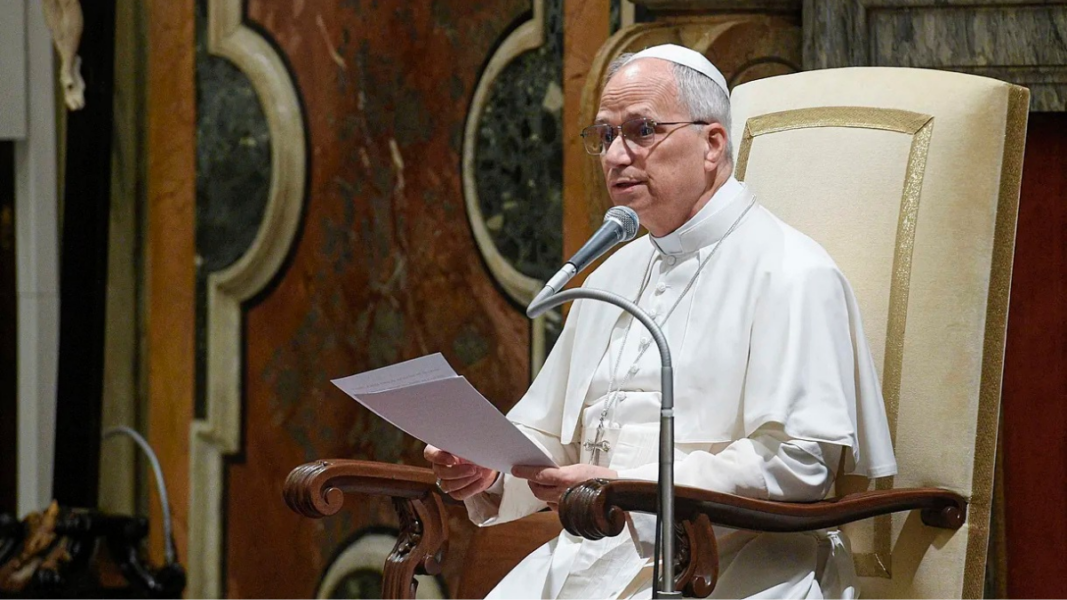
In the General Audience held this Tuesday, January 7, in the Paul VI Hall, Pope Leo XIV inaugurated a new cycle of catechesis dedicated entirely to the Second Vatican Council and to the direct reading of its documents. Before pilgrims and faithful from Italy and various countries, the Pontiff emphasized that the Council must be rediscovered from its authentic texts and not through ideological interpretations or mere «hearsay.»
Leo XIV presented this new catechetical itinerary as an opportunity to recover the richness and relevance of one of the most decisive ecclesial events of the 20th century, recalling that its documents remain today the magisterial reference that guides the Church’s path. Citing St. John Paul II and Benedict XVI, he affirmed that Vatican II was a «great grace» for the Church and that, far from having been surpassed by the passage of time, it continues to offer valid criteria for addressing the challenges of the present.
With this new series of catechesis, Leo XIV made it clear that the authentic reception of the Council does not pass through partial or rupturist readings, but through a serious knowledge of its documents and an ecclesial reform that has as its axis holiness, the centrality of God, and the faithful proclamation of the Gospel to the contemporary world.
We leave below the complete message of Leo XIV:
Dear brothers and sisters, good morning and welcome!
After the Jubilee Year, during which we have dwelt on the mysteries of Jesus’ life, we begin a new cycle of catechesis that will be dedicated to the Second Vatican Council and to the re-reading of its Documents. This is a precious occasion to rediscover the beauty and importance of this ecclesial event. St. John Paul II, at the end of the Jubilee of the year 2000, stated as follows: «I feel more than ever the duty to point to the Council as the great grace of which the Church has benefited in the 20th century» (Apostolic Letter Novo millennio ineunte, 57).
Along with the anniversary of the Council of Nicaea, in 2025 we have commemorated the sixty years of the Second Vatican Council. Although the time that separates us from this event is not excessive, it is equally true that the generation of bishops, theologians, and faithful of Vatican II is no longer among us. For this reason, while we perceive the call not to extinguish its prophecy and to continue seeking ways and means to carry out its intuitions, it will be important to know it again up close, and to do so not through «hearsay» or the interpretations that have been given, but by re-reading its Documents and reflecting on its content. It is, in fact, the Magisterium that still today constitutes the polar star of the Church’s path. As Benedict XVI taught, «with the passage of the years the documents have not lost their timeliness; their teachings prove particularly pertinent in relation to the new demands of the Church and of the present globalized society» (First message after the Mass with the cardinal electors, April 20, 2005).
When Pope St. John XXIII opened the conciliar assembly on October 11, 1962, he spoke of it as the dawn of a day of light for the entire Church. The work of the numerous Fathers convened, coming from the Churches of all continents, effectively paved the way for a new ecclesial stage. After a rich biblical, theological, and liturgical reflection that had traversed the 20th century, the Second Vatican Council rediscovered the face of God as Father who, in Christ, calls us to be his children; it contemplated the Church in the light of Christ, light of the nations, as a mystery of communion and sacrament of unity between God and his people; it initiated an important liturgical reform by placing at the center the mystery of salvation and the active and conscious participation of the entire People of God. At the same time, it helped us to open ourselves to the world and to understand the changes and challenges of the modern era in dialogue and co-responsibility, as a Church that desires to open its arms to humanity, to echo the hopes and anxieties of peoples, and to collaborate in the construction of a more just and fraternal society.
Thanks to the Second Vatican Council, «the Church becomes word; the Church becomes message; the Church becomes dialogue» (St. Paul VI, encyclical letter Ecclesiam suam, 67), committing itself to seek the truth along the path of ecumenism, interreligious dialogue, and dialogue with people of good will.
This spirit, this interior attitude, must characterize our spiritual life and the pastoral action of the Church, because we still need to more fully realize the ecclesial reform in a ministerial key and, in the face of current challenges, we are called to remain attentive interpreters of the signs of the times, joyful proclaimers of the Gospel, courageous witnesses of justice and peace. Msgr. Albino Luciani, future Pope John Paul I, as bishop of Vittorio Veneto, wrote prophetically at the beginning of the Council: «There exists, as always, the need to realize not so much organisms or methods or structures, but a deeper and more widespread holiness. […] It may be that the optimal and abundant fruits of a Council will be seen after centuries and will mature laboriously overcoming contrasts and adverse situations.»
Rediscovering the Council, therefore, as Pope Francis has affirmed, helps us «to restore primacy to God and to a Church that is mad with love for its Lord and for all men, loved by Him» (Homily on the 60th anniversary of the beginning of the Second Vatican Council, October 11, 2022).
Dear brothers and sisters, what St. Paul VI said to the conciliar Fathers at the end of the works remains today also for us a criterion of orientation; he affirmed that the hour of departure had come, of leaving the conciliar assembly to go out to meet humanity and bring it the good news of the Gospel, with the awareness of having lived a time of grace in which past, present, and future were condensed: «The past: because here is gathered the Church of Christ, with its tradition, its history, its Councils, its Doctors, its Saints. […] The present: because we separate to go toward the world of today, with its miseries, its pains, its sins, but also with its prodigious achievements, its values, its virtues. […] The future, finally, is there, in the imperious call of peoples to greater justice, in their will for peace, in their conscious or unconscious thirst for a higher life: precisely that which the Church of Christ can and wants to give them» (St. Paul VI, Message to the conciliar Fathers, December 8, 1965).
It is the same for us. By approaching the Documents of the Second Vatican Council and rediscovering its prophecy and its timeliness, we welcome the rich tradition of the Church’s life and, at the same time, we question ourselves about the present and renew the joy of going out to meet the world to bring it the Gospel of the Kingdom of God, Kingdom of love, of justice, and of peace.