


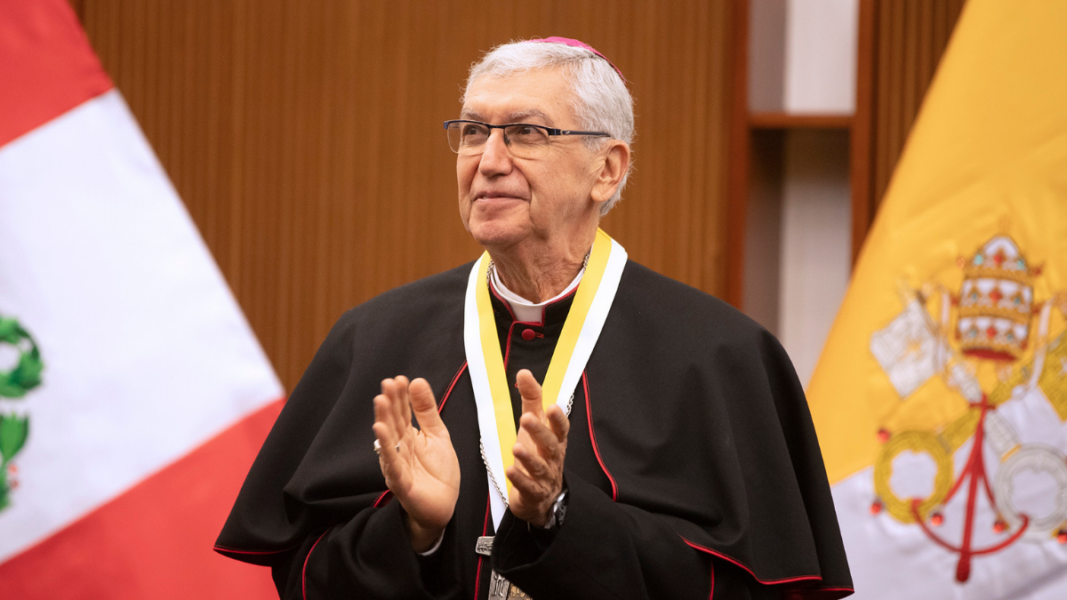
The message pronounced by Cardinal Carlos Castillo at the II Synodal Assembly of the Archdiocese of Lima does not contain simple pastoral inaccuracies nor unfortunate expressions typical of an oral discourse. What is evident, upon careful analysis of his words, is the coherent exposition of an ecclesiology that directly conflicts with Catholic doctrine on essential points. Among all the problematic elements of his intervention, three stand out for their objective gravity and doctrinal consequences: a historicist conception of the Church, the inversion of the order between Church and mission, and a formulation that effectively eliminates God’s transcendence with respect to the created world.
The first serious error appears in the way the cardinal presents the identity of the Church as dependent on historical becoming and its capacity for adaptation to the world. The literal affirmation is clear: “each era the Church has tried to respond to the challenges of a changing humanity.” This idea is further reinforced when he adds: “if the Church does not reform, if it does not change with the times, it becomes strange to the world.” The problem does not lie in recognizing that the Church lives in history or that it must proclaim the Gospel to concrete men in concrete contexts, something that Catholic doctrine has always upheld. The problem is in turning historical change into a normative criterion for ecclesial identity. In this approach, the Church ceases to be the depositary of a definitive revealed truth to become an institution that redefines itself based on the “challenges” of the world. The logical consequence is that doctrine ceases to be received and safeguarded to be reformulated according to the cultural expectations of the moment. It is not the world that must be evangelized by the Church, but the Church that runs the risk of being evangelized by the world.
The second error, closely linked to the previous one, is the radical inversion of the order between Church and mission. The cardinal does not limit himself to emphasizing the importance of the mission, but explicitly formulates an ecclesiology in which the Church is not the subject of the mission, but its product. The literal quote leaves no room for interpretations: “the Church derives from the mission. It is not that the Church exists and does missions, but that the mission makes the Church.” This affirmation directly contradicts Catholic doctrine on the divine foundation of the Church. The Church does not arise from a historical missionary praxis, but from the sovereign act of Christ who calls the Apostles, confers authority on them, and promises to remain with them until the end of time. The mission springs from the Church because the Church exists beforehand as a reality willed and founded by Christ. By inverting this order, the Church is reduced to a functional structure that legitimizes itself by its activity, not by its supernatural origin. Ultimately, a Church that “derives from the mission” can redefine itself as many times as the mission itself is redefined.
The third error, the most serious from a doctrinal point of view, affects the very core of faith in God the Creator. The cardinal states literally: “God did not create the world outside of him. The world is within God.” As formulated, this phrase eliminates the ontological distinction between God and creation. Catholic doctrine teaches that God freely creates the world from nothing, sustains it in being, governs it providentially, and is present in it by his power and action, but without ever confusing himself with the creature. To say that “the world is within God,” without any clarification that preserves divine transcendence, introduces a conception incompatible with Christian faith, for it turns creation into a kind of prolongation of the divine being. This formulation not only obscures the doctrine of creation but makes the very notion of sin, redemption, and salvation incomprehensible, since it dissolves the real distance between God and the world that makes both the fall and grace possible.
These three errors do not appear in isolation, but reinforce each other. A Church that defines itself by historical change, that is born from its own mission, and that is situated within a world “contained in God” ceases to be the Church that receives a revealed truth to proclaim it, correct it, and safeguard it. It becomes a self-referential, procedural, and horizontal Church, more concerned with not appearing “strange to the world” than with being faithful to Christ.
From a pastoral perspective, it is difficult not to perceive in these affirmations a profound doctrinal disorientation. The mission of a bishop is not to reinvent the Church according to the categories of time, but to transmit integrally the faith received, even when it is uncomfortable or countercultural. When theological language loses precision, the faith of the people weakens.