


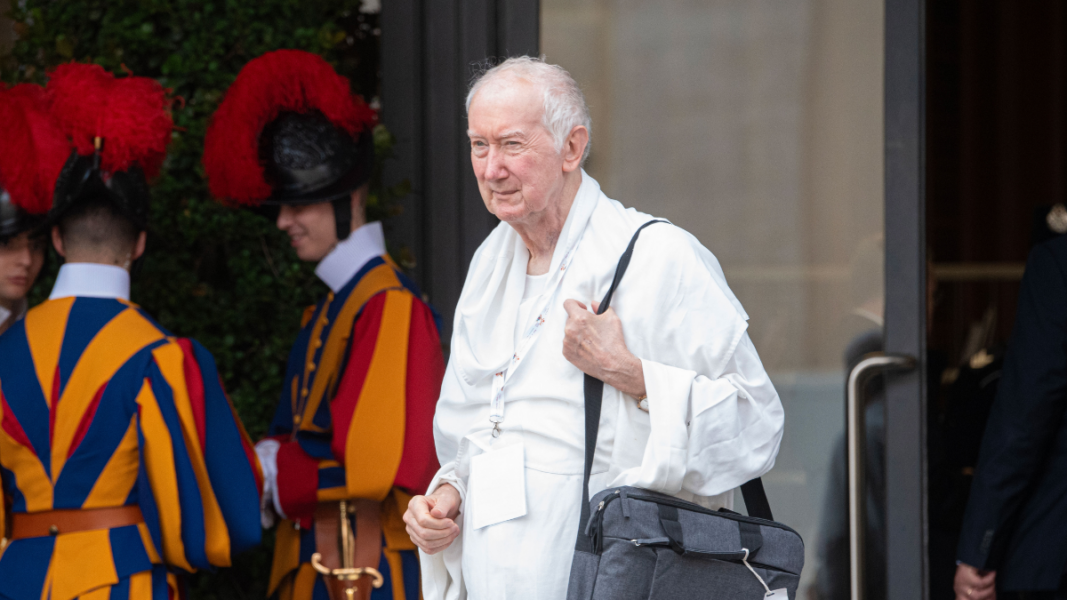
English Cardinal Timothy Radcliffe has offered a straightforward interpretation of the reasons that led the College of Cardinals to elect Leo XIV as the new Pope, while expressing his support for advancing “rapidly” in the ordination of women as deacons. He states this in an extensive interview granted to The Telegraph, in which he reflects on the conclave, the legacy of the previous pontificate, and the pending debates in the Church.
According to Radcliffe, Leo XIV was elected with a dual objective: to continue part of the pastoral momentum inherited from Francis’s pontificate and, at the same time, to recover sectors of the Church that had felt marginalized or uneasy about his style of governance. “We chose him because he could do both things,” the cardinal states, pointing out that the new Pope has the capacity to advance without breaking internal communion.
A Pope to Restore Balances
Radcliffe describes Leo XIV as a figure “centered on God,” prudent in his decisions and with a notable capacity for listening and mediation. In his view, these qualities were decisive at a time when many cardinals perceived the need to restore balances after years of internal tensions.
The cardinal emphasizes that the conclave took place in a serene and fraternal atmosphere, without opposing blocs or visible power struggles, and maintains that the election responded more to a shared discernment than to political strategies. Leo XIV, he says, was seen as someone capable of “bringing together” without paralyzing the Church.
Continuity and Correction of Francis’s Legacy
Radcliffe does not hide his personal and spiritual closeness to Pope Francis, whom he describes as a man marked by the “culture of encounter” and by a frontal rejection of clericalism. However, he acknowledges that this style provoked fear and resistance in not a few ecclesial spheres.
From this perspective, he interprets the election of Leo XIV as a way to give continuity to some intuitions from the previous pontificate—especially regarding synodality—but with a less disruptive style and more oriented toward integrating those who felt displaced.
Explicit Support for Women’s Diaconate
In the interview, Radcliffe again expresses his support for the possibility of ordaining women as deacons and argues that this step should be taken “rapidly,” provided it has the consent of the Church as a whole. In his opinion, the female diaconate does not pose the same theological problems as priestly ordination and could be a concrete way to recognize the role of women in ecclesial life.
Nevertheless, he warns that any advance must take into account the truly universal dimension of the Church and not be imposed from an exclusively Western perspective. In this regard, he recalls that many bishops from Africa and other regions, although committed to social justice, firmly oppose the ordination of women.
A Vision Not Without Controversy
Radcliffe insists that ordination should not be understood as the only criterion of relevance in the Church and criticizes a clericalist vision that identifies power and holiness with access to ordained ministry. Even so, his call to advance rapidly in the female diaconate clearly places him within the ecclesial sector that pressures for structural changes in this area.
His statements offer a significant reading of the current moment in the Church: a pontificate that begins with the mission of restoring internal unity, while fundamental debates—such as the role of women—remain open and will continue to mark the ecclesial agenda under Leo XIV.