


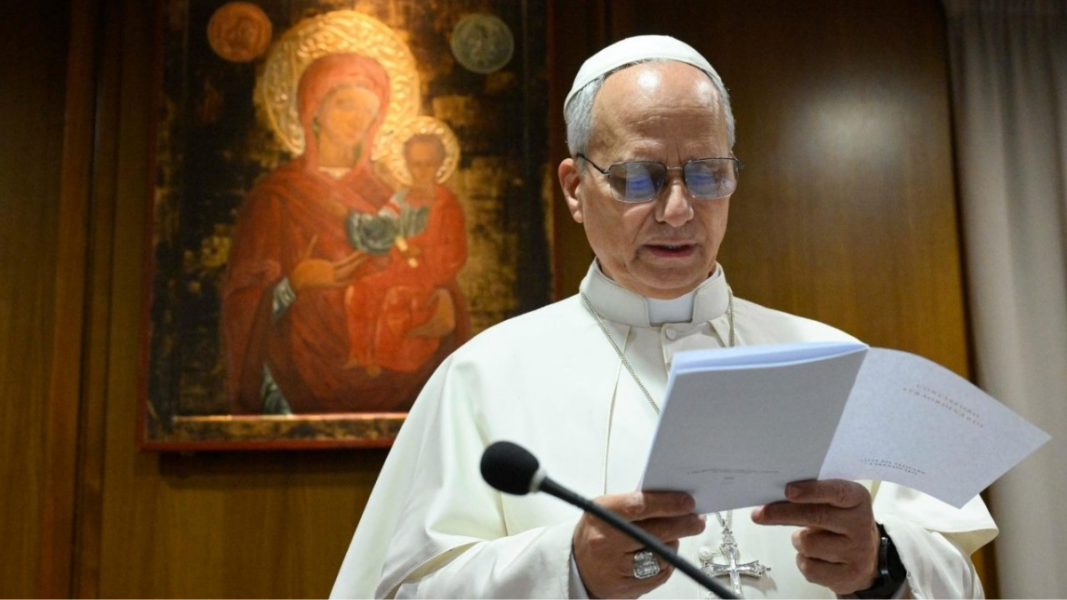
Pope Leo XIV inaugurated this Wednesday, January 7, the extraordinary consistory convened in the Vatican, which takes place over two days, with a speech addressed to the College of Cardinals. This is the Pontiff’s first message to the cardinals in this context since the beginning of his pontificate and sets the tone with which he wishes to exercise the government of the Church.
In his address, Pope Leo XIV emphasized the Church’s evangelizing mission, understood as the radiation of Christ’s light, insisted on unity and charity as conditions for Christian witness, and reclaimed listening and collegiality as central elements of the synodal path. The Pope recalled that the Church does not grow by proselytism, but by attraction, and presented the consistory as a space for dialogue to discern the pastoral priorities of the coming years.
We leave below the words of Pope Leo XIV:
Dear brothers:
I am very pleased to welcome you and bid you welcome. Thank you for your presence! May the Holy Spirit, whom we have invoked, guide us in these two days of reflection and dialogue.
I consider it very significant that we have gathered in Consistory the day after the solemnity of the Lord’s Epiphany, and I would like to introduce our work with an inspiration that comes precisely from this mystery.
In the liturgy has resounded the ever-moving call of the prophet Isaiah: “Arise, shine, for your light has come, and the glory of the Lord has risen upon you! For behold, darkness shall cover the earth, and thick darkness the peoples; but the Lord will arise upon you, and his glory will be seen upon you. And nations shall come to your light, and kings to the brightness of your rising” (Is60,1-3).
These words recall the beginning of the Constitution on the Church of the Second Vatican Council. I read the first paragraph in full: “Christ is the light of the peoples. Because of this, this sacred Synod, gathered together in the Holy Spirit, ardently desires to illuminate all men, announcing the Gospel to every creature (cf.Mc16,15) with the clarity of Christ, which shines on the face of the Church. And because the Church is in Christ as a sacrament, or sign and instrument of intimate union with God and of the unity of the whole human race, she proposes to her faithful and to the whole world with greater precision her nature and her universal mission, drawing abundantly from the doctrine of the preceding Councils. The conditions of our time make this duty of the Church more urgent, namely, that all men, who today are more intimately united by multiple social, technical, and cultural bonds, may also achieve full unity in Christ” (Lumen gentium, 1).
We can say that the Holy Spirit, centuries apart, inspired the same vision to the prophet and to the conciliar Fathers: the vision of the Lord’s light that illuminates the holy city—first Jerusalem, then the Church—and, reflecting on it, allows all peoples to walk amid the darkness of the world. What Isaiah announced “in figure,” the Council recognizes in the fully revealed reality of Christ, light of the nations.
The pontificates of St. Paul VI and St. John Paul II can be interpreted globally from this conciliar perspective, which contemplates the mystery of the Church fully included in that of Christ and thus understands the evangelizing mission as the radiation of the inexhaustible energy that emanates from the central event of the history of salvation.
Popes Benedict XVI and Francis summarized this vision in a single word: attraction. Pope Benedict did so in the inaugural homily of the Aparecida Conference, in 2007, when he said: “The Church does not engage in proselytism. She grows much more by ‘attraction’: as Christ ‘draws all to himself’ with the power of his love, which culminated in the sacrifice of the cross, so the Church fulfills her mission to the extent that, united to Christ, she carries out her work by conforming in spirit and in fact to the charity of her Lord.” Pope Francis fully agreed with this approach and repeated it on several occasions in different contexts.
Today, with joy, I take it up again and share it with you. And I invite you and myself to pay close attention to what Pope Benedict pointed out as the “force” that presides over this movement of attraction: that force is Charis, it is Ágape, it is the Love of God that became incarnate in Jesus Christ and that in the Holy Spirit is given to the Church and sanctifies all her actions. Indeed, it is not the Church that attracts, but Christ, and if a Christian or an ecclesial community attracts, it is because through that “channel” comes the vital sap of charity that flows from the Heart of the Savior. It is significant that Pope Francis, who began with Evangelii gaudium “on the proclamation of the Gospel in the present world,” concluded with Dilexit nos “on the human and divine love of the Heart of Christ.”
St. Paul writes: “Caritas Christi urget nos” (2 Co5,14). The verb sunechei says that the love of Christ urges us because it possesses us, envelops us, and captivates us. Here is the force that draws all to Christ, as He himself prophesied: “And I, when I am lifted up from the earth, will draw all people to myself” (Jn12,32). To the extent that we love one another as Christ has loved us, we are his, we are his community, and He can continue to attract through us. In fact, only love is credible, only love is worthy of faith.[1]
Unity attracts, division scatters. It seems to me that this is also reflected in physics, both in the microcosm and in the macrocosm. Therefore, to be a truly missionary Church, that is, capable of bearing witness to the attractive force of Christ’s charity, we must above all put into practice his commandment, the only one he gave us after washing his disciples’ feet: “As I have loved you, so you also should love one another.” And he adds: “This is how all will know that you are my disciples, if you have love for one another” (Jn13,34-35). St. Augustine comments: “He loved us, then, for this, that we might love one another, by giving us this, by loving us: that mutual love might bind us together, and, united by such a sweet bond, the members might form the body of so great a Head” (Treatise on the Gospel of John, 65,2).
Dear brothers, I would like to start from here, from this word of the Lord, for our first Consistory and, above all, for the collegial path that, with God’s grace, we are called to walk. We are a very varied group, enriched by multiple origins, cultures, ecclesial and social traditions, formative and academic trajectories, pastoral experiences, and, naturally, characters and personal traits. We are called, first of all, to know each other and to dialogue in order to be able to work together at the service of the Church. I hope that we can grow in our communion to offer a model of collegiality.
Today, in a certain sense, we continue the memorable meeting that I was able to have with many of you immediately after the Conclave, with “a moment of communion and fraternity, of reflection and exchange, intended to support and advise the Pope in the grave responsibility of the government of the universal Church” (Letter convening the Extraordinary Consistory, December 12, 2025).
In these days we will have the opportunity to experience a community reflection on four themes: Evangelii gaudium, or rather, the mission of the Church in the present world; Praedicate Evangelium, that is, the service of the Holy See, especially to the particular Churches; Synod and synodality, instrument and style of collaboration; and liturgy, source and summit of Christian life. For reasons of time and to favor a deeper analysis, only two of them will be the object of a specific presentation.
The 21 groups will contribute to the decision we make, but, since it is easier for me to seek advice from those who work in the Curia and live in Rome, the groups that will present their reports will be the 9 from the local Churches.
I am here to listen. As we learned during the two Assemblies of the Synod of Bishops of 2023 and 2024, the synodal dynamic implies par excellence listening. Every moment of this kind is an opportunity to deepen our shared appreciation for synodality. “The world in which we live, and which we are called to love and serve even in its contradictions, demands of the Church the strengthening of synergies in all areas of her mission. Precisely the path of synodality is the path that God expects of the Church of the third millennium” (Francis, Address on the 50th anniversary of the institution of the Synod of Bishops, October 17, 2015).
This day and a half that we will spend together will be a prefiguration of our future path. We must not arrive at a text, but maintain a conversation that helps me in my service to the mission of the whole Church.
Tomorrow we will address the two chosen themes, with the following guiding question:
Facing the path of the next one or two years, what aspects and priorities could guide the action of the Holy Father and the Curia on this issue?
Listening to the mind, heart, and spirit of each one; listening to one another; expressing only the main point and very briefly, so that all can speak: this will be our way of proceeding. The ancient Roman sages said: Non multa sed multum. And in the future, this way of listening to one another, seeking the guidance of the Holy Spirit and walking together, will continue to be of great help for the Petrine ministry entrusted to me. Also from the way we learn to work together, with fraternity and sincere friendship, something new can arise, which puts at stake the present and the future.
Dear brothers, I already thank God for the presence of all of you and your contributions. May the Virgin Mary, Mother of the Church, always assist us.