


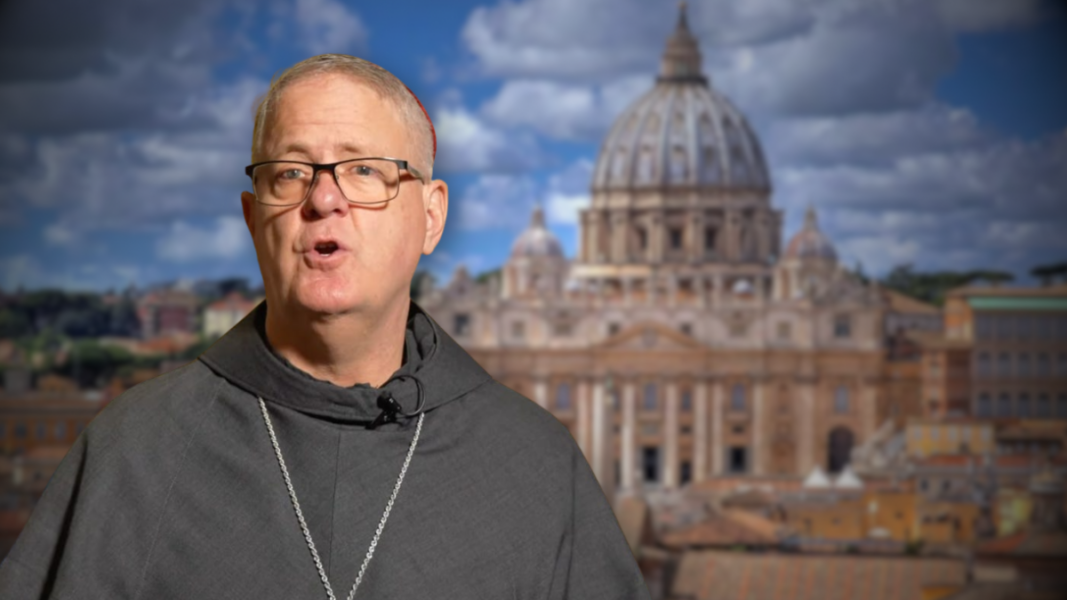
Doubts in Rome over the ban on communion rails in the Diocese of CharlotteMore than three dozen priests from the Diocese of Charlotte (United States) have formally raised a series of dubia to the Vatican to request legal clarification on recent liturgical changes imposed by their bishop, Michael Martin, OMF Conv., including the prohibition of receiving Communion kneeling and the ban on the use of communion rails and kneelers.
According to The Pillar, the letter was sent on January 5 to the Dicastery for Legislative Texts and is signed by 31 priests from the diocese, approximately one-quarter of the local clergy. Two-thirds of the signatories are active pastors.
Ban on Communion Rails and Kneelers
The initiative arises as a direct response to a pastoral letter published by Bishop Martin on December 17, in which he announced that, starting from early 2026, the use of communion rails, kneelers, or prie-dieus for receiving the Eucharist will not be permitted in the diocese. Additionally, he orders the removal of any movable elements intended to facilitate kneeling Communion before January 16.
Read also: A U.S. bishop imposes standing Communion and orders the removal of kneelers in parishes
In the letter accompanying the dubia, the priests point out that both this pastoral letter and a draft leaked last summer—with proposals for new liturgical restrictions—have generated “great concern among the priests and the faithful of the Diocese of Charlotte,” especially in those parishes where the traditional practice of receiving Communion kneeling had been maintained.
Appeal to the General Instruction of the Roman Missal
One of the dubia explicitly asks whether a diocesan bishop has the authority to prohibit the installation of communion rails or to order the removal of those that already exist legitimately in churches.
The priests cite the General Instruction of the Roman Missal (GIRM), which states that the presbytery must be distinguished from the rest of the church “by an appropriate structure and ornamentation” (GIRM 295), and recalls that “the tradition of the Roman rite and the spiritual good of the common People of God must be respected, and not private inclinations or arbitrary decisions” (GIRM 42).
From this, they ask whether it can be considered licit for a bishop to prohibit a traditional structure like the communion rail, widely used to delimit the presbytery and facilitate a legitimate form of receiving Communion.
Kneeling Communion and Other Liturgical Practices
Another dubium directly addresses the issue of kneelers, asking whether a bishop can prohibit their use when the faithful, “on their own initiative,” wish to receive Holy Communion kneeling. The priests recall that the GIRM explicitly allows this form of reception and raise whether a pastor or rector can, as a pastoral provision, place kneelers to accommodate those faithful.
The letter also questions whether the bishop can prohibit specific styles of priestly vestments that are not forbidden by liturgical law, as well as the distribution of Communion by intinction, an option expressly included in the GIRM but ruled out by Bishop Martin in his pastoral letter.
Likewise, the signatories ask whether it is legitimate to prohibit prayers, gestures, hymns, or vestments merely because they are associated with the liturgical use prior to the Second Vatican Council, when documents such as Redemptionis Sacramentum and the GIRM itself recognize the legitimacy of traditional practices and vestments.
A Growing Conflict
The presentation of these dubia is part of a series of growing tensions in the diocese since Michael Martin assumed episcopal governance in May 2024. The bishop has been criticized for imposing new limitations on the use of pre-conciliar liturgical texts and for a style of governance that some local priests describe as “arbitrary micromanagement” and “autocratic.”
For the moment, the Dicastery for Legislative Texts has not publicly responded to the questions raised by the priests of Charlotte.