


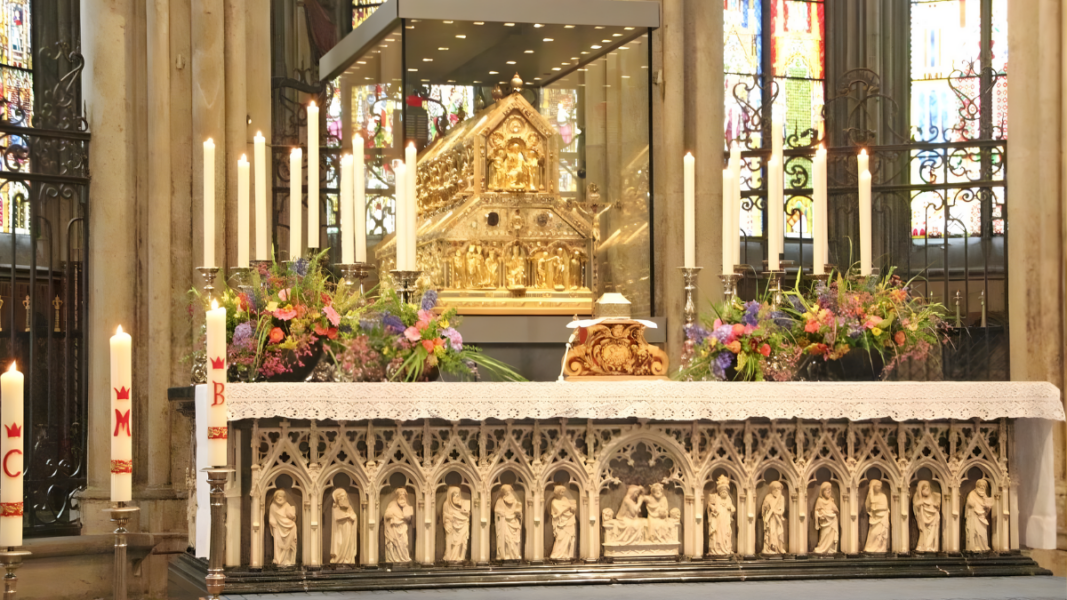
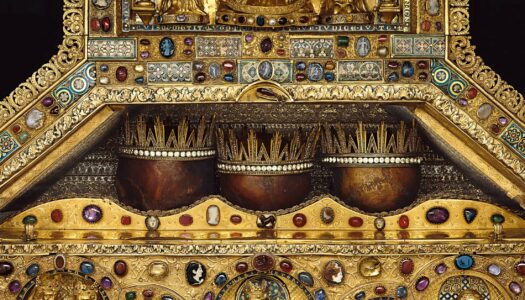
In the heart of the majestic Cologne Cathedral, standing as a Gothic testament to faith, is one of the most venerated relics of Christendom: the Shrine of the Three Wise Men (Dreikönigenschrein), a reliquary that, according to Catholic tradition, holds the remains of Melchior, Caspar, and Balthasar, the wise men from the East who came to adore the newborn Savior.
These relics are not mere objects of historical curiosity, but a profound symbol of the manifestation of Christ to all peoples, proclaimed liturgically in the solemnity of the Epiphany of the Lord. That men from distant regions bowed before the Child of Bethlehem is, for the Church, a figure of the universality of salvation and of the faith that transcends cultures and times.
The Magi: Worshipers from Afar
The Gospel of Saint Matthew narrates the episode with sobriety. It speaks of some Magi from the East, wise men who, attentive to the signs in the sky, recognized that the King of the Jews had been born. They left their land behind, embarked on an uncertain journey, and upon arriving in Bethlehem, they prostrated themselves and worshiped him (cf. Mt 2:1–12).
When Jesus was born in Bethlehem of Judea, in the days of King Herod, some magi from the East arrived in Jerusalem, saying: “Where is the King of the Jews who has been born? For we saw his star in the East and have come to worship him.”
The living Tradition of the Church, meditated and proclaimed for centuries in the liturgy, recognized in them three kings—Melchior, Caspar, and Balthasar—image of the peoples of the earth who come to Christ. Their gifts—gold, incense, and myrrh—were not simple presents, but a confession of faith: Christ the King, Christ God, Christ who would die for the salvation of the world.
The Long Journey of the Relics
The history of these relics is as ancient as it is fascinating. According to tradition, it all begins in the 4th century, when the empress Saint Helena, mother of Constantine, dedicated to recovering relics from the Holy Land, would have found the remains of the Magi in the city of Saba and ordered their transfer to Constantinople. They remained there for centuries until, later, they were brought to Milan, where they were kept in the Basilica of San Eustorgio.
However, the turning point came in 1164, when the emperor of the Holy Roman Empire Frederick Barbarossa transferred the relics from Milan to Cologne, entrusting them to the archbishop Rainald von Dassel. From that moment on, the German city became a center of pilgrimage that attracted thousands of faithful during the Middle Ages and up to our days.
The Cathedral and Its Reliquary: Art in the Service of Faith
To safeguard this spiritual treasure, a reliquary of unique proportions was commissioned: the Shrine of the Three Wise Men, a medieval goldsmith’s work whose basilica-shaped structure is made of solid gold and silver, enriched with enamels, filigree, and precious gems, and decorated with figures of biblical characters that embody the history of salvation.
The construction of the Cologne Cathedral, whose foundation stone was laid in 1248, was directly linked to the need to house these relics. The Gothic temple, which took more than six centuries to complete, stands as a witness to the faith of generations who have come to honor the Wise Men and at the same time to worship Christ.
Cologne, along with Rome and Santiago de Compostela, is counted among the great centers of Christian pilgrimage precisely because of this sacred custody. The reliquary is not only an artistic and cultural treasure, but a symbol of God’s call to the peoples, inviting every believer to follow the light that leads to Christ.
The Current Meaning of a Millennial Tradition
In the solemnity of the Epiphany, the Church recalls that the Magi did not come simply to offer gifts, but to worship the King of the universe and to testify that God’s salvation is destined for all humanity. The Cologne reliquary, its art and its history, speak to us of a path of faith and a search that does not end with the contemplation of the remains, but continues in the life of every Christian called to recognize and worship the living Christ.
Today, those relics continue to be a center of devotion, a reason for pilgrimage, and an invitation for all the faithful to renew their own search for the true Light amid the shadows of the world.