


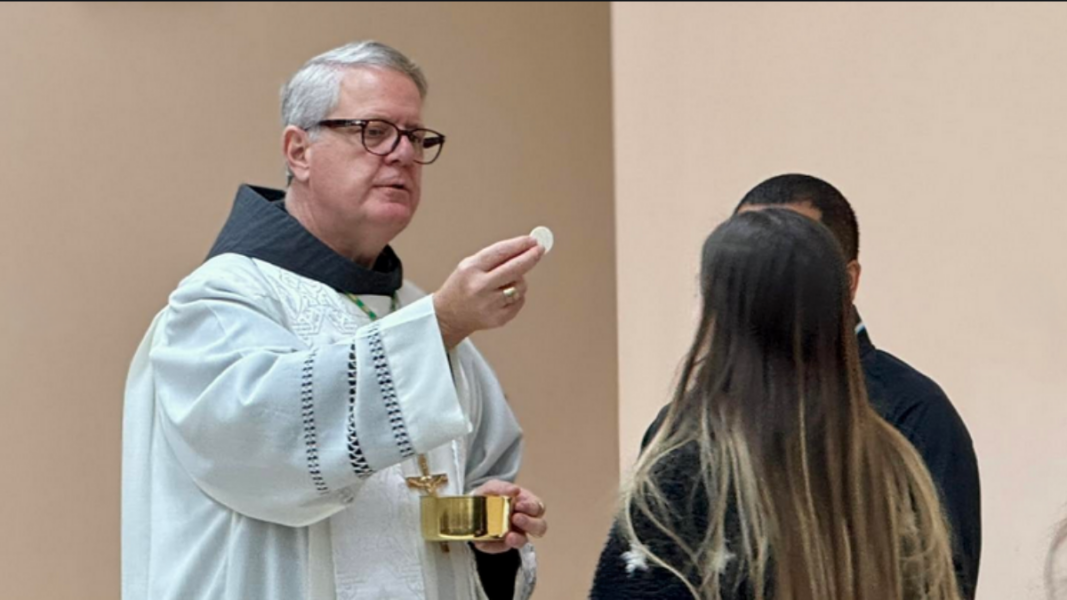
In recent weeks, the diocese of Charlotte (United States) has been embroiled in an unprecedented liturgical controversy following the publication of a pastoral letter from Bishop Michael Martin that imposes new norms for the reception of Holy Communion. The provision requires that, starting from January 16, 2026, the faithful receive the Eucharist standing as the ordinary posture and orders the removal of kneelers and communion rails in all public celebrations within the diocesan territory. Although the instructions formally recognize the right of each faithful to kneel—guaranteed by the universal law of the Church—they prohibit priests or catechists from teaching that posture as something “better” or more reverent, and in practice, they disallow any public promotion of genuflection.
Read also: A US bishop imposes standing communion and orders the removal of kneelers in parishes
In this context, a mother of a family from the diocese has made public an open letter, disseminated by Liturgy Guy and addressed directly to Bishop Martin, in which she asks him to apply to his own ministry the principles that he himself preaches about dialogue, vulnerability, and personal conversion. In the text, the faithful woman questions whether traditional liturgical practices—such as the use of Latin or communion at the communion rail—are really the problem, or if what is uncomfortable is the spiritual and vocational vitality that has flourished precisely in parishes marked by a reverent liturgy faithful to tradition.
The letter denounces that the measures adopted are not generating unity, but division, discouragement among young people discerning the priesthood, and dilemmas of conscience for priests, who are forced to choose between obeying restrictive directives or respecting the canonical rights of the faithful. In response, the author exhorts the bishop to listen to his priests, to dialogue with the faithful, and to not impose drastic changes by force, reminding him that he inherited a diocese rich in vocations and ecclesial life.
Below, we reproduce the open letter in full:
Merry Christmas, Bishop Martin. I hope you have been able to take some time for rest during this intense yet beautiful season.
I have dedicated much of my time in prayer and reflection to trying to understand your ministry. I have followed closely the recent live broadcasts in which you have participated offering the Holy Sacrifice of the Mass, and one homily in particular has led me to a reflection that I would like to share with you, hoping to know your response.
In September, when you appointed Father Patrick Cahill as pastor of St. Matthew’s Catholic Church, you began your homily with an analogy about soft-shell crabs.
First, I appreciated your words on how parishioners can serve their parish. It is more than just attending once a week and fulfilling the Sunday Mass obligation. It is reasonable to expect families to feel motivated to perform good works for the parish and the community.
What now prompts deeper reflection in me is the way you apply your own homily to your personal spiritual path, particularly when you referred to vulnerability and the need to step out of the comfort zone.
What makes you uncomfortable? Latin? The distribution of Holy Communion at the communion rail? Any practice that recalls Catholic tradition? The spiritual life of many of your faithful? The genuine love for Christ shown by the priests of the diocese, in preaching the Gospel and calling for conversion without diluting the doctrine? Or the high number of vocations that have flourished in the fertile soil of authentic Catholic tradition?
Who has the hardened heart? Who refuses dialogue? Who has refused to understand? Who has responded to the legitimate concerns of his flock with a form letter? Who has fixed their stance immovably?
“I need conversion. I need a change of heart.” I quote you verbatim, Your Excellency.
Therefore, I ask you to be consistent with your own words and to practice what you preach. I invite you to accept the discomfort, to listen to your well-formed priests, and perhaps even to sit in the choir during a Latin Mass at Little Flower Chapel. I also invite you to distribute Holy Communion at the communion rail at least once. You will find faithful who kneel and receive in the hand, and others who stand and receive on the tongue. However, until now, distribution at the communion rail has not been allowed when you act as celebrant.
I also invite you to release the accumulated tension and to set aside the axe with which you seem to be dismantling everything simultaneously; perhaps it would be more fruitful to persuade the faithful to modify their worship practices rather than imposing changes on them by force.
Uniformity does not equal unity, and you are generating a greater division than ever. You are leading many young people to reconsider their call to the priesthood by adding additional obstacles to their vocational discernment.
These measures are forcing priests to face difficult decisions that they should not be compelled to make. Must they obey directives that involve denying the faithful their requests, violating their canonical rights, or disregard them, placing themselves in a situation of instability before episcopal authority?
Much of the country suffers from the closure of parishes and the pastoral overload of priests. You inherited a diocese rich in vocations. There is an old saying: “if it ain’t broke, don’t fix it.” What do you think will happen with so many changes introduced simultaneously?
Please do not be a hard-shelled crab, Your Excellency. I wish you a blessed New Year and assure you of our constant prayers.