


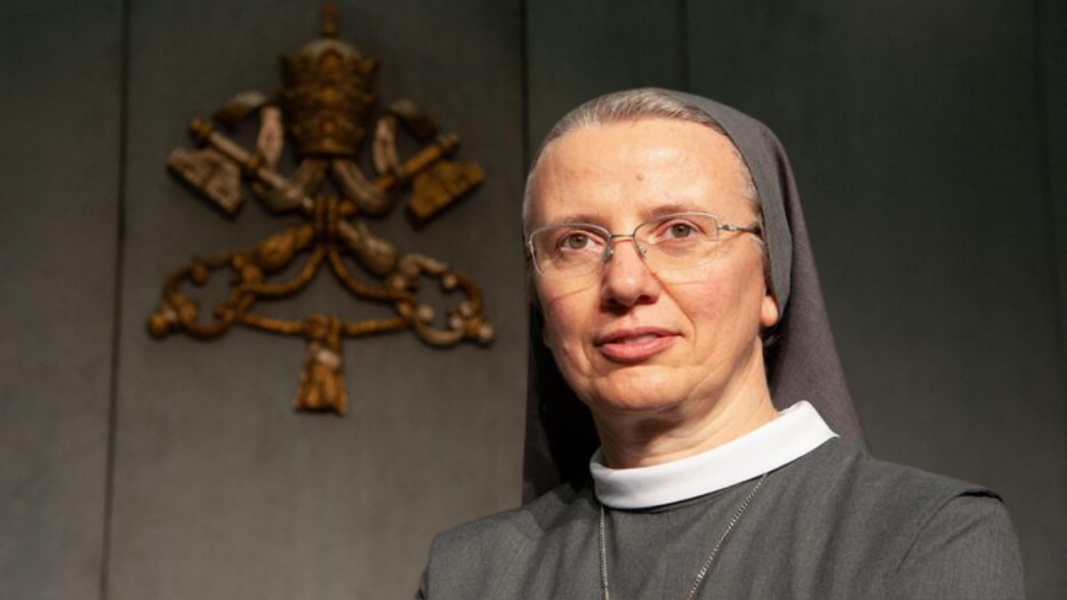
A year ago, the news surprised the Catholic world: on January 6, 2025, Pope Francis appointed the first woman to head a Vatican dicastery. The Consolata missionary Simona Brambilla was named to oversee more than 600,000 religious sisters and brothers (including 128,559 priests) worldwide.
No less unprecedented was the appointment of a pro-prefect, a position not previously provided for by curial norms in this case. Cardinal Ángel Fernández Artime, SDB, assumed this role, whose performance remains opaque.
The major secular media outlets cheered the news: «opening» toward women, «pink revolution,» «female empowerment» in the Church. The clichés delighted Francis, who dreamed of «demasculinizing» the Church, although he had already commented, without fear of falling into inconsistency, that appointing a woman to a dicastery would be something merely «functional.»
The new prefect had illustrious predecessors, such as Cardinal José de Calasanz Félix Santiago Vives y Tutó, OFM Cap. (1908-1913), the Thomistic theologian and Mariologist Alexis-Henri-Marie Lépicier, OSM (1928-1935), and Teodoro Valfre di Bonzo (1920-1922), doctor in Theology and Canon Law.
Sister Simona Brambilla’s credentials: being a woman
What were Sister Simona Brambilla’s credentials?
Only one: being a woman.
One could argue that she had been the superior general of the Consolata Missionaries. But was she competent? Let’s look at the data: when she assumed the position in 2011, the Consolata Missionaries had 746 sisters and 121 houses; in 2023, she left the position with 532 sisters and 73 houses. These figures raise doubts about the management of religious and vocational life and the administration of her congregation’s assets (a strong 40% reduction in houses in just over a decade).
In any case, she has already confessed that «what matters is not the numbers, but the heart». For her, it is positive that the institute is «small,» because in this way «good is done without noise»… This seems to be one of her projects as prefect: to reduce religious vocations, in a rather questionable logic.
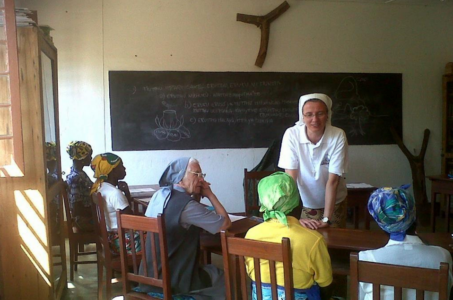
Sister Simona Brambilla trained in nursing and holds a doctorate in Psychology. Her thesis dealt with inculturation in the evangelization of the Macua-Xirima people, in northern Mozambique. In fact, the Italian sister was sent to this country in 1999 to take charge of youth pastoral care among the population. Her mentor there was Father Giuseppe Frizzi, from the male branch of her congregation.
Revolutionary missiology: the peoples who must evangelize us
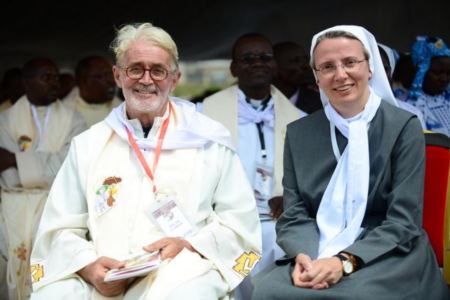
And what is Fr. Giuseppe Frizzi’s missiology?
Fr. Frizzi follows the aggiornata and structuralist missiology typical of the 1970s. The premise of this vision is that indigenous peoples already live the Beatitudes. There is no need to catechize them. Quite the contrary: it is they who teach us the good, because they already have a «pre-evangelical gospel.» In this way, Fr. Frizzi defines the missionary as «a disciple of Jesus who goes with an empty backpack and returns with a full backpack.» Go and make disciples of all peoples? No, go and be evangelized yourself… In short, it is a «mission in reverse.»
In fact, just like for Fr. Frizzi, for Sister Brambilla, in the ad gentes mission «we must always have an attitude of learning. We are students. Because wherever we arrive, God is already there; He does not need us to bring Him, right? God is already there; He has already sown His word and this word has borne fruit.»
From this romantic perspective, at minimum, the Virgin Mary at Tepeyac (Our Lady of Guadalupe) would then have been an «intruder» to convince the Aztecs to abandon human sacrifices (20,000 victims a year), and the mass conversion (8 million Mexicans between 1531-1541) would have been an imposition of the Catholic faith…
St. Joseph Allamano, founder of the Consolata missionaries, would weep with disgust at hearing these deviations from the charism. In fact, the Italian saint clearly defined the purpose of his institute: «The sanctification of the members and the conversion of the peoples.» In the Brambillian vision, however, it is the other way around: it is the non-Christian peoples who teach us. And here arises the question: if the prefect of religious is not even faithful to her own charism, how can she oversee the other religious charisms of the Church?
Tribal matriarchy as the source of Brambillian feminism
But what most catches Sister Simona Brambilla’s attention about the Macua ethnicity? She comments:
«It is a Bantu ethnicity characterized by a worldview, an anthropology, and a theology that are absolutely original and fascinating, rooted in the perception of femininity and motherhood as fundamental axes of the universe, a perception that also translates into a particular matriarchal, matrilineal, and matrilocal social structure and a spirituality with clear feminine and maternal connotations.»
Sister Simona also endorsed it on another occasion: «They are a matriarchal, matrilocal, and matrilineal people. Everything revolves around the woman and the mother. Even the image of God: God is mother, God is woman. Woman is the image most like God, most faithful to God.»
In summary, Sister Simona Brambilla assimilated Macua anthropology as a theological model: God is woman, is mother, and ultimately, woman is the best image of God.
Her feminist theology is articulated: in her farewell words on the occasion of Fr. Frizzi’s death, the Italian sister invokes «God the Mother» so that he (or she?) may welcome him into her bosom.
The existence of matriarchal peoples on different continents is nothing new. The crux of the matter is that Sister Simona uses this idea to create a theological broth not very different from that propagated by the radical feminist theories of recent decades. This androgynous image of God also finds echoes in ancient Gnosticism and Hinduism. Feminist theology, moreover, is related to liberation theology (which also has affinity with tribalism), since both recognize themselves as «genitive theologies»: «theology of women,» «theology of the oppressed.»
In the Macua-Xirima perspective, subscribed to by Fr. Frizzi and Sister Brambilla, «the center is the woman» and «man is a learner at the service of woman.» In this way, the Italian sister adapts these concepts to religious life. Therefore, she comments that in canonical visits to female houses, one must speak of «sisterly visit» and no longer of «brotherly visit.» She confesses that «happily contaminated by the Macua perspective, I found myself savoring and valuing in a new way the intrinsic feminine and maternal dimension of our charism.» If a consolidated feminist theology already existed since the last century, now we have a feminist theology for consecrated life.
Feminist theology of consecrated life
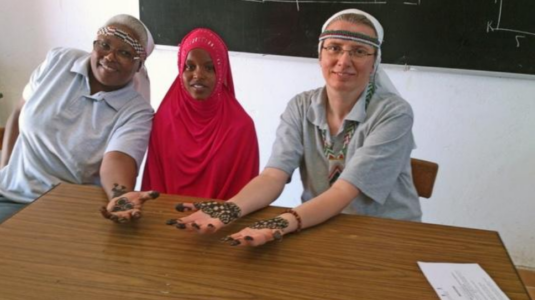
However, for Brambillian feminism to work in the West, it needs to rely on gender ideology (gender theory), which confines its worldview to a struggle against machismo, sexism, misogyny, and the imposition of gender norms, applying it to the mission and to religious life.
Brambilla’s conception is no less radical than that of Moltmann-Wendel, for whom the Trinity of Father, Son, and Holy Spirit is a «patriarchalism.» Her ideas would also not be foreign to the deification of Mother Earth, so typical of recent ecotheology.
Sister Brambilla’s theses cannot be accepted in a sound theology. In fact, Jesus addresses God in a very concrete way, namely, with the vocative «Abbá—Father,» never with the feminine attributes proposed by the Italian sister. Moreover, Cardinal Ratzinger, in the Rapporto sulla fede, emphasizes that we are not authorized to transform the Our Father into an Our Mother, because that goes against the very way in which Christ taught us to pray.
Finally, St. John Paul II commented that feminism manifests itself in the Church not only through the radical ideology that demands the right to priesthood for women, but also in other forms: «Some forms of nature worship and the celebration of myths and symbols are displacing the worship of God revealed in Jesus Christ. Unfortunately, this form of feminism has the support of some people within the Church, including some religious whose beliefs, attitudes, and behaviors no longer correspond to what the Gospel and the Church teach.»
Conclusion
After a year in office, the poor management of the dicastery governed by Sister Brambilla has been confirmed, which has followed to the letter the ineffectiveness of Cardinal Braz de Aviz—recognized as incompetent—especially due to the disorganization of the dicastery—there are inexplicable and systemic delays in dialogue with various institutes—, legal insecurity, and the multiplication of arbitrary interventions in certain institutions (remember the paradigmatic case of the Heralds of the Gospel).
Instead of relying on the writings of her founder, St. Joseph Allamano, who urged missionaries to seek more and more «prayer, mortification, sanctification, an extraordinary sanctification,» Sister Brambilla prefers to deliver emotional speeches, full of clichés, especially of a feminist and Gnostic character, and therefore contrary to sound doctrine.
In any democratic state, the corresponding minister of state would have been dismissed from the government long ago. But unfortunately, ideology, media applause, and opacity have supplanted probity, impartiality, and effectiveness in recent years.
May the next consistory be an occasion to inspire the cardinals, and especially the Supreme Pontiff, to seek more and more the kingdom of God and His justice, so that all these things may be added unto them (Mt 6:33). Ideologies pass, but the authentic word of Christ will never pass away (Mt 24:35).