


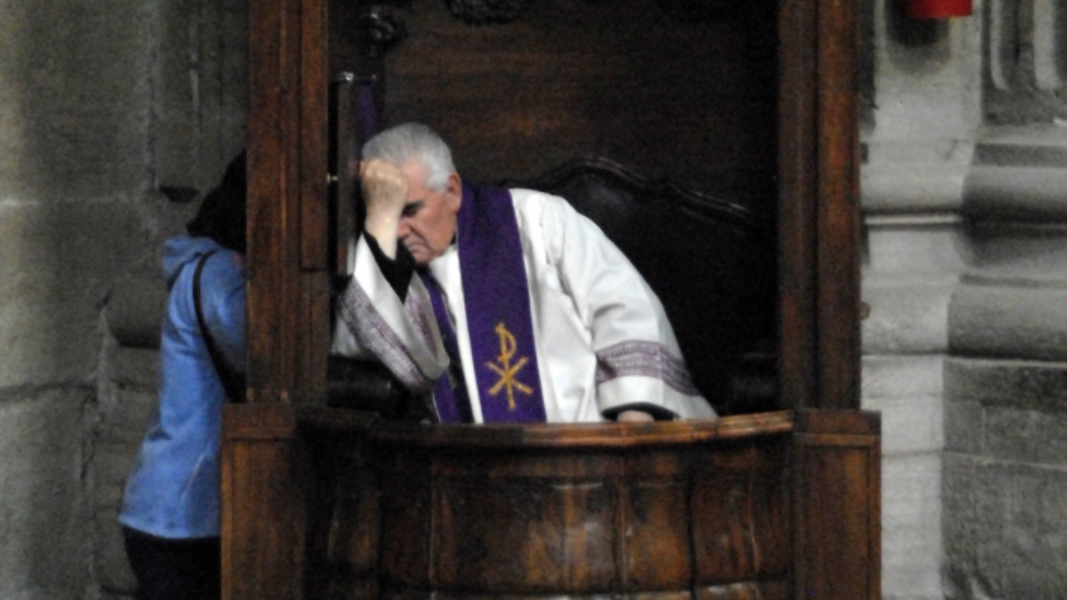
There is a pastoral maxim that anyone who has frequented parishes with a minimum of regularity can confirm without the need for sociological studies: wherever the sacrament of confession is truly offered, people come. Where there are open confessionals, lights on, clear schedules, and real availability, lines form. Where not, confession disappears from the ordinary life of the faithful. Not due to explicit rejection, but due to simple pastoral evaporation.
This observation inevitably leads to a fundamental question that is rarely formulated clearly: if the Church does not exist for the salvation of souls, then what does it exist for? Can the worship of God be separated from the redemption of man? Is Christ made present in the sacraments for a reason other than to forgive, heal, and save? The loss of awareness of sin and grace is not a collateral or cultural problem, but a central theological crisis. Where sin ceases to be named, grace becomes irrelevant; and where grace ceases to be necessary, the Church runs the risk of becoming a self-referential institution.
Marginalizing the sacrament of penance is not a neutral decision. It is, in fact, amputating the Church of one of the ordinary means that Christ instituted to reconcile man with God. And yet, it is enough to visit parishes to see to what extent confession has passed, in practice, to a marginal situation, if not directly residual.
Four Parish Models (Very Recognizable)
- The parish where nothing is offered. There are no schedules, no operational confessional, no announcements at all. The faithful who wishes to confess must “hunt” for the priest in the sacristy, interrupt a conversation, create an awkward situation. Meanwhile, the choir ladies observe the scene with a mix of surprise and curiosity, as if it were a custom from another time. If the priest has a slot, he confesses; if not, it is postponed. And if there is confession, it is not uncommon for the penitent to leave with the feeling that their sins have been relativized or directly dissolved in a generic exhortation.
- The “reactive” parish: WhatsApp on the bulletin board and little more. A WhatsApp number “for confessions” appears, sometimes accompanied by testimonial schedules in which, curiously, there is almost never anyone in the confessional, which again forces one to go to the sacristy. It is better than nothing, no doubt, but it conveys a clear implicit message: confession is not part of the ordinary life of the temple, but requires prior management, individual initiative, and some insistence. In a cultural context not very conducive to examination of conscience, this approach is pastorally weak.
- The parish that confesses before Mass… until Mass begins. Confessions are offered before the celebration, and the result is usually immediate: lines form. The problem is that, in many cases, due to the obvious lack of priest availability, confessions are interrupted when the celebration begins or, when there is a second priest, at some point during it, because the second priest is required to go up to the altar or distribute communion. It is not uncommon to see the confessional close during the Gospel, leaving dozens of faithful without access to the sacrament. Paradoxically, the pastoral success of confession becomes its practical limit. I have seen in parishes dozens of people in line who cannot confess. In many cases, the priest gives no indication or notice for the end of Mass. There are schedules like at the tax agency window. Come back tomorrow, sir.
- The parish that puts confession at the center. In crowded Masses, there are confessionals open before, during, and after the celebration. If the priest is alone, he explicitly announces that he will stay after Mass for as long as necessary to confess everyone. No one goes home without having received God’s forgiveness. The pastoral priority is unequivocal: that the faithful be in a state of grace. Not as an abstract ideal, but as the real center of parish life.
The Uncomfortable Question: Why Not Make It the Norm?
In the face of this panorama, the question is uncomfortable but inevitable: why not turn this practice into the norm? Why not establish as the ordinary criterion that in all parishes confession is offered before Mass, that confessions are heard during Mass if another priest is available, and that, in any case, it is clearly announced that after the celebration all necessary confessions will be attended to? Is there any serious theological, canonical, or pastoral impediment for a bishop to regulate something as simple as explicitly reminding of this availability in all homilies?
Exceptional situations exist and must be treated as such. The rural parish priest who serves several communities with very tight schedules cannot become the general excuse for an impoverished practice. The exception cannot be made the rule, nor difficulty a permanent alibi. The norm must be formulated from the centrality of the sacrament, not from its marginality.
The Church today devotes enormous efforts to multiple areas of pastoral action, many of them legitimate. Delegations, plans, and structures are created for almost everything: communication, climate, synodality, participation, media. All of this may have its place, but it is profoundly disproportionate if, at the same time, effective access to the sacrament that reconciles man with God and guarantees his salvation is neglected. If souls go to hell… climate pastoral is secondary. And if the Church stops putting at the center that for which it exists, it runs the risk of playing, even unintentionally, for the enemy.