


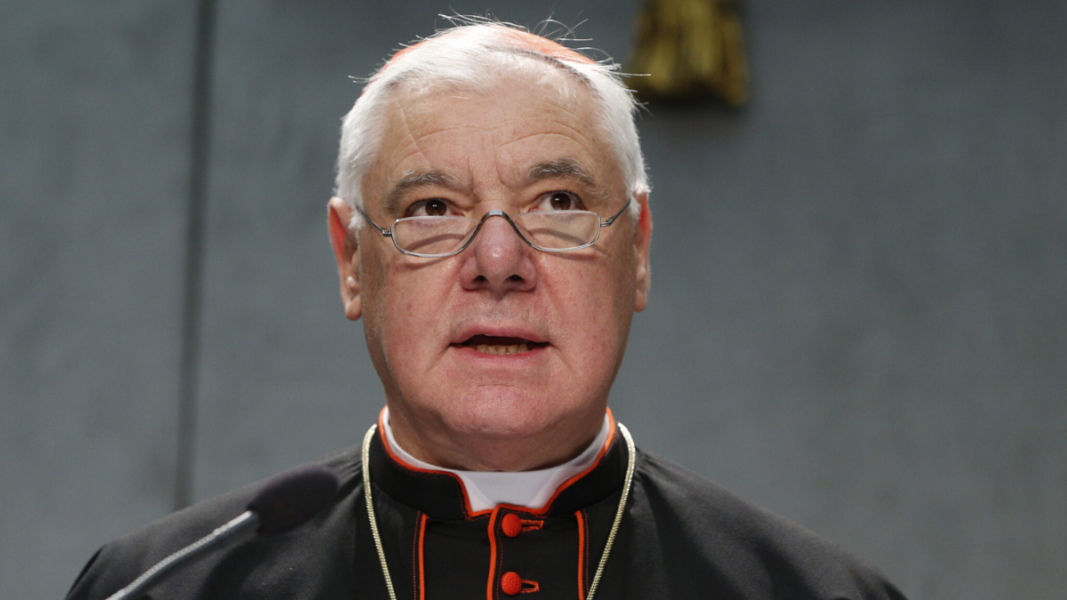
«I consider that the greatest danger for the new evangelization in the West, especially in Germany, is the return of the doctrine of double truth. This doctrine originates from Gnosticism».
Gerhard Card. Müller, Rome
The whole Church thanks Pope Leo XIV for his Christocentric preaching, in which, as successor of Peter, he unites all bishops and faithful in the confession of Christ, Son of the living God (Mt 16:16).
I consider that the greatest danger for the new evangelization in the West, especially in Germany, is the return of the doctrine of double truth. This doctrine originates from Gnosticism. Irenaeus of Lyon already opposed it to Catholic hermeneutics. The unity and integrity of Revelation are present in the Church through Sacred Scripture, Apostolic Tradition, and the magisterium of the bishops, especially in the Roman Church. The Second Vatican Council, in the Dogmatic Constitution on Divine Revelation «Dei verbum» 1-10, has highlighted in this regard, against the immanentization of faith and the secularization of the Church, the supernaturalness of faith and the sacramentality of the Church, both against the rationalism of the Enlightenment, with the reduction of Christianity to a natural morality (Kant), and against the irrationalism of Romanticism, with the falsification of rational faith into mystical sentimentalism (Rousseau). In popular terms: religion is a matter of individual and collective feeling and, therefore, all historical religions are merely its cultural expression. No religion has a monopoly on truth, even though the Church considers itself the teacher appointed by God of the revelation given once and for all in Christ, that is, as the sacrament of salvation in Christ. The new Doctor of the Church John Henry Newman, in his last major work, An Essay in Aid of a Grammar of Assent, gave contemporary form to Catholic hermeneutics after the naturalism of the Enlightenment.
The doctrine of double truth is today dressed in the slogan of paradigm shift. This may be valid for the formation of theories in the natural sciences. For theology, which is based on the fullness of truth and grace in Christ, it is a fatality. It is not like in Nietzsche, who makes truth depend on perspective, or like in Heidegger, who makes the truth of being depend on its revelation in the corresponding era. Truth is, therefore, temporal.
However, Christ is in his person the truth in the fullness of time. And he unites all the eras of the history of salvation, of the Church, and of the dogmas in the unity of the Church’s faith consciousness in its past, present, and future. The Son of God, by virtue of his assumed human nature, mediates to every believer and to the whole Church immediacy with the one and true God, who encompasses all times in the divinity and humanity of his Son.
A destructive consequence of the doctrine of double truth is the demand that pastoral care take priority over the revealed truths of the doctrine of faith and morals. What is dogmatically true can be pastorally false and vice versa, for example, marriage between a man and a woman is based on the Logos of the Creator and Redeemer, in whom all things were made, but nevertheless, for pastoral reasons, that is, for their subjective well-being, homosexual couples can be led to believe the illusion that their objectively sinful relationship is blessed by God.
To cite another example: one cannot, on the one hand, profess with the Second Vatican Council the hierarchical-sacramental constitution of the Church as revealed truth (Lumen gentium 18-29) and, at the same time, turn the Synod of Bishops into a symposium of participants from all estates of the Church, whose opinions, contrary to all collegiality of the bishops, the Pope, like an absolutist prince, confers the authority of the ordinary magisterium, although by ordinary magisterium is meant the regular proclamation of revealed truths by the bishops and the Pope (that is, that at Christmas they preach about the birth of Christ and the incarnation of the Son of God and not about their private ideas on politics). Moreover, the Church in Germany cannot call itself Catholic and, at the same time, undermine the doctrinal authority and jurisdiction of the bishops by divine right (iuris divini) with the Synodal Council, a decision-making body established by men, and dissolve the pastoral ministry of the bishops into an Anglican-type ecclesiastical parliament.
But Christ as teacher of truth and Christ as good shepherd cannot be separated in a neo-Nestorian way, because he is the same divine person who teaches divine truth and gives his disciples the divine life of grace, conversion, and renewal in the Holy Spirit. We must overcome the dualistic opposition between dogma and pastoral care, between truth and life. We must preserve our thinking and judgment from ideological categories that divide the one and indivisible body of Christ, which is the Church, into traditionalists and progressives, conservatives and liberals.
Apostolic Tradition recognizes in the Church, with the help of the Holy Spirit, a progress in the understanding of the revelation given once and for all, especially through the preaching of those who, succeeding in the episcopal ministry, have received the sure charism of truth (cf. Dei verbum 8). And only in the same and only Christ is revealed the full depth of the truth about God and the salvation of man, because he «is at the same time, in his humanity, the mediator and, in his divinity, the fullness of all revelation» (Dei verbum 2).
Article originally published in German on kath.net