


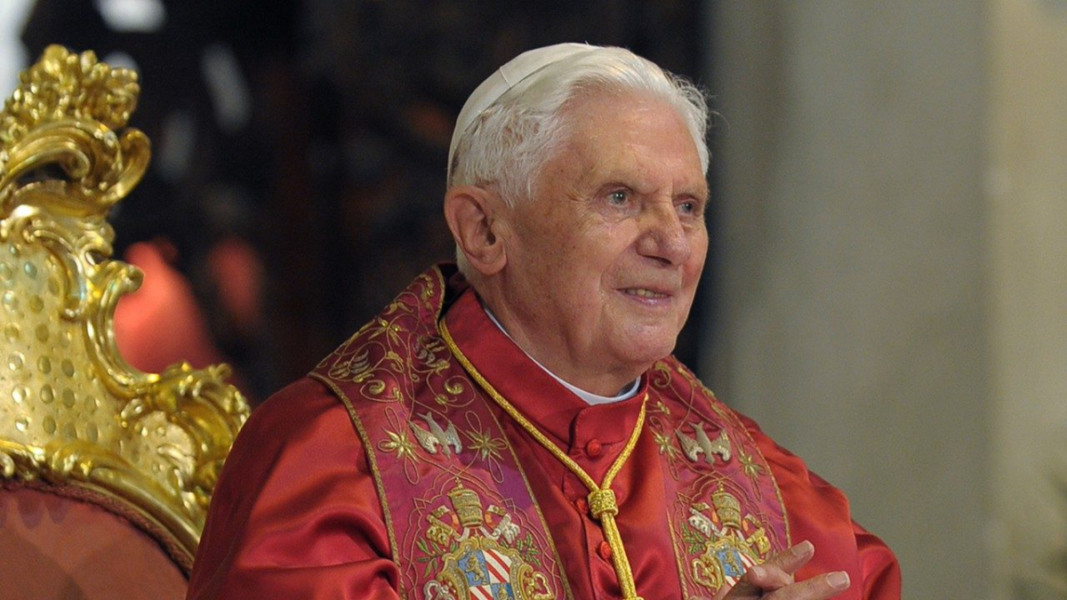
In view of the extraordinary consistory convened by Pope Leo XIV for January 7 and 8, in which one of the planned topics will be the liturgy, the legacy of Benedict XVI and his proposal for a “reform of the reform” regains relevance. This is what Msgr. Nicola Bux, theologian and former consultant to the then Congregation for Divine Worship during the pontificate of Joseph Ratzinger, asserts in an interview granted to La Nuova Bussola Quotidiana.
Bux emphasizes that Benedict XVI’s contribution to the liturgy was not just another revolution, but a call to rediscover the sense of Mystery and the primacy of God. As he explains, the German Pope showed the need to understand the liturgy not as a human construction, but as the act in which the Church recognizes and expresses the centrality of God. In this sense, he recalls that Summorum Pontificum and the apostolic exhortation Sacramentum Caritatis responded to a profound theological vision, rooted in ecclesiology and doctrine.
The theologian points out that Ratzinger always defended the idea that in the history of the liturgy there is growth and progress, but no rupture, and that what was sacred for previous generations remains sacred and valuable today. From this perspective, the recognition of the extraordinary form of the Roman rite was not only of a juridical scope, but also pastoral and theological, aimed at fostering peace and unity in the Church.
Asked about the holiness of Benedict XVI, Msgr. Bux recalls the etymological meaning of the term sanctus, understood as separation from the mentality of the world. In his opinion, Ratzinger was a thinker faithful to the truth, alien to fashions and capable of denouncing the “dictatorship of relativism”. He adds that, after his death, there was an acceleration of certain ecclesial dynamics that sought to marginalize the liturgy in the Vetus Ordo, although he affirms that, despite the restrictions, many priests continue to celebrate it, learning to live the ordinary form with greater devotion and order as well.
Bux maintains that the so-called “reform of the reform” is neither outdated nor archived. On the contrary, he considers that the publication of the volume dedicated to the theology of the liturgy in Benedict XVI’s Opera omnia has irreversibly expanded the debate on liturgical reform and its correct application. He also recalls words from Ratzinger himself, who linked the contemporary ecclesial crisis to the weakening of the sense of the liturgy and the loss of reference to God.
In relation to the upcoming consistory, the theologian states that the legacy of Benedict XVI is key to centering the liturgical debate and overcoming polarizations. In particular, he highlights that the historical, theological, and pastoral reflection on the liturgy planned in the agenda cannot disregard its essential nature: the encounter with God and the recognition of his primacy. From there, he points out, depends the true renewal of the liturgy and, consequently, that of the Church.
Msgr. Bux concludes by recalling that, for Joseph Ratzinger, there is no authentic reform without interior conversion. Liturgical renewal begins —he affirms— with the presence of the sense of the sacred in hearts, since a liturgy that loses its character of mystery runs the risk of becoming not a reform, but a deformation.
We leave below the translation of the interview conducted by La Nuova Bussola Quotidiana with Msgr. Nicola Bux:
Msgr. Bux, when speaking of Benedict XVI, it is almost inevitable to speak of the liturgy. Why is it so central in his work and in his spirituality?
Some liturgists, without taking into account the dogmatic foundation of the sacred liturgy, did not recognize Ratzinger’s competence in the matter. However, in his writings, one can observe how, beneath the critique of modern liturgy, there lies a fundamental and dogmatic theology that is meditated and coherent, including ecclesiology and ecumenism. The issue is that the aforementioned critiques are invalidated by the conviction, not always declared, that the liturgy is exclusively a human competence. Once he became Pope, with the motu proprio Summorum Pontificum and the apostolic exhortation Sacramentum Caritatis, he showed the need to reinterpret the liturgy as the act that expresses the primacy that must be given to God. One of his fundamental assertions: “In the history of the liturgy there is growth and progress, but no rupture. What was sacred for previous generations remains sacred and great for us as well…” is a warning to some and others to recover balance. Benedict had observed that the extraordinary form of the Roman rite aroused living forces and vocations, so he strove to demonstrate its historical, theological, and pastoral value for the peace and unity of the Church. This is the first sign of the holiness of Joseph Ratzinger.
In what sense can we (at least for now) understand this holiness?
Sanctus, in its Latin etymology, means “separated from the world,” not subject to the mentality of the present age, as the Apostle reminds us. And Benedict did not fear, during his life, those who accused him of having been progressive and then a restorer: he had a thought attentive to the truth and independent of fashions, to the point of denouncing the dictatorship of relativism. His death provoked a hardening and an acceleration of a certain “agenda” within the Church, which would have implied the prohibition of the liturgy in Vetus Ordo. But the thoughts of God are not those of men: they can do nothing if a work comes from God. It is happening that many priests, around the world, despite the restrictions, by celebrating Mass in Vetus Ordo, learn to celebrate the ordinary Mass with devotion and order. Therefore, the “reform of the reform,” desired by Joseph Ratzinger, is already underway.
So Ratzinger’s proposal for a “reform of the reform” has not been archived?
Benedict XVI’s resignation has led many to wonder if the “reform of the reform” had not already been discarded. In reality, the publication of volume 11 of his Opera omnia —Theology of the Liturgy— does not close, but irreversibly expands the debate on liturgical reform and its application. As a theologian and cardinal, he had spoken of current liturgies as “an empty dance around the golden calf that we ourselves are.” He proposed it again in the meditation of the Vía Crucis of Holy Week 2005. Three weeks later he was elected pontiff. A sign! But, on the matter, he had already spoken: “I am convinced that the ecclesial crisis in which we find ourselves today depends to a great extent on the collapse of the liturgy, which is sometimes conceived even etsi Deus non daretur: as if in it it no longer mattered whether God exists, whether he speaks to us and listens to us” (My Life). As Pope, it does not seem that he was able or wanted to force the times; on the other hand, he had not hidden his conviction that continuous changes, even those that suppose a setback to the traditional way of doing things, can really be destructive.
In practice, a patient rediscovery instead of yet another revolution?
Joseph Ratzinger participated in the liturgical movement, as Guardini and other minds of that generation understood it, but, as a council expert, he regretted the rhetoric of impatience and discredit that highlighted the problems of the liturgy more than its achievements. Therefore, he did not intend a fundamental change, but a careful restoration. Instead, he found himself faced with a liturgical revolution that ended Latin and, with it, a thousand years of liturgical music. And other changes occurred that seemed to him a fundamental misunderstanding of the nature of the liturgy: in particular, improvised prayer formulas and the priest’s position “facing the people” during Mass: the exact opposite of an introduction to the Mystery.
The liturgy is also one of the agenda items in the extraordinary consistory convened by Leo XIV for January 7 and 8. How much can Joseph Ratzinger’s legacy weigh to refocus the “debate” and overcome human polarizations?
The legacy of Benedict XVI consists in the fact that the fourth point of the consistory’s agenda (“The historical, theological, and pastoral reflection on the liturgy to preserve the healthy tradition and, nevertheless, open the way to legitimate progress”) cannot disregard the nature of the liturgy, that is, that it refers to the relationship with God or the sacred, which is constantly reborn in hearts, impelling the “reform in the continuity of the single subject Church,” as he affirmed on December 22, 2005, in his famous address to the Roman Curia. Benedict XVI, with Summorum Pontificum, not only wanted to resolve the juridical issue of the ancient Roman Missal, but to raise the question of the very essence of the liturgy and its place in the Church. What is at stake is the primacy of God, and therefore faith: from it depends the true renewal of the liturgy, which in turn is the fundamental condition for the renewal of the Church.
Is there no real reform without conversion?
To the question of where to start the “reform of the reform,” Ratzinger answered: with the presence of the sacred in hearts, with the liturgy and its mystery. Because we always find ourselves before the excess of mystery: “The liturgy that has lost its character of mystery and its cosmic dimension ends up provoking not a reform, but a deformation of the liturgy.” He stated that “in the background of all the controversies, a profound disagreement has arisen about the essence of the liturgical celebration (…). The dominant concepts of the new vision of the liturgy can be summarized in the keywords ‘creativity,’ ‘freedom,’ ‘feast,’ ‘community.’ From this point of view, ‘rite,’ ‘obligation,’ ‘interiority,’ and ‘order of the universal Church’ appear as negative concepts, which describe the situation of the ‘old’ liturgy that must be overcome.” Thus, he recalls St. Cyprian, who stated: “The words and posture of prayer are accompanied by a discipline that includes calm and profound respect. We must remember that we are under the gaze of God.