


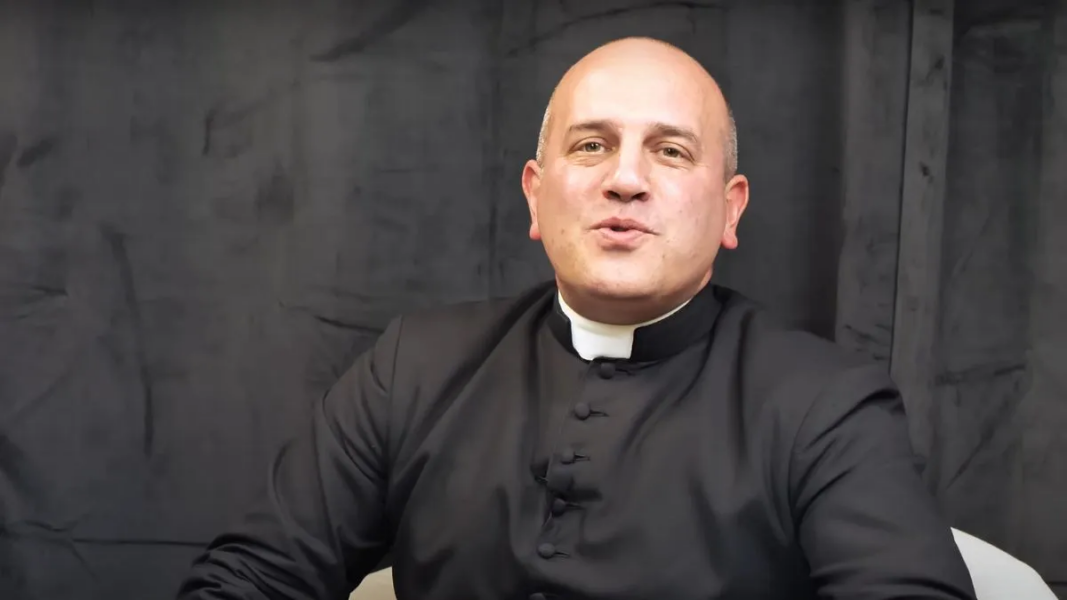
The letter sent by the French priest Louis-Marie de Blignières to numerous cardinals of the College of Cardinals, in which he proposes the creation of a specific ecclesiastical jurisdiction for the traditional Roman rite, has reopened the debate on possible solutions to the liturgical conflict that arose after the publication of the motu proprio Traditionis custodes. The initiative has gained special relevance as it coincides with the celebration of the next extraordinary consistory of the pontificate of Leo XIV, in whose agenda the liturgical issue is expressly included.
In order to delve deeper into the real scope of this proposal, its canonical implications, and its possible pastoral consequences, the journalist Diane Montagna interviewed Father Matthieu Raffray, superior of the European district of the Institute of the Good Shepherd and a direct knower of the letter’s content. In this conversation, the priest offers a detailed explanation of the initiative, emphasizing that it is not a request or a demand directed to the Pope, but rather a working hypothesis presented to the cardinals as a basis for serene discernment.
Father Raffray addresses key issues: how a personal jurisdiction dedicated to the vetus ordo might function; what its relationship would be with the territorial dioceses; what implications it would have for communities traditionally linked to the former Ecclesia Dei Commission; and how it could contribute to restoring peaceful coexistence between diverse liturgical sensitivities within the Church.
The interview also allows placing the proposal in a broader historical perspective, recalling existing canonical precedents and emphasizing that the Church has known, in other moments, how to create specific legal structures to safeguard unity without suppressing legitimate diversity. Far from posing a doctrinal confrontation, the approach analyzed seeks to offer a stable institutional solution to a situation that, according to its proponents, has ceased to be mainly theoretical to become a concrete pastoral problem.
Below is the full translation into English of the interview:
Diane Montagna: Father Raffray, what is the main objective of the letter sent to the cardinals by Father de Blignières?
Fr. Matthieu Raffray: Its main objective is to propose a stable and constructive ecclesial solution to an opposition that has become sterile and has divided the Church for many years, between those attached to the ancient Latin rite and those who oppose it. Observing the pastoral and human stagnation produced by this recurrent conflict, the text seeks to overcome confrontation and open a positive path in service to ecclesial communion.
This prolonged opposition has caused real suffering, especially in communities attached to traditional liturgy, which have often found themselves in a situation of institutional fragility and, at times, have faced attitudes suggesting that they have no legitimate future within the Church. The letter takes this reality seriously and underscores the urgency of a just, peaceful, and lasting solution.
From this perspective, it proposes the creation of a specific ecclesiastical jurisdiction—such as a personal apostolic administration or an ordinariate—that would provide a stable canonical framework for priests and faithful in full communion with the Holy See and linked to the ancient Latin rite. Far from presenting this liturgy as a threat or a nostalgic step backward to an idealized past, the text highlights its current fruitfulness as a genuine means of sanctification and evangelization, especially in highly secularized societies.
Thus, the letter does not seek to reignite a liturgical controversy, but to offer a pragmatic institutional response, in continuity with the Church’s living tradition, which has repeatedly devised legal structures to safeguard unity while respecting legitimate diversity. Its distinctive merit lies in proposing a constructive way out of an impasse, rather than entering a new phase of internal confrontation.
The letter proposes an ecclesiastical jurisdiction analogous in some respects to the Military Ordinariates. For readers unfamiliar with these structures, could you explain how the proposed jurisdiction would function, particularly with regard to cumulative jurisdiction and relations with the local bishops of existing dioceses?
The letter draws on the analogy of the Military Ordinariates to show how the proposed solution could be harmoniously integrated into existing diocesan structures. A Military Ordinariate is a personal ecclesiastical jurisdiction, defined not by territory but by the persons belonging to it due to a particular pastoral need. In the present case, this need would consist of a free and voluntary adherence to traditional liturgy.
Therefore, the proposed jurisdiction would overlap with territorial dioceses without replacing them, within a framework of complementarity and communion. The bishop in charge of this structure—at the level of country or linguistic area—would work in coordination with diocesan bishops to discern, according to local contexts, the most appropriate pastoral arrangements.
A key point of this proposal is that it does not seek to isolate faithful attached to traditional liturgy, but to offer them a clear and legitimate pastoral framework, accessible to anyone who might benefit from it, whether temporarily or long-term. Placed under the authority of the Holy See and in harmony with local Ordinaries, such a jurisdiction could thus contribute to a more peaceful pastoral care, in service to communion and unity within the Church.
What would the creation of an Ordinariate or personal ecclesiastical jurisdiction for the Vetus Ordo concretely mean for the former Ecclesia Dei communities, such as yours? Is it intended that these communities come under the authority of such an Ordinariate? Given the diversity among these communities, how would concerns about autonomy or charism be addressed?
Concretely, such a solution would not entail any substantial change in the status or internal life of communities previously associated with the Ecclesia Dei Commission. These institutes would retain their canonical autonomy, their own governance, and their specific charism. As is already the case, their priests could place themselves at the service of various ecclesial realities through clearly defined agreements: either within territorial dioceses or, when pastoral needs require it, within the proposed Ordinariate or personal jurisdiction.
Relations between these communities, the authority of the Ordinariate, and diocesan bishops would be regulated by clear canonical agreements, ensuring respect for each party’s respective competencies and full ecclesial communion. Such a configuration would allow the liturgical and pastoral experience of these communities to be placed at the service of the Church without absorbing or standardizing them, while offering a more stable and intelligible legal framework for their mission.
How would priestly formation be organized within such an ecclesiastical jurisdiction? Would it provide for its own seminaries, shared seminaries, or cooperation with existing institutions? How would it ensure formation both in fidelity to tradition and in full ecclesial communion?
In principle, an Ordinariate or personal ecclesiastical jurisdiction could have its own seminary, provided that pastoral, human, and institutional conditions allow it. However, such a possibility would require prudent and gradual discernment and could not be envisaged uniformly or immediately.
In practice, the organization of priestly formation should adapt to the realities of each country or geographical area. Depending on the context, this could take various forms: the creation of proper seminaries when the number of candidates and the stability of structures justify it; formation programs carried out in diocesan seminaries; or formation provided in seminaries or formation houses belonging to communities specialized in the celebration of traditional liturgy. Mixed solutions could also be envisaged, allowing shared formation in certain academic disciplines while ensuring specific liturgical and spiritual formation.
Such a gradual and pragmatic approach, based on real pastoral needs, would provide the necessary guarantees to ensure both fidelity to the liturgical and doctrinal tradition proper to the Vetus Ordo and full insertion into ecclesial communion, under the authority of the Holy See and in coordination with existing formation structures in the Church.
What practical effects would the establishment of such a jurisdiction have on the use of the Vetus Ordo within existing dioceses and on diocesan clergy who wish to celebrate it?
The establishment of a personal ecclesiastical jurisdiction dedicated to the Vetus Ordo would have mainly pastoral and pragmatic effects, to be discerned case by case according to local circumstances. In dioceses where the local bishop and interested faithful are satisfied with existing arrangements, there would be no need to modify the current organization: the use of the Vetus Ordo could continue to be fully exercised within the ordinary diocesan framework.
Conversely, in situations marked by tension, or where a new group of faithful emerges, the proposed jurisdiction would provide a clear framework for mediation and coordination. In such cases, it would be up to the Ordinary of the personal jurisdiction to engage in dialogue with the diocesan Ordinary to identify the most appropriate pastoral solutions, with due respect for each party’s respective competencies and for the good of the faithful.
Regarding diocesan clergy, several possibilities could be envisaged. Diocesan priests could place themselves at the disposal of the personal jurisdiction for a limited period or request permanent incardination in it. This practice would follow a canonical model already well established, comparable to that of diocesan priests assigned, either temporarily or definitively, to the service of Military Ordinariates.
Understood in this way, the creation of such a jurisdiction would not aim to deprive dioceses of their clergy or impose rigid solutions, but to offer canonical flexibility capable of responding with greater serenity to pastoral needs related to the use of the Vetus Ordo, in service to peace and ecclesial communion.
Given the geographical overlap between dioceses and the proposed ecclesiastical jurisdiction, could this structure offer solutions in situations involving the closure of churches, underutilized buildings, or the decline of parish life?
The question of places of worship and parish structures once again requires differentiated responses, based on pragmatic pastoral discernment attentive to local realities. The geographical coexistence of territorial dioceses and a personal ecclesiastical jurisdiction would allow for flexible solutions to a wide range of situations.
In certain parts of the world, particularly in Europe, where an increasing number of churches are closed or underutilized, such a jurisdiction could provide a fruitful pastoral response. Ecclesial buildings could be entrusted to the Ordinariate by diocesan bishops through clearly defined agreements, ensuring both the preservation of ecclesial heritage and the restoration of stable liturgical and pastoral life.
In other contexts, for example in Latin America or Asia, where ecclesial dynamics are different and pastoral needs are more oriented toward growth than restructuring, the Ordinariate could, on the contrary, foster the construction of new places of worship, with the support of local communities. Depending on circumstances, the acquisition of existing suitable buildings for liturgical and pastoral use could also be envisaged.
Thus, by virtue of its personal character and its capacity for coordination with local Ordinaries, such a jurisdiction would be in a position to contribute realistically and orderly to the management of places of worship, supporting pastoral vitality where it is fragile and promoting a more fruitful use of existing ecclesial resources, always in a spirit of communion and respect for the responsibilities of diocesan bishops.
As noted in the letter, this solution has been proposed several times in the past. Pope Benedict XVI established the Anglican Ordinariates through the 2009 Apostolic Constitution Anglicanorum coetibus, but opted for a different approach—Summorum Pontificum—to address the Vetus Ordo. Why do you believe a personal jurisdiction would be an appropriate or even preferable solution today?
Since the promulgation of Summorum Pontificum, traditional communities and groups have tried to work directly with parishes and dioceses, but the truth is that in some places it worked very well, while in others it did not. Therefore, it seems reasonable to seek a new solution and not return to Summorum Pontificum.
The current relevance of a solution based on the establishment of a personal ecclesiastical jurisdiction rests, first of all, on a theological clarification. In fact, successive approaches to the Vetus Ordo have highlighted a real tension regarding its liturgical status. Pope Benedict XVI, in Summorum Pontificum, proposed a unifying interpretation by speaking of two forms—ordinary and extraordinary—of the one Roman rite. Pope Francis, on the other hand, has explicitly affirmed that there is only one form of the Roman rite, namely that resulting from the liturgical reform.
Faced with this apparent contradiction, the most coherent solution would seem to be the recognition, de facto if not yet fully de iure, of the existence of two distinct Latin rites: an ancient or traditional Latin rite and a reformed Latin rite. Such recognition would allow overcoming a conceptual opposition that has become increasingly difficult to sustain, while offering a clearer theological and canonical framework.
The peaceful coexistence of two Latin rites would also be in keeping with the Church’s own tradition, which has long known how to accommodate a plurality of rites within the unity of ecclesial communion. It also corresponds to the evangelical image of the prudent steward who «brings out of his treasure what is new and what is old,» recognizing that the fruitfulness of tradition lies not in exclusion, but in the ordered integration of what has been received and what has developed.
From this perspective, a personal ecclesiastical jurisdiction would not appear simply as a pastoral solution, but as the appropriate institutional expression of a theological reality that has now reached maturity: namely, the existence of two Latin rites called to coexist peacefully, in service to the unity of the Church and its evangelizing mission.
Was the letter sent to Pope Leo XIV?
To my knowledge, the text was not sent directly to the Pope. This point is significant, as the letter is not presented as a request or a demand, but rather as a working hypothesis addressed to the cardinals in a preparatory context. It is proposed as a contribution to reflection, intended to be examined and further developed, particularly with the help of canonists.
This approach recognizes from the outset that this proposal is not the only possible solution. It is likely that some members of traditional communities may not be in favor of this path or suggest alternative avenues for study. The letter does not seek to impose a uniform response, but to open a serious and reasoned debate.
What seems most positive in this text is precisely this constructive spirit. Traditionalist communities have often been criticized for adopting a mainly reactive or critical stance. Here, on the contrary, the letter seeks to contribute proactively to the building of ecclesial unity, in a spirit of communion and in service to the Holy See.