


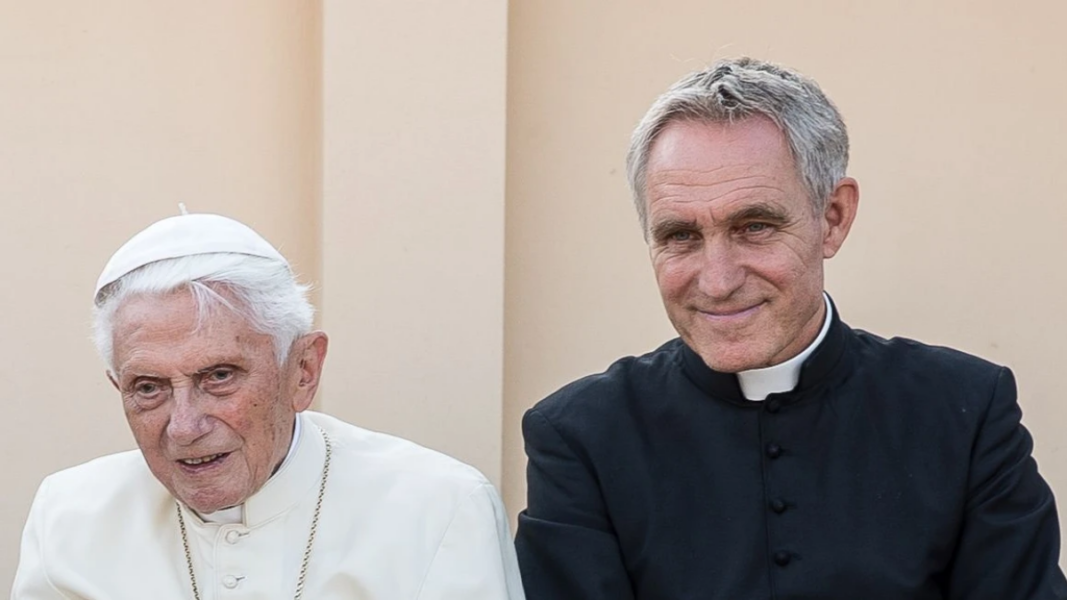
Three years after the death of Benedict XVI, who died on December 31, 2022, a perception of holiness is beginning to take shape more clearly, one that does not respond to media noise or hasty campaigns, but to a serene and profound esteem among the faithful. This is affirmed by Monsignor Georg Gänswein, current apostolic nuncio in Lithuania, Estonia, and Latvia, and personal secretary to Joseph Ratzinger before, during, and after his pontificate.
In statements to La Nuova Bussola Quotidiana, Gänswein recalls the multitudinous popular homage that accompanied the funeral rites of the Pope Emeritus, debunking the image of a cold or distant pontiff. That massive influx of faithful—he points out—was also an expression of a sensus fidelium that was beginning to perceive what he defines as “a holiness without fanfare, but gentle and discreet, like his personality”.
The Church’s time versus the “culture of haste”
Asked about a possible beatification cause, Gänswein emphasizes that holiness cannot be measured by the criteria of the current “civilization of haste.” In his view, speaking of speed in relation to holiness is a contradiction in terms, since urgency is the enemy of true spiritual life. The fame of holiness—he explains—must mature over time, far from the logic of worldly popularity.
In this sense, he recalls that the Church has its own rhythms, long except in justified exceptions, and that what is decisive is not to accelerate processes, but to allow the authenticity of a holy life to emerge clearly.
Testimonies of graces attributed to his intercession
The former secretary of the Pope Emeritus confirms that, since his death, various testimonies of graces attributed to the intercession of Benedict XVI have arrived. Among them, he mentions letters recounting healings, help received in serious personal situations, and thanks for prayers heard, although without entering into official evaluations.
A relationship that continues in the communion of saints
Gänswein also explains how his personal relationship with Benedict XVI has changed after his death. Although the everyday closeness no longer exists, he affirms that the bond remains, now in a different form, within the communion of saints. Prayer, the reading of his homilies, and the study of his writings keep that spiritual relationship alive.
Holiness as a radical response to God’s call
According to Gänswein, Joseph Ratzinger never considered himself a saint, but he lived seriously the universal vocation to holiness. For him—he recalls—holiness consisted in taking seriously the Lord’s call, being aware that the paths to achieve it are multiple and varied.
Evoking a well-known statement by Ratzinger about saints and beauty as the true apologetics of Christianity, the nuncio also defends an “aesthetic” dimension of holiness, as long as it is not confused with the superficial. External beauty, he explains, is the fruit of an interior life nourished by truth and love.
Finally, Gänswein warns against a reductive reading of Benedict XVI as a mere intellectual. Although he recognizes his theological finesse, he insists that this dimension does not exhaust his figure. Before the intellectual—he concludes—his deep faith, his goodness, his meekness, and his human sincerity must be highlighted.