


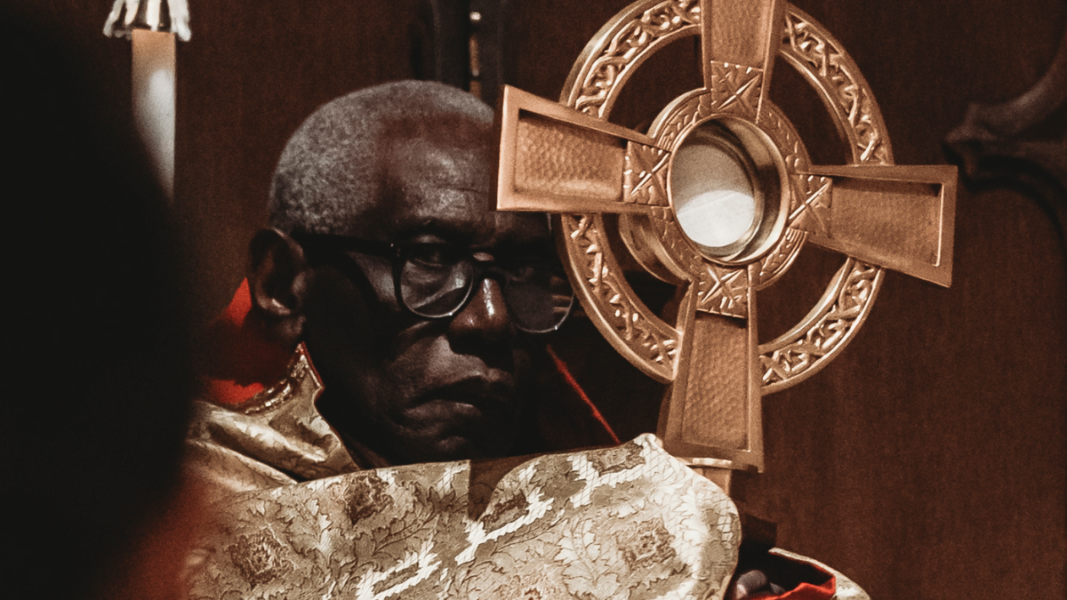
Cardinal Robert Sarah has emphasized in several recent interventions in the United States the central importance of sacred music in the liturgy, the need for Catholics to live attentive to the calls of the “four last things”—death, judgment, heaven, and hell—and the conviction that only the reign of Christ can bring authentic and lasting peace.
The reflections of the African cardinal took place on the occasion of the presentation of his new book The Song of the Lamb: Sacred Music and Heavenly Liturgy, written together with the ecclesiastical musician Peter Carter, and were collected by National Catholic Register.
Read also: The new book by Cardinal Sarah claims the objective greatness of sacred music
The liturgy is not a space for improvisation
In two conferences delivered on November 21 and 22, 2025, at Princeton University, Cardinal Sarah warned that, for decades, the liturgy has been “instrumentalized” and, in many cases, “politicized.” In the face of this drift, he insisted on the need to understand what the liturgy truly is and why sacred music constitutes an essential part of divine worship.
The emeritus prefect of the Dicastery for Divine Worship recalled the teaching of Benedict XVI on the hermeneutic of continuity between the reformed liturgy and the previous tradition, emphasizing that “what previous generations considered sacred remains sacred and great for us as well.” In this sense, he pointed out that liturgical abuses distort the proper purpose of worship: to give God the adoration due to Him and to recognize that the liturgy does not revolve around what man does, but around what God works in him.
Interior participation and truly sacred music
Cardinal Sarah insisted that full, conscious, and active participation in the liturgy is not identified with an accumulation of external gestures, but with the interior disposition of the soul, tuning the mind and heart to the meaning of the Church’s rites, chants, and prayers.
In addressing the musical question, he clearly distinguished between liturgical music and music that is not, denouncing as “scandalous” the fact that sometimes pieces foreign to the sacred character of worship are performed in temples. Quoting Benedict XVI again, he recalled that “in the liturgy, one song is not the same as another.”
Sacred music— he affirmed— possesses an objectivity rooted in the Church’s liturgical tradition and finds its privileged expression in Gregorian chant, which must retain a preeminent place. It is not a mere aesthetic addition, but an essential element of the liturgical act.
Christ the King and the peace that is not of this world
These ideas were extended in the homily delivered on November 23, 2025, the solemnity of Christ the King according to the ordinary calendar, in the chapel of Princeton University. There, Cardinal Sarah affirmed that without submitting to the truth and the law of love of Christ, there can be no authentic peace either in personal life or in politics.
The cardinal recalled that the kingdom of Christ is not of this world and that the peace He offers is not fundamentally political, but the fruit of humility and the acceptance of suffering, as shown by the plea of the good thief on the cross.
The four last things and the call to vigilance
In a subsequent homily, during a traditional Latin Mass celebrated on the solemnity of Christ the King at St. John the Baptist parish in Allentown (New Jersey), Cardinal Sarah exhorted the faithful not to be discouraged by the current situation of the Church and to live with a spirit of vigilance and prudence.
He recalled that the Church, at the end of the liturgical year, invites meditation on the four last things, realities that—he warned—cannot be ignored without grave spiritual risk. In the face of obsessive speculations about the end times, he proposed the evangelical attitude of serene and responsible vigilance.
The cardinal concluded by encouraging the faithful to prepare to give an account of their lives, resorting to repentance, penance, and the mercy of God, with the certainty that whoever remains faithful to Christ and to the teaching of the Church has nothing to fear, but the promise of eternal life.