


By Michael Pakaluk
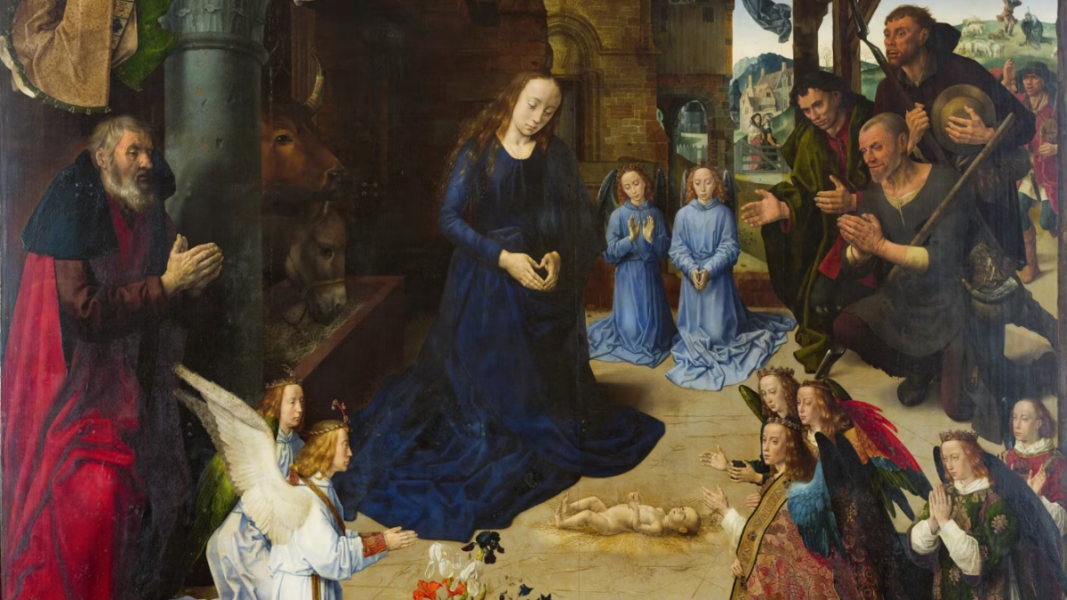
Did the Virgin Mary suffer the trauma of childbirth and its pains? Not a few preachers at the Christmas Mass speak as if she had. But a long tradition in the Church presents a very different picture.
First, what does Scripture say?
«She gave birth to her firstborn son, wrapped him in swaddling clothes, and laid him in a manger» (Luke 2:7). As the Catholic Encyclopedia observes, this language implies that Mary did not go through an ordinary childbirth. Mothers after delivery are not in a condition to stand up, look for swaddling clothes, wrap their baby, and walk around the room to place him in a manger. Others must do it for them. Joseph, strikingly, is not mentioned.
Luke also changes his language when going from Elizabeth’s case to Mary’s. The change is not easy to perceive in English. He says of Elizabeth that «the time came for her to give birth and she gave birth (egennēsen) to a son» (1:57), using a word that means the son burst forth from her. But of Mary, Luke writes: «the time came for her to give birth and she gave birth (eteken) to her son» (2:7), using a softer and more ambiguous word, which in Greek is used for both gestation and birth.
Moreover, there are words in Greek for labor pains (see Matthew 24:8; Galatians 4:19). Would not Luke, the physician, have deliberately used them if Mary had gone through labor? For, clearly, her childbirth would have been significant.
Then there are the passages from the Old Testament interpreted by the Fathers as indicative that Mary’s virginity was like a door or a wall, through which nothing entered or exited.
Consider Ezekiel 44:2: «And the Lord said to me: “This gate shall remain shut; it shall not be opened, and no one shall enter by it; for the Lord, the God of Israel, has entered by it; therefore it shall remain shut”». On this verse, St. Ambrose says (Letter 42):
Why is it difficult to believe that Mary gave birth in a manner contrary to the law of natural birth and remained a virgin, when against the law of nature the sea saw and fled, and the waters of the Jordan returned to their source?… It is not incredible that a man proceeded from a virgin when a rock brought forth a spring, iron floated on the water, and a man walked on the waters. If the waters supported a man, could not a virgin give birth to a man (hominem virgo generare)?
The manner of giving birth of a virgin who begets the God-man must be miraculous, insists St. Ambrose, just as her manner of conceiving the God-man is miraculous.
Or consider Song of Songs 4:12: «A garden enclosed, my sister, my bride; a garden enclosed, a fountain sealed». On this verse, St. Jerome says (Against Jovinian, I,31): «That which is closed and sealed represents the Mother of our Lord, who was a mother and a virgin».
Certainly, we take nothing away from Mary’s motherhood if we say that she did not suffer childbirth. She was already fully a mother when she conceived Jesus: «Who am I that the mother of my Lord should come to me?» (Luke 1:43), said very probably when Jesus was a blastula in one of Mary’s Fallopian tubes.
In God’s intention for Creation, childbirth did not imply trauma or pain: these are part of the penalty for Original Sin (Genesis 3:16). So, why would Mary, free from Original Sin from the moment of her conception, be subject to this penalty, any more than she was to disordered concupiscence?
Sometimes a Christian woman chooses to give birth without anesthesia, in solidarity with her sisters of the past, or to embrace part of the penalty due to sin, but not because she would be less of a mother if she resorted to pain relief. Similarly, no one believes that a mother who gives birth by cesarean is thereby less of a mother.
Nor can it be said that Mary’s labor pains were meant to be a model for us. Catholic hospitals place crucifixes over delivery beds, not images of Mary in labor. The Lord himself says that his crucifixion is the appropriate model for a woman’s childbirth pains (John 16:21). And was not Mary’s role to suffer precisely in «giving birth» at the foot of the Cross, as Simeon prophesied? (Luke 2:35).
The traditional sorrows and joys of St. Joseph include his sorrow over the poverty of the stable and his joy at the appearance of the Magi, but, notably (if the birth had been ordinary), not his anguish over Mary’s labor nor his joy when the child was delivered safe and sound.
The Church, in insisting on the mystery we celebrated yesterday, that Mary is the Mother of God, never also insisted—as it would presumably have had to if this were part of her motherhood—that she went through labor. Rather, the Church at Ephesus insisted with equal fervor on the doctrine of Mary’s perpetual virginity: that Mary was a virgin before the birth of the Lord; that Mary was a virgin after his birth; and that Mary remained a virgin in the very act of his birth (CCC 499). If Mary was the Mother of God, she gave birth to him without any trauma or corruption.
St. Thomas Aquinas quotes the Council of Ephesus on this point:
Whoever gives birth to pure flesh ceases to be a virgin. But since she gave birth to the Word made flesh, God preserved her virginity in order to manifest his Word, by which he thus manifested himself: for our word, when spoken, does not corrupt the mind; nor does God, the substantial Word, when deigning to be born, destroy virginity (ST III,28,2).
And St. Augustine: «To the substance of a body in which the divinity was, closed doors were no obstacle. For truly he had the power to enter through doors not opened, he whose birth left the virginity of his Mother intact».
About the author
Michael Pakaluk, a scholar of Aristotle and Ordinarius of the Pontifical Academy of St. Thomas Aquinas, is Professor of Political Economy at the Busch School of Business at the Catholic University of America. He lives in Hyattsville, Maryland, with his wife Catherine, also a professor at the Busch School, and their children. His collection of essays The Shock of Holiness (Ignatius Press) is available. His book on Christian friendship, The Company We Keep, can be found at Scepter Press. He contributed to Natural Law: Five Views, published by Zondervan last May, and his most recent evangelical book appeared in March with Regnery Gateway, Be Good Bankers: The Economic Interpretation of Matthew’s Gospel. You can follow him on Substack at Michael Pakaluk.