


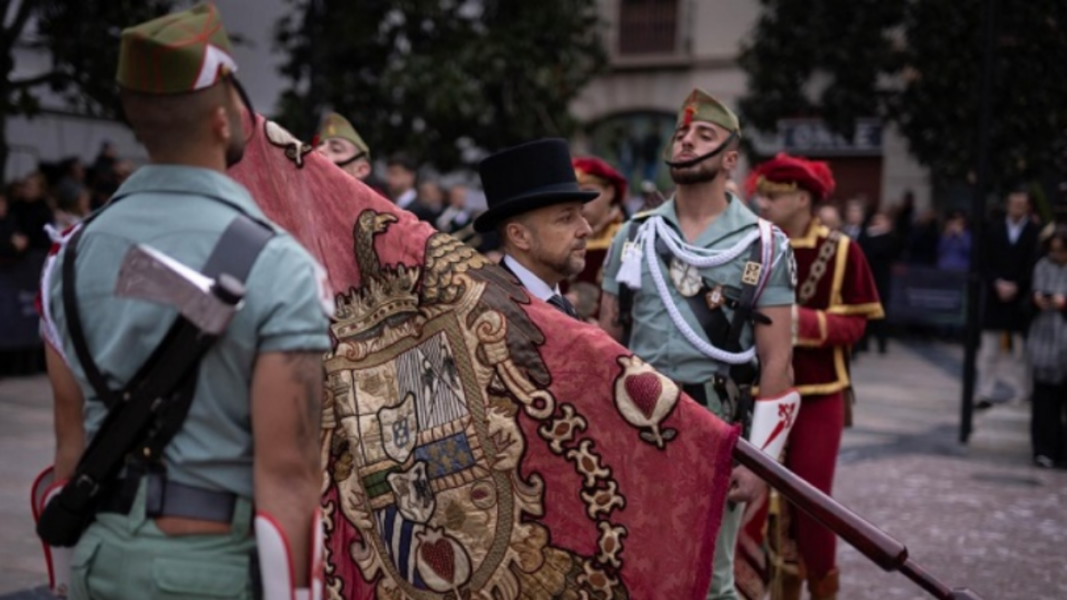
Granada commemorated one of the decisive events in its history: the entry of the Catholic Monarchs into the city in 1492, an event that ended the Nasrid Kingdom and definitively closed the long process of the Reconquista begun centuries earlier. More than five hundred years later, the Granada capital keeps alive a tradition that combines historical memory, institutional solemnity, and religious act.
The date refers to January 2, 1492, when Isabella I of Castile and Ferdinand II of Aragon received the keys to the city after the capitulation of Boabdil, the last Nasrid emir. That day marked not only a political change, but also the definitive reestablishment of Christian Spain after nearly eight centuries of Islamic presence on the Iberian Peninsula. Since then, the city annually remembers the Taking as a foundational milestone of its historical identity.
Start of the official events
According to the newspaper Granada Hoy, the events began mid-morning in Plaza del Carmen, in front of the City Hall, with the arrival of the councilors from all municipal groups. At 11:20 a.m., the mayor of Granada, Marifrán Carazo, received the lieutenant general of the Training and Doctrine Command (Madoc), José Manuel de la Esperanza. Both reviewed the military formation, formally starting the commemorative day.
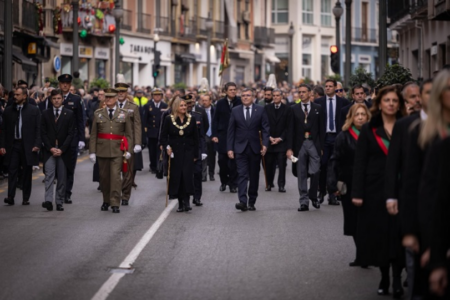
In this 534th anniversary, the presence of the Legion was once again one of the most prominent elements of the event. More than half a hundred legionaries participated in the ceremony, belonging to a section of the Rey Alfonso XIII 2nd Brigade, based in Viator (Almería), along with personnel from the VII Valenzuela Flag of the Don Juan de Austria Tercio. This was joined by the deployment of a war band and a music unit, reinforcing the solemn character of the event.
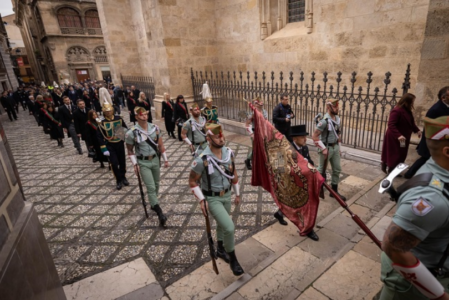
The procession to the Royal Chapel
After the initial event, at 11:40 a.m., the official procession departed from Plaza del Carmen toward the Royal Chapel, following the traditional route through Reyes Católicos, Gran Vía, and Oficios streets. The itinerary is not casual: it symbolically reproduces the path to the historical and spiritual heart of the city.
At 12:00 p.m., the Eucharist began in the Cathedral, one of the central moments of the commemoration. The celebration took place in the setting of the Royal Chapel, where the mortal remains of Isabella and Ferdinand rest, direct protagonists of the Taking of Granada and key figures in the closure of the Reconquista.
The most symbolic gesture of the day
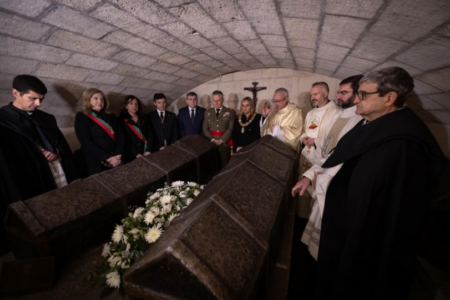
After the mass, at 1:10 p.m., the Cathedral Chapter, the Royal Chapel Chapter, and the Municipal Corporation entered the Regia Classroom. There took place one of the most symbolically charged gestures of the day: the solemn waving of the Royal Standard in front of the tombs of the Catholic Monarchs.
The event was completed with a floral offering, consisting of the placement of a laurel wreath and a bouquet of flowers next to the sepulchers, as an institutional homage to the monarchs who culminated the recovery of the city for the Crown and Christendom.
Return to City Hall and closing of the commemoration
Next, at 1:20 p.m., the procession began the return to Plaza del Carmen following the same route. Already at the doors of the City Hall, the Municipal Band played the hymn of Granada and the hymn of Andalusia, followed by the hymn of Spain performed by the Military Band.
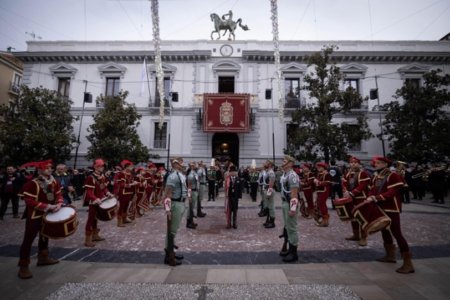
The event concluded from the main balcony of the Consistory, where the councilor in charge of carrying the Royal Standard waved it three times. The ceremony closed, as tradition dictates, with the well-known shout of “Granada, what?”, responded by the attendees, putting an end to a day laden with history.