


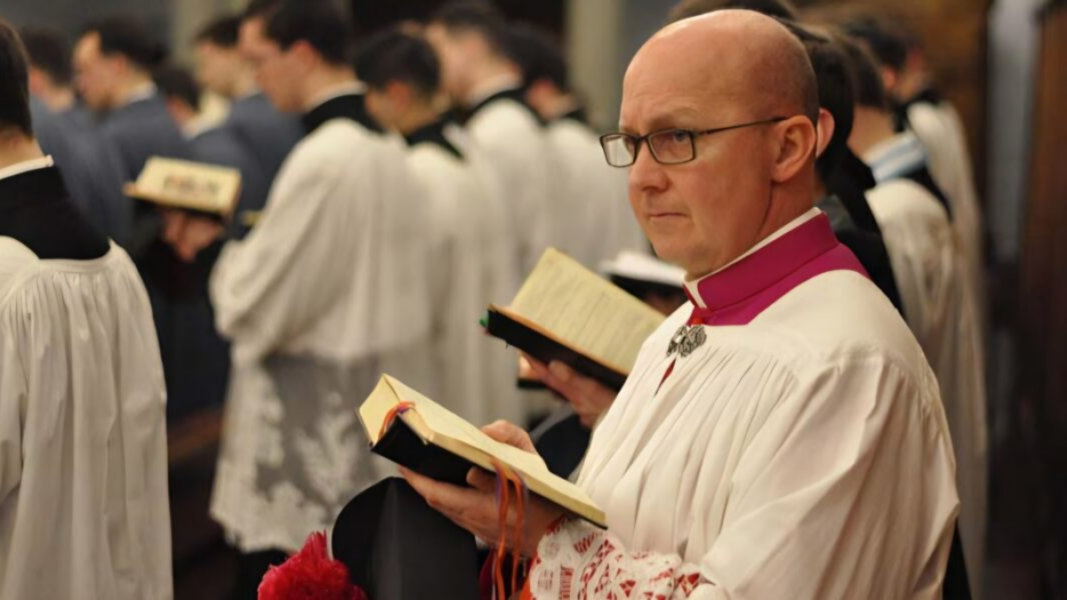
Marco Agostini is an Italian priest who has spent his entire adult life in service to the Church, first in his diocese of origin and, for the last sixteen years, in the very heart of the Vatican. His name was barely known outside liturgical and curial circles, but his figure was habitual—though always discreet—in the great pontifical celebrations.
Early Priestly Vocation
Belonging to the Diocese of Verona, Marco Agostini was ordained a priest on June 6, 1992. From the beginning of his ministry, he showed a clear inclination toward liturgical service, a demanding and little-visible field, but essential for the life of the Church. His early years were spent between pastoral tasks and diocesan assignments, in a career without upheavals, marked by regularity and institutional fidelity. Those who know him highlight a methodical, reserved, and deeply clerical profile, far from media prominence.
From Verona to Rome
Over time, Agostini was called to Rome to join structures of the Holy See. Before his appointment as master of ceremonies, he worked as an official in the Secretariat of State, specifically in the Section for Relations with States, a school of rigor, discretion, and institutional obedience. That step consolidated his profile as a trusted priest, accustomed to silent work and curial discipline.
The Appointment That Marked His Life
On June 13, 2009, during the pontificate of Benedict XVI, he was appointed Pontifical Master of Ceremonies, a position that would completely change the axis of his ministry. From that moment, his life was tied to the Pope’s calendar: solemn celebrations, canonizations, consistories, apostolic journeys, and acts of maximum public exposure.
The master of ceremonies does not decide, he executes. He does not speak, he indicates. He does not improvise: he ensures that the rite is fulfilled with precision. Agostini performed that function for more than sixteen years, an exceptionally long period in an environment where rotations are usually frequent.
A Constant Presence Under Three Pontificates
Throughout his tenure as master of ceremonies, Agostini served under three pontificates, adapting to different liturgical styles and sensitivities without starring in conflicts or controversies. His prolonged permanence is, in itself, an indicator of institutional trust and technical solvency. He was never a political or media figure: his name rarely appeared in chronicles, and when it did, it was as a functional reference, not as a protagonist.
Liturgy as Identity
In recent years, Agostini has been increasingly identified with traditional liturgy. He frequently celebrated the Mass according to the traditional Roman rite in the crypt of St. Peter’s Basilica, a place where priests and faithful particularly attentive to the classical form of the rite converge. His participation in the traditional pilgrimage to Covadonga reinforced that identification. For many, Agostini represented a type of priest on the verge of extinction: formed, obedient, silent, and liturgically traditional.
An Abrupt Exit After Decades of Service
Until yesterday, Marco Agostini was still, de facto, pontifical master of ceremonies. His sudden dismissal, without official explanation, has put an end to more than sixteen years of direct service in the pontifical ceremonial.
In the Vatican, these exits usually occur without administrative noise, but with immediate consequences. For a priest who has made discretion his way of life, the manner of his dismissal is as striking as it is disconcerting.