


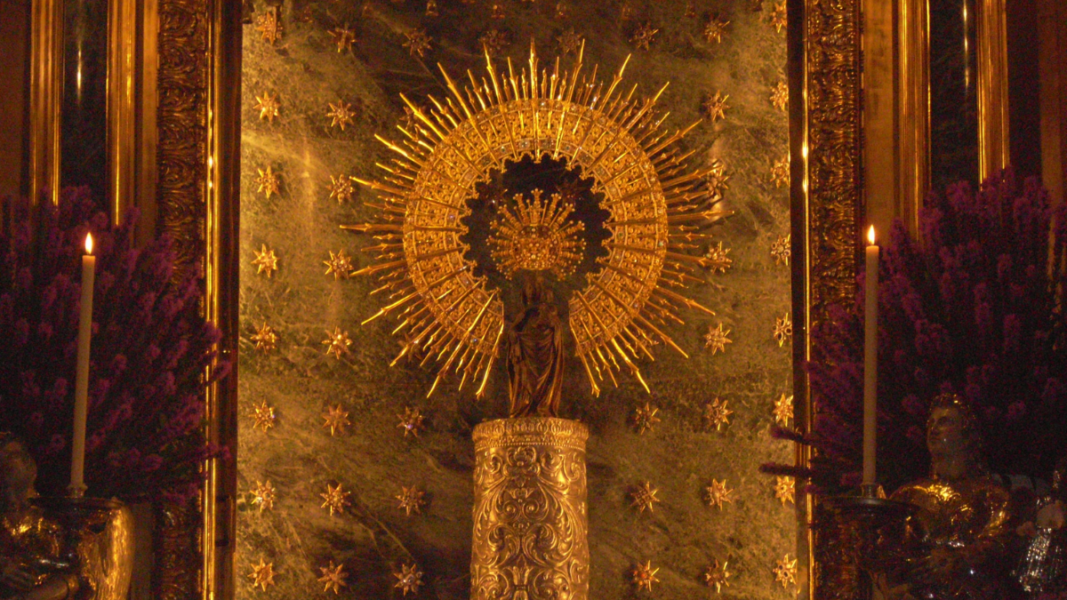
January 2nd holds a singular place in the Christian memory of Spain. According to the oldest and most constant tradition, on that day in the year 40 A.D., the first Marian apparition in history occurred in Hispania: the manifestation of the Virgin Mary to the Apostle James in the Roman city of Caesaraugusta, present-day Zaragoza, on the banks of the Ebro River.
It is not a late devotion nor a medieval legendary elaboration, but a tradition rooted since the first centuries of Hispanic Christianity, preserved and transmitted as a foundational fact of faith in the Peninsula.
Mary Appears in the Flesh: A Unique Event
The uniqueness of Our Lady of the Pillar lies in the fact that Mary would have appeared in mortal flesh, before her Assumption, which makes this event unique in the history of Marian apparitions.
The Apostle James, sent to evangelize Hispania, was discouraged by the poor reception of his preaching. In that context, the Virgin appeared to him on a pillar of marble or jasper, accompanied—according to tradition—by a choir of angels, to console him and confirm him in his mission.
Mary did not promise him immediate successes or human triumphs. She asked him for perseverance. And she expressly requested that he build a church in that place in her honor.
From the Pillar to the Basilica
After the vision, James and his disciples built a small chapel around the pillar left by the Virgin. Over the centuries, that humble oratory became the spiritual heart of Zaragoza and, later, the current Catedral-Basílica de Nuestra Señora del Pilar, one of the most important Marian shrines in Christendom.
The pillar venerated in the Holy Chapel is not just a material relic. It is a theological symbol: the firmness of the Christian faith, the apostolic continuity, and the doctrinal stability in the face of the adversities of history.
A Date that Frames the History of Spain
It is no less significant that centuries later, also on January 2nd, in 1492, the Nasrid Kingdom of Granada fell, putting an end to the Reconquista. For the Christian consciousness of the time, that event marked the closure of a long historical process begun precisely with the apostolic preaching.
Thus, January 2nd appears symbolically as an arch that unites the beginning and the culmination of the Christian history of Spain: Mary encouraging James at the beginnings, and Christendom recovering its territorial unity after centuries of resistance.