


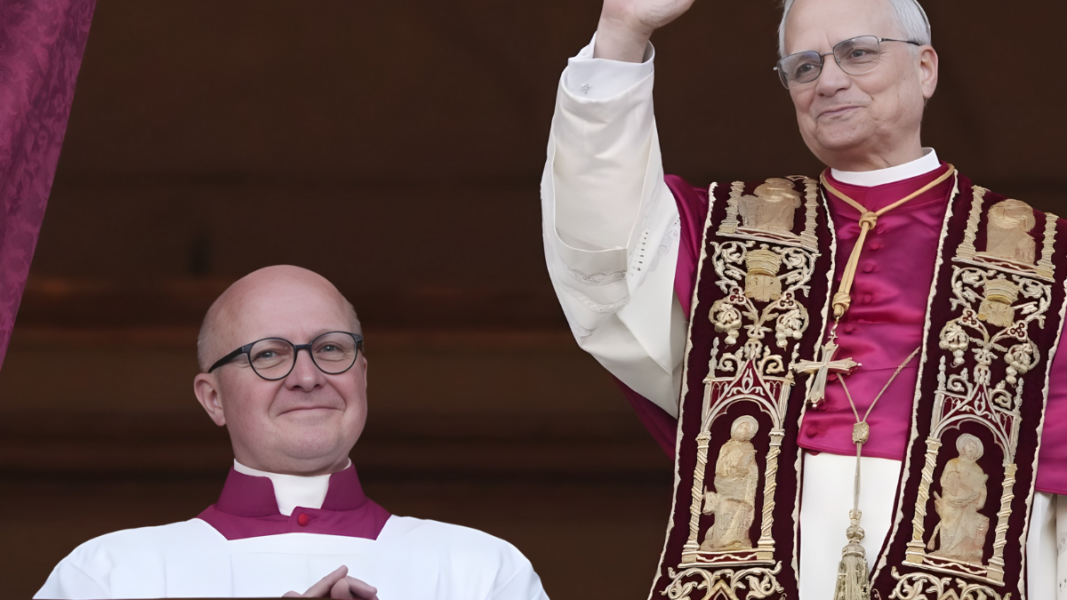
A comment picked up by an open microphone, barely audible, without verifiable context and without any objective possibility of identifying its recipients, has been enough to trigger a fulminating reaction against Monseñor Marco Agostini, one of the pontifical ceremonialists and, to this day, one of the figures most clearly identified with the defense of traditional liturgy within the Vatican. The phrase—«culattomi tutti insieme» (los maricas todos juntos)—appears fleetingly in an off-the-record moment in an institutional video from Vatican News of the Pope’s Christmas meeting with cardinals and bishops residing in Rome. Nothing in the audio allows for certainty about who it was referring to, nor even if it was an expression directed at a specific and isolated group or a private comment poorly captured during a transitional organizational moment.
The attribution of the comment to Agostini was advanced by Silere non possum and, from that instant, the machinery activated with a speed as revealing as it was unsettling. There has been no clear official explanation, no serene contextualization of the facts, no transparent investigation that allows for evaluating the real gravity of the incident. The mere existence of a blurry audio has been sufficient to justify a disproportionate and automatic reaction.
An uncomfortable profile at the wrong time
Agostini is not a neutral name within the Vatican. He is known for his closeness to the traditional Mass, for habitually celebrating according to the ancient Roman rite in the crypt of St. Peter’s and for his presence in spheres unequivocally associated with classical liturgical Catholicism, including the traditional pilgrimage to Covadonga. In the current climate, that trajectory is not a mere personal trait: it is an uncomfortable ecclesial position for some. And when the profile becomes bothersome, any pretext will do.
The problem is not a phrase. The problem is who pronounces it.
Real scandals, prolonged tolerance
The contrast becomes scandalous when observing the management that the Vatican has given, in recent years, to cases infinitely more serious. The recent history of the Roman Curia is marked by documented episodes of high-level clerics involved in active sexual conduct, double lives, drug use, sexual parties in Vatican premises, and even internal blackmail systems based precisely on those conducts.
In many of those cases, the institutional reaction was slow, opaque, or directly nonexistent. Discreet transfers, administrative silences, calls for mercy and pastoral accompaniment. No hurry. No immediate exemplarity. No open microphone turned into a cause for summary execution.
The Carlo Capella case: mercy without nuances
The contrast reaches its most hurtful point with the case of Carlo Capella, former official of the Vatican Secretariat of State. Capella was prosecuted by U.S. justice for downloading and sharing child pornography, facts proven judicially and recognized by Vatican authorities.
Well, after serving his sentence, Capella has been welcomed back into Vatican structures, residing in an important ecclesiastical residence, in coexistence with other clerics, and restored to internal official functions. All of this in the name of mercy, rehabilitation, and accompaniment.
This is not about denying the possibility of Christian forgiveness. It is about noting an uncomfortable fact: institutional mercy has been applied with extreme generosity in a case of objectively monstrous crimes, while it shows itself nonexistent before an ambiguous verbal comment, without an identifiable recipient and without real consequences.
Double standard as a system
The message that is transmitted is devastating. Not all faults weigh the same. Not all profiles receive the same treatment. Indulgence seems to abound when the scandal affects delicate internal balances or consolidated power networks. But it disappears fulminantly when the targeted person represents a vision of the Church that some wish to eradicate.
In this context, the “Agostini case” ceases to be an anecdotal episode to become a structural symptom. Tradition is not corrected: it is punished. And when the decision is made, a poorly captured audio, an open microphone, and an interested interpretation are enough to justify an orchestrated fall through specific means and by specific people.