


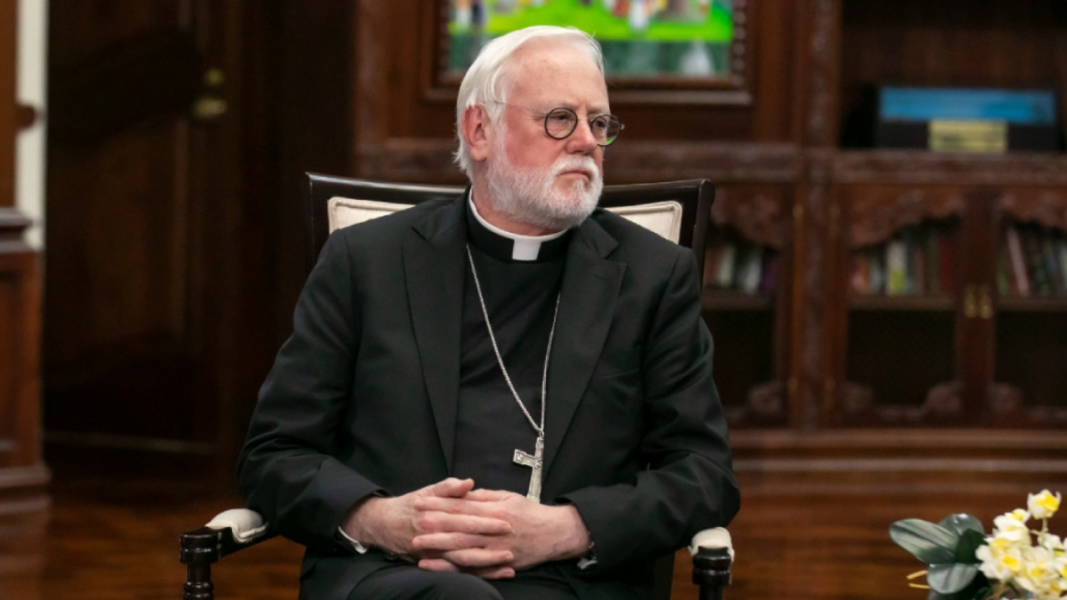
On the occasion of the World Day of Peace, Monsignor Paul Richard Gallagher, responsible for Vatican diplomacy, has outlined a broad diagnosis of the state of the world at the beginning of 2026 in an interview granted to the Agencia SIR. Geopolitical fragmentation, rearmament, forgotten conflicts, warlike language, normalization of emergency. The analysis is serious, orderly, and accurate about the international scenario we are experiencing. But it leaves an unsettling feeling: something fundamental is missing from the discourse. It is not something new; on the contrary, the absence of God has become a constant, and precisely for that reason, it is worth emphasizing it.
Gallagher speaks as international organizations speak today. With more moral height, no doubt, but within the same conceptual framework. War is denounced, dialogue is called for, warnings are issued against resignation, a change of course is demanded. All correct. All reasonable. And yet, the question imposes itself: what peace are we talking about?
«True peace is not the fruit solely of disarmament, but is based on trust and peaceful relations between peoples,» says Gallagher.
Throughout the entire interview, peace appears defined almost exclusively in political and humanitarian terms. Trust between peoples, verifiable gestures, strengthened institutions, non-polarizing language. Even when the Church is mentioned as the «critical conscience» of the global system, that conscience seems to move in a strictly horizontal plane. The system is criticized, yes, but from within the system. Principles are elevated, but the foundation is not changed.
«Let us not forget that the path of dialogue is always possible, indeed desirable, a “humble and persevering” dialogue, as Pope Leo XIV exhorts us, to contribute to a change of course, to rebuild relations of trust and for the good of all humanity.»
What has become a constant is the practical absence of God. Not as a rhetorical crutch, not as a pious quote, but as a real and structural reference. On a World Day of Peace promoted by the Church, it is hard not to wonder why the ultimate origin of peace—God himself—is relegated to the background, almost invisible.
«The Holy See presents itself not as a geopolitical actor among others, but as a critical conscience of the international system, a sentinel in the night that already sees the dawn, that demands responsibility, rights, and the centrality of the person.»
The Catholic tradition has not been ambiguous on this point. Peace is not simply the result of diplomatic balances or multilateral consensuses. Nor is it only the absence of war. Peace, in the Christian sense, is born from the just order willed by God, from the truth about man, and from the conversion of the heart. When this dimension is omitted, peace becomes a technical objective, manageable, but profoundly fragile.
«The urgent measures are well known: protection of civilians, access to humanitarian aid, support for the most vulnerable populations, a renewed commitment to conflict prevention and the strengthening of supranational institutions,» Gallagher recalls.
The underlying problem is deeper than a specific interview. It is the risk of assuming that the world can fix itself, as long as the appropriate mechanisms are fine-tuned. It is the very modern temptation to think that more effective institutions, kinder languages, and better-drafted agreements with a slight mention of God are enough to give it the religious touch. History proves the opposite: when God is expelled from the horizon, man not only emancipates himself, he becomes disoriented.
Talking about peace without God amounts, in practice, to accepting that salvation can come from politics, technology, or consensus. But the Church exists precisely to remind us that this is not true. Its mission is not to compete with chancelleries or to offer a morally improved version of the same secular discourse. Its mission is to announce what the world does not want to hear: that without Truth there is no peace, and that Truth has a name.
That is why it is insufficient to define the Church solely as the «critical conscience» of the international system. The Church is not called only to criticize the excesses of the system, but to question its presuppositions. To say that war is not only a political failure, but a consequence of sin. To remind that human dignity cannot be sustained without a true anthropology. To affirm that there will be no lasting reconciliation as long as it is pretended to build it disregarding God. As Gallagher mentions, «these are the crises that run the risk of falling more and more into oblivion. And it is here where the Church and the Holy See can do so much, calling attention to them and working for the good of all,» only that he refers to poverty, corruption, discrimination, and the exploitation of people from the reigning anthropocentrism—and yes, they are serious issues, but it is what man does when he lives without God—.
Vatican diplomacy has a legitimate and necessary role, no one disputes that. But when ecclesial discourse mimics too much the language of international organizations, it loses its mission. The Church is not in the world to manage balances, but to announce the truth that liberates.
The peace that the world proposes is usually a truce. The peace that Christ is in eternal life.