


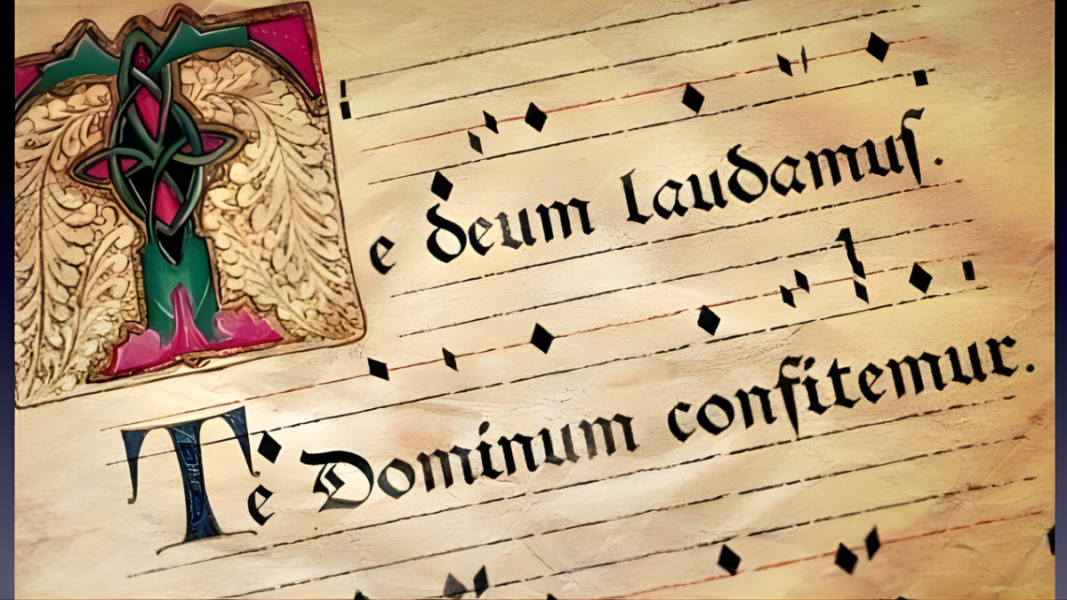
Every December 31, when the civil year comes to an end, the Church raises one of its oldest and most solemn prayers: the Te Deum. In parishes, cathedrals, and especially in St. Peter’s Basilica, this hymn of thanksgiving resounds as a public expression of recognition to God for the gifts received throughout the time that is ending.
Far from being a recent custom, the Te Deum is part of the oldest spiritual heritage of Christianity. It is a Latin prose hymn whose name comes from its first verse: Te Deum laudamus (“We praise you, O God”). Its composition dates back to between the end of the 4th century and the beginning of the 5th.
Its authorship is not fully established. Over the centuries, it has been attributed to figures as prominent as St. Ambrose, St. Augustine, or St. Cyprian of Carthage. However, many scholars today consider the most probable author to be St. Nicetas of Remesiana, a 4th-century bishop known for his catechetical and liturgical writings and praised by St. Paulinus of Nola.
Whatever its author may be, the fact is that the Te Deum was recognized very early as a text of great theological and spiritual depth. For this reason, it was stably incorporated into the Church’s official prayer and became a habitual element of liturgical life, especially in contexts of praise and thanksgiving.
A sung synthesis of the Christian faith
From its first verses, the hymn presents a choral praise in which heaven and earth unite: angels, archangels, apostles, prophets, and martyrs together proclaim the holiness and glory of God.
At its core, the hymn formulates a clear Trinitarian confession and covers the great mysteries of the faith: the Incarnation of the Son of God, his Passion and Death, the Redemption wrought by the Cross, and his glorification at the right hand of the Father. Christ is proclaimed as King of glory, victor over death and judge of the living and the dead.
Constant presence in the liturgy and in history
From very early on, the Te Deum was incorporated into the Liturgy of the Hours, where it is sung at the end of the Office of Readings on Sundays, feasts, and solemnities, except during the penitential seasons of Advent and Lent. In Rome—and by extension in the whole Church—the Pope maintains the tradition of presiding over a solemn Te Deum at the end of the civil year, as a public gesture of gratitude and trust in divine providence.
Throughout history, this hymn has also accompanied great ecclesial and civil events: papal elections, coronations of kings, peace treaties, national anniversaries, and especially significant events. In many countries with a Catholic tradition, the Te Deum has been a visible sign of the relationship between faith and public life.
At the end of the year, the Te Deum acquires a particular meaning. It is the opportune moment to recognize that time belongs to God and that history remains under his providence. Therefore, when the Church sings the Te Deum at the conclusion of the year, it proclaims that all good comes from God, and in Him is founded the hope with which a new year begins.
Original text in Latin
Te Deum laudamus:
te Dominum confitemur.
Te aeternum Patrem,
omnis terra veneratur.
Tibi omnes angeli,
tibi caeli et universae potestates:
tibi cherubim et seraphim,
incessabili voce proclamant:
Sanctus, Sanctus, Sanctus
Dominus Deus Sabaoth.
Pleni sunt caeli et terra
maiestatis gloriae tuae.
Te gloriosus Apostolorum chorus,
te prophetarum laudabilis numerus,
te martyrum candidatus laudat exercitus.
Te per orbem terrarum
sancta confitetur Ecclesia,
Patrem immensae maiestatis;
venerandum tuum verum et unicum Filium;
Sanctum quoque Paraclitum Spiritum.
Tu rex gloriae, Christe.
Tu Patris sempiternus es Filius.
Tu, ad liberandum suscepturus hominem,
non horruisti Virginis uterum.
Tu, devicto mortis aculeo,
aperuisti credentibus regna caelorum.
Tu ad dexteram Dei sedes,
in gloria Patris.
Iudex crederis esse venturus.
Te ergo quaesumus, tuis famulis subveni,
quos pretioso sanguine redemisti.
Aeterna fac
cum sanctis tuis in gloria numerari.
Salvum fac populum tuum, Domine,
et benedic hereditati tuae.
Et rege eos,
et extolle illos usque in aeternum.
Per singulos dies benedicimus te;
et laudamus nomen tuum in saeculum,
et in saeculum saeculi.
Dignare, Domine, die isto
sine peccato nos custodire.
Miserere nostri, Domine,
miserere nostri.
Fiat misericordia tua, Domine, super nos,
quem ad modum speravimus in te.
In te, Domine, speravi:
non confundar in aeternum.
Text in English
We praise you, O God,
we acknowledge you to be the Lord.
You, the eternal Father,
all the earth worships.
All the angels, the heavens
and all the powers adore you.
The cherubim and seraphim
sing to you without ceasing:
Holy, Holy, Holy
Lord God of Hosts.
Heaven and earth
are full of the majesty of your glory.
The glorious choir of the apostles praises you,
the admirable multitude of prophets,
the white army of martyrs.
The holy Church throughout the world confesses you:
Father of immense majesty;
your venerable true and only Son;
and the Holy Paraclete Spirit as well.
You are the King of glory, Christ.
You are the eternal Son of the Father.
You, taking on humanity to set it free,
did not disdain the Virgin’s womb.
You, having overcome the sting of death,
opened to believers the kingdom of heaven.
You sit at the right hand of God,
in the glory of the Father.
You are believed to be coming as judge.
Therefore, we beseech you, assist your servants,
whom you redeemed with your precious blood.
Make them
to be numbered with your saints in glory.
Save your people, Lord,
and bless your inheritance.
And govern them,
and exalt them forever.
Day by day we bless you;
and we praise your name forever,
and for generation upon generation.
Deign, Lord, this day
to keep us from sin.
Have mercy on us, Lord,
have mercy on us.
May your mercy, Lord, be upon us,
as we have hoped in you.
In you, Lord, I have trusted:
let me not be put to shame forever.