


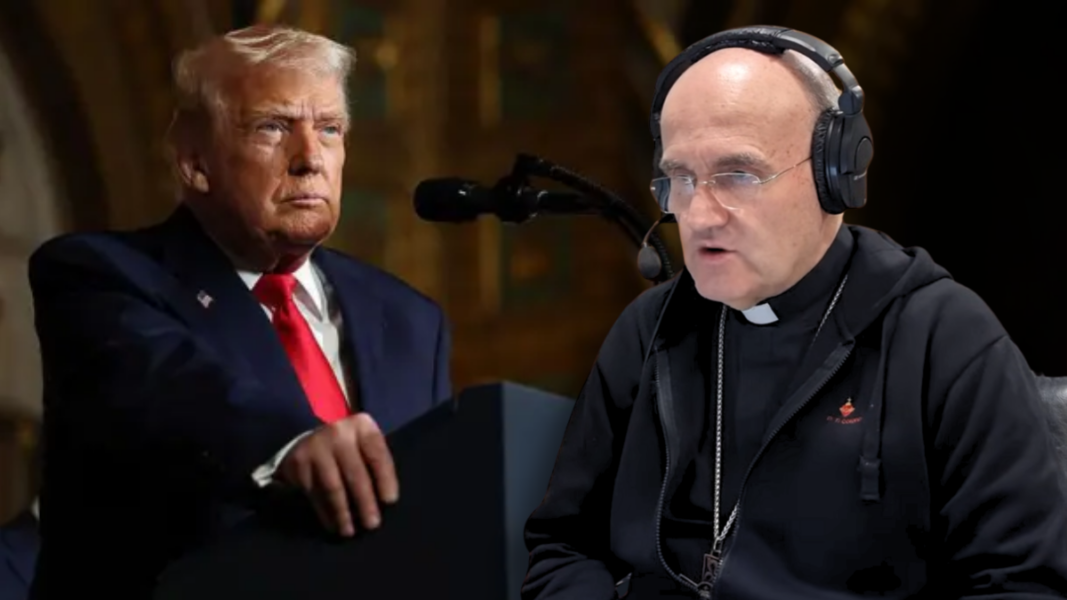
The Bishop of Orihuela-Alicante, José Ignacio Munilla, dedicated a central part of his program Sexto Continente on Monday, December 29, to harshly criticizing the attack ordered by the President of the United States, Donald Trump, against jihadist bases in northern Nigeria on Christmas Day. In his intervention, Munilla once again lashed out at Trump, accusing him of instrumentalizing the Nativity and acting driven by a spirit of vengeance incompatible with the Gospel.
Munilla recalled that Pope Leo XIV had explicitly requested a global 24-hour truce for all wars during Christmas 2025, and contrasted this request with the U.S. Government’s decision to launch missiles precisely on December 25. In his view, choosing that day for a military operation would not only be debatable from a political or strategic standpoint, but would represent “a profound misunderstanding of the Gospel,” by turning Christmas—according to his words—into “the day of vengeance.”
Read also: His obsession against Trump leads Munilla to condemn the attacks on ISIS
The bishop insisted that, although Christian tradition admits legitimate armed defense in certain circumstances, it can never be exercised with “glee, sarcasm, or a spirit of revenge.” In that context, Munilla focused particularly on the message posted by Trump after the attack—“Merry Christmas to all, including the dead terrorists”—which he described as a banalization of death and a reduction of human suffering to “rhetorical ammunition” for ideological applause.
During the program, Munilla emphasized that Christians do not pray for “the bad to die,” but for “the bad to convert,” and warned of the risk of normalizing a culture of violence in which any armed response becomes acceptable. In this regard, he compared the case to other historical episodes—such as the war on drugs in the Philippines under former President Duterte—to alert against a drift in which the physical elimination of the enemy replaces the rule of law.
Read also: Olivera Ravasi explains the Nigeria issue in the light of the DSI
Munilla also pointed out that, up to that point, the only Nigerian bishop who had spoken out publicly about the attack was Mons. Matthew Hassan Kukah, of the Diocese of Sokoto, one of the areas most affected by violence. As he explained, Kukah would have criticized the resort to violence and emphasized that the conflict in Nigeria is more complex than a mere religious confrontation, pointing to factors such as structural poverty, illiteracy, and the country’s moral collapse.
The Bishop of Orihuela-Alicante concluded his reflection by stating that using Christmas as a symbolic framework for military actions represents, in his opinion, “tarnishing” the profound meaning of the Nativity, which the Church proposes precisely as a platform to question war and denounce violence. In his final assessment, Munilla once again warned against what he considers a confusion between justice and vengeance, and against the use of religious language to legitimize political and strategic decisions.