


By Fr. Paul D. Scalia
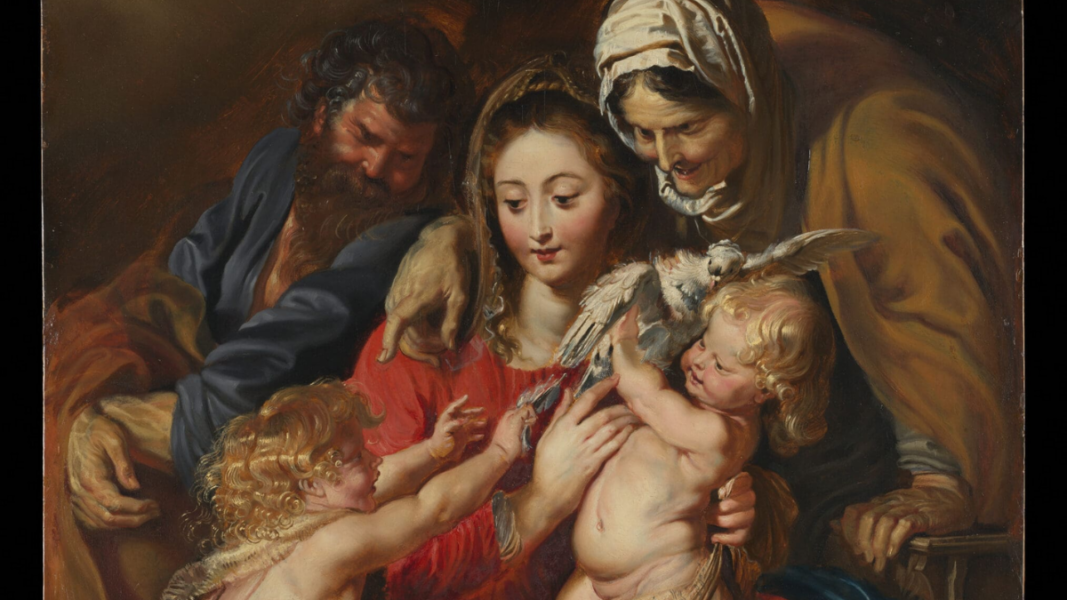
The collect prayer for today’s feast reads: «O God, who deigned to give us the example of the Holy Family, grant us graciously that we may imitate it.» Now, that’s asking a lot. After all, the Holy Family was exceptional. Inimitable, one might say. Joseph and Mary were certainly married, but their marriage was not like any other. Jesus was truly their Son… but not in the usual sense.
However, this collect and the intuition of the faithful throughout history indicate that, in fact, there is something here that can be imitated and that is capable of being imitated. Now, that does not mean lowering the Holy Family to our level. Rather, what we find in it in a unique and unrepeatable way reveals what is true for every family.
First, the Holy Family begins with the love of Joseph and Mary. Many Christians might see their marriage as a kind of fiction. Mary was going to have a son and a husband/father was needed on the scene. Hence the depictions of an elderly and clumsy Joseph trying to keep up with Jesus and Mary.
But God does not operate with fictions. Joseph and Mary loved each other with an authentic spousal love, although lived in a unique way. She entrusted herself to him, along with her consecrated virginity, for him to protect her. He gave himself out of love as her spouse and guardian. What each desired for the other was the holiness to which God called them. Her holiness inspired his generous response to God, and his protection made hers possible.
So too, the holiness of a family begins with the love of the spouses. It is not the romanticized theory of the soulmate, which ironically leads to infidelity and broken families. No: it is the simple conjugal love discerned by a bride and groom that leads them to promise permanence, fidelity, and openness to children. It is the daily choice to love each other that not only keeps those vows but deepens them.
Second, although Joseph and Mary never had conjugal relations, they were, nevertheless, open to life, obviously in an exceptional way. The Child born of Mary is the fruit of their union. Their marriage already existed at the moment of Christ’s conception. It was within their marriage that He was conceived. Not only by Mary’s faith in God, but also by her trust in Joseph, was she able to say Yes to the angel. This singular openness to life brought the Lord of Life into the world.
«Be fruitful and multiply.» This is God’s first commandment and, therefore, the most fundamental. Like all His commandments, it is for our good, and despising it only brings us sadness. The openness of a marriage to children—and, even better, their generosity in welcoming them—indicates trust in God’s providence and willingness to be stretched in self-giving. That openness and generosity in turn become a means of sanctification, of growth in trust and self-gift. The ordinary sacrifices of mothers and fathers have been woven into the fabric of Christian holiness.
Third, the Holy Family had a clear purpose, that is, a mission. Christ had been entrusted to the marriage of Joseph and Mary. Their mutual love established the home where He was welcomed and where «He grew in wisdom, in stature and in grace before God and before men» (Luke 2:52). In short, their purpose was Jesus. Everything in their love and in their home was ordered toward Him and His mission.
Every family has a mission and a purpose. On the natural level, the family brings many benefits to society (and, as the family disintegrates, we are sadly discovering how many of those benefits are lost). But the ultimate purpose of the family goes beyond this world. Indeed, as in the Holy Family, the purpose of every family is Jesus Christ: to give Him a place to dwell in the home, among its members; to grow in knowledge and love toward Him; to increase the capacity to imitate Him.
Finally, the Holy Family prayed. Given the presence of the Incarnate Word and the Immaculate Conception in their home, their prayer was unique. But, in another sense, it was ordinary. They prayed as their people prayed. They knew themselves to be members of the People of God and prayed according to the times, seasons, texts, and rites that had been handed down to them. Their prayer was ordinary also in the sense that it was simply woven into their daily life. Talking with God was as natural as breathing.
Every family is called to prayer. The famous adage of Father Peyton remains true: «The family that prays together stays together.» But prayer brings more than mere permanence. Prayer in the home—beginning with the spouses—brings sanctification. It makes the family more attentive to God’s presence and gives Him more space to act in their lives.
Like the Holy Family, the prayer of every family must be ordinary. In a first sense, because it is done according to the times, seasons, texts, and rites of the Church. The domestic church must be the place where the doctrines and liturgy of the Church take root. Family prayer must also be ordinary in a second sense: that it has nothing strange or exceptional about it. The ordinary in a family should be to be aware of God’s presence: to bow the head in prayer, to give thanks and praise to Him from whom every family in heaven and on earth takes its name (Ephesians 3:15).
About the author
Fr. Paul Scalia is a priest of the Diocese of Arlington, Virginia, where he serves as episcopal vicar for the clergy and pastor of Saint James in Falls Church. He is the author of That Nothing May Be Lost: Reflections on Catholic Doctrine and Devotion and editor of Sermons in Times of Crisis: Twelve Homilies to Stir Your Soul.