


By Fr. Raymond J. de Souza
High culture—and the spiritual appreciation of high culture—has returned to the Vatican this month. Pope Leo XIV is discreetly restoring some recent traditions, such as personally celebrating Holy Mass on Christmas morning, something that had not been done since 1994. Earlier this month, he also revived the concert of classical sacred music.
Sixty years ago, at the conclusion of the Second Vatican Council, some “messages” addressed to various groups were read; one of them was intended for artists, including musicians:
The council Church declares to you that, if you are friends of authentic art, you are our friends. The Church needs you and turns to you. Do not refuse to put your talents at the service of divine truth. Do not close your mind to the breath of the Holy Spirit.
A few months later, in April 1966, St. Paul VI made this friendship visible by attending a concert in the auditorium of Santa Cecilia, near the Vatican. Four years later, on the occasion of his golden priestly jubilee, Beethoven’s Missa Solemnis was performed in his presence in St. Peter’s Basilica itself.
Papal patronage of classical music after the Council reached its peak forty years ago. St. John Paul the Great, during a visit to Austria in 1983, met with the renowned Herbert von Karajan, who suggested that a magnificent musical Mass be performed at a pontifical Mass. John Paul agreed.
In 1985, for the solemnity of Saints Peter and Paul, Karajan conducted Mozart’s Missa de la Coronación in St. Peter’s. The Vienna Philharmonic joined renowned soloists, including Kathleen Battle. It was the last great moment of the “conductor of Europe’s” career, and the elderly and ill Karajan received Holy Communion from the hands of the Holy Father. He would die four years later, reconciled with the Church, with which his relationship had been difficult.
The great papal concerts continued, with another highlight in 1994, when John Paul organized a concert to commemorate the Shoah, conducted by Gilbert Levine in the Paul VI Hall. It was a moment of great history and intense emotion. The Chief Rabbi of Rome sat next to the Holy Father. Richard Dreyfuss recited the Kaddish. Cardinal Jean-Marie (born Aron) Lustiger of Paris, whose mother died in Auschwitz, embraced Levine. Thus, music fulfilled its highest vocation.
Pope Benedict XVI had a great esteem for music and was a musician himself, playing Mozart on the piano. It was therefore appropriate that this year the Ratzinger Prize for a distinguished career in the academic and cultural field was awarded to his lifelong friend, Maestro Riccardo Muti.
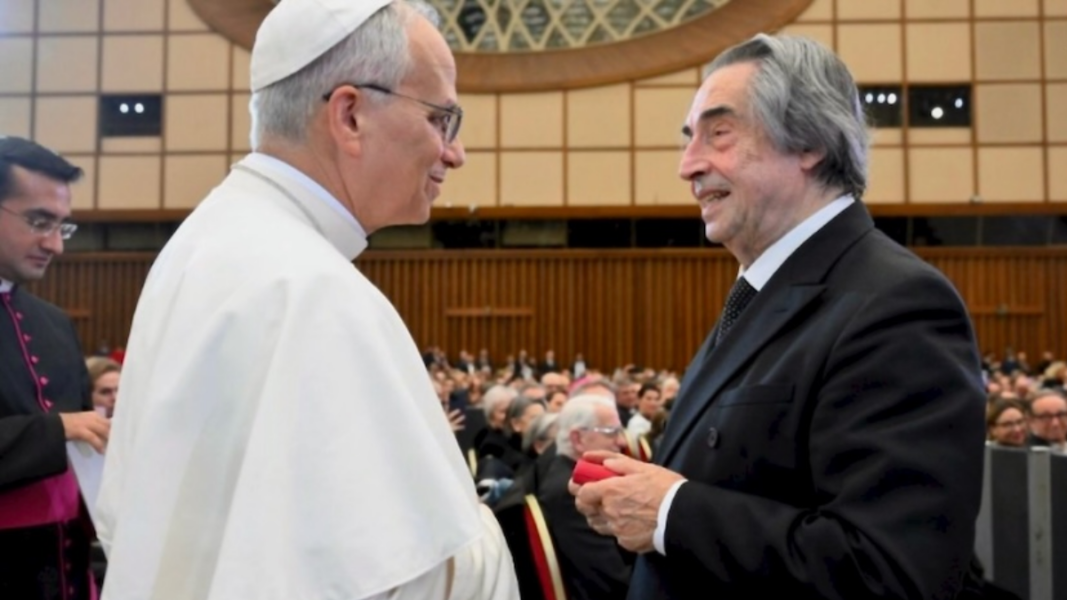
Even better: after a certain suspension of papal concerts during the pontificate of Pope Francis, the prize was presented by Pope Leo XIV himself at a concert offered by Muti in the Paul VI Hall. He chose Luigi Cherubini’s Misa de la Coronación de Carlos X, composed in 1825. Muti selected this work for its bicentennial, a moment when sacred music itself briefly reaffirmed its presence in the cultural and spiritual heritage of France after the vandalism of the revolution and the terror. The coronation of Charles X was the first since 1775 and the last of the French monarchy.
Upon receiving the prize, Muti spoke affectionately of Pope Leo, recalling his many years as music director of the Chicago Symphony Orchestra. Muti mentioned that he had conducted Haydn’s Las siete últimas palabras de nuestro Salvador en la cruz in Chicago’s Holy Name Cathedral, with Cardinal Cupich as narrator of the work.
Muti also recalled Benedict’s thoughts on sacred music. In 2015, Benedict, already retired, received an honorary doctorate from the Pontifical John Paul II University of Krakow and the Krakow Academy of Music. On that occasion, he spoke of the “three places” from which music springs: the experience of love, the experience of sadness, suffering, and loss, and the encounter with the divine:
The quality of music depends on the purity and greatness of the encounter with God, with the experience of love and suffering. The purer and truer that experience is, the purer and greater the music that arises and develops from it will be.
In conferring the prize, Pope Leo echoed this by quoting a favorite phrase of Benedict: “True beauty wounds, opens the heart and dilates it.”
That such ideas animated Benedict until the end was confirmed when Muti spoke of his last meeting with him. The Pope Emeritus was reading Muti’s El infinito entre las notas and invited the maestro to visit him to discuss it.
“[The words] are from Mozart,” said Muti. “Between one note and another lies the infinite, that is, the mystery, and that is what I seek: not to wildly agitate on the podium, but what Dante, in the Paradiso, calls rapture, not understanding.”
“We talked a lot about Mozart,” Muti recalled. “I consider him one of the tangible forms of God’s existence and, as I’m a bit argumentative, we talked about all those productions that sometimes tarnish the music.”
“The Pope’s last words I will carry with me until the end of my days,” Muti added. “Looking at me with those heavenly eyes of his, he said: ‘Let poor Mozart rest in peace.’”
The concert and the prize awarded to Muti were something like a balm for Benedict’s devotees, whose appreciation for sacred music and liturgical culture did not continue under Francis. The concert, the prize, and the words of both Leo and Muti marked a sort of return of Benedict’s spirit to the Vatican for a few hours. It was easy to imagine Benedict himself saying the same as Leo in opening his brief speech:
St. Augustine, in his treatise on music, called it scientia bene modulandi, linking it to the art of leading the heart toward God. Music is the privileged path to understanding the supreme dignity of the human being and confirming him in his most authentic vocation.
If Leo follows Augustine in this, as Benedict did, then Muti’s concert will be only the first to honor this new pontificate.
About the author
Fr. Raymond J. de Souza is a Canadian priest, Catholic commentator, and senior fellow at the think tank Cardus.