


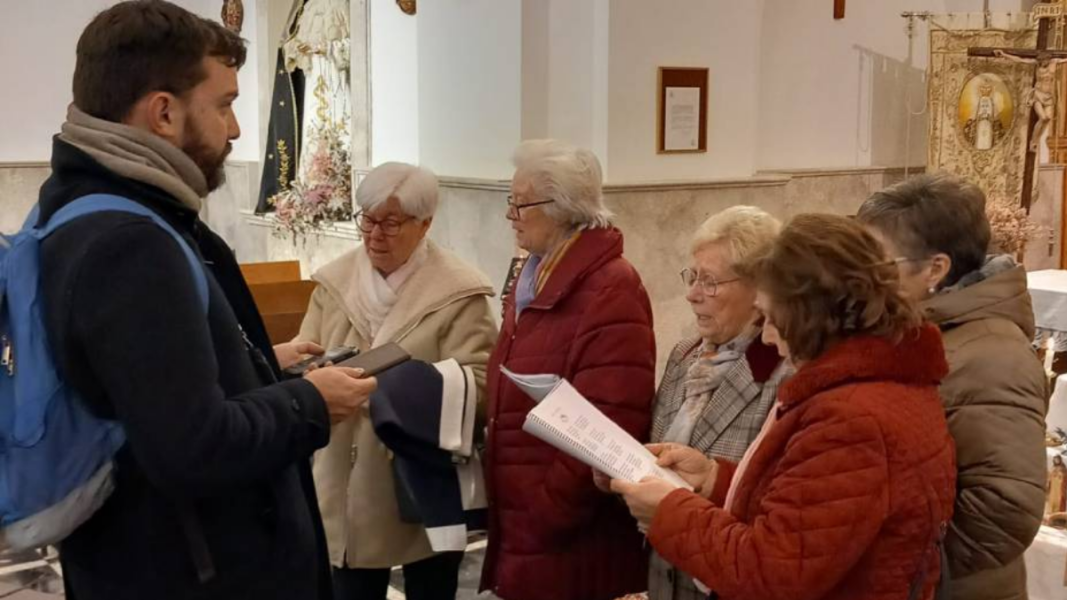
In many towns in Spain, a treasure almost unknown still persists in the memory of the elderly: liturgical chants in Latin learned by ear and transmitted from generation to generation. Kyries, Glorias, Credos, Sanctus and Agnus Dei that were sung for decades in parish churches and that today are on the verge of disappearing. Preserving them is the main objective of the project led by Pablo Delgado, historian and musician, who travels the country recording these chants before they are lost forever.
In an interview granted to Alfa & Omega, Delgado explains that, although he collects all kinds of popular religious music, what interests him most is precisely that popular Latin sung by the simple people of the towns. It is not about large choirs or academic versions, but about the way in which the Christian people assimilated the liturgical Latin and made it their own.
The Latin that the people sang
“What interests me most is the popular Latin”, affirms Delgado. He refers to the ordinary parts of the Mass —Kyrie, Gloria, Credo, Sanctus and Agnus Dei— sung by the faithful who, in many cases, did not know Latin, but had learned it through the liturgy. It is a phenomenon that today seems almost unthinkable, but that was common for generations.
These chants did not always follow academic or strict Gregorian models. They varied from one town to another, adapted to local tradition, and were transmitted orally. Precisely for that reason, explains Delgado, they have enormous historical, liturgical, and spiritual value: they show how Latin was not a foreign language, but a language prayed and sung by the Christian people.
Much more than ancient music
Although the project also includes chants of popular religiosity —rogations, novenas, Stations of the Cross or carols—, Delgado emphasizes that Latin occupies a central place. Recovering it is not an aesthetic or nostalgic issue, but a way to better understand how faith was lived and how one participated in the liturgy before the great changes of the second half of the 20th century.
As a historian, his interest arose when researching the liturgical transition after the Second Vatican Council and the shift from the Vetus Ordo to the Novus Ordo. In archives and libraries, he found chants of great beauty, but inaccessible to the public. From there came the decision to go to the towns and record directly from those who still remember them.
A living archive of liturgical memory
The recordings are being incorporated into a public digital archive accessible through his website, Cantuscrucis. There, different versions of the same chant can be heard according to the area, a richness that was lost with the arrival of recorded music and liturgical homogenization.
Delgado’s greatest fear is to arrive too late. With the disappearance of that generation and rural exodus, a concrete way of praying and singing the faith is also lost. That is why he insists on the urgency of the project: to preserve popular Latin not as a relic, but as a living testimony of a Church that knew how to make the language of the liturgy its own.