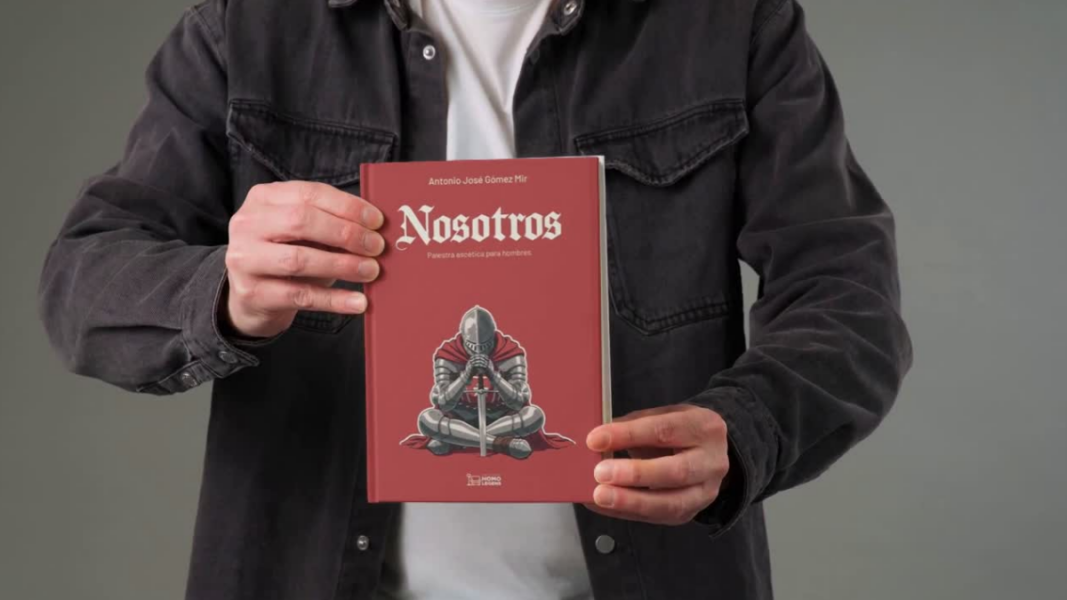
There are books that aspire to more than just teaching or entertaining: there are books called to awaken consciences and provoke changes. «Nosotros,» by the diocesan priest from Barcelona Antonio Gómez Mir, clearly belongs to this second category. It is not just a good book; it is a text called to become a true generational manifesto.
Published by the editorial Homo Legens, Nosotros presents itself as an essay on Catholic spirituality, but it soon reveals itself as something more ambitious: a treatise on Christian anthropology applied to concrete life. Through the adaptation of a cycle of lectures, Father Gómez Mir does not write from academic abstraction or ideological provocation, but from a lucid pastoral experience, which observes with concern how the Church has been losing the capacity to propose a virile, demanding, and vocational faith.
The diagnosis that runs through the book is uncomfortable, but vital. The postmodern Church has configured itself as a soft, effeminate, flabby institution. A Church obsessed with not discomforting, with not demanding, with not confronting. A Church that has replaced character formation with emotional accompaniment, asceticism with well-being, strength with misunderstood tolerance. The result is an amiable spirituality, yes, but incapable of sustaining lives subjected to the harsh demands of the world.
Faced with this panorama, Nosotros proposes recovering a strong and ordered vision of the human being, and very especially of the man. One of the great merits of the book is its insistence on returning to Christian life a full vocational sense. Not only the priestly or religious vocation, but vocation as a way of understanding existence as a whole: living not as drift, but as mission; not as accumulation of experiences, but as response to a call.
In this framework, Father Gómez Mir bravely addresses a question systematically avoided in contemporary pastoral care: the violence and inner aggressiveness of man. Far from demonizing them or repressing them outright, the author interprets them as natural forces that must be recognized, channeled, and put at the service of the good. They are not, in themselves, an evil. They become destructive when they lack direction. Christian spirituality—well understood—does not annul this instinct, but orders it toward sacrifice, discipline, the defense of the weak, and responsible self-giving.
Here appears one of the most powerful ideas in the book: the contrast between the pagan hero and Christ. Gómez Mir describes the overcoming of the figure of Achilles as a paradigm of a powerful but incomplete virility. Achilles is strong, brave, admirable, but his sacrifice always ends up revolving around the self: honor, glory, memory. Christ, on the other hand, archetype of authentic masculinity, brings human strength to its fullness by taking it out of the logic of the ego. He does not flee from combat, but transfers it to the interior of the soul. He does not repress strength, aggressiveness, or inner violence, but submits them to obedience, to love, and to sacrifice for the neighbor.
Christ thus infinitely surpasses the pagan hero: not because he is less strong, but because his strength is not consumed in itself. Where Achilles dies for his name, Christ dies for others. And it is that crucified virility—not sentimental or sweetened—that the book proposes to recover as a spiritual model.
From this solid anthropology, Nosotros fully enters into issues that many prefer to avoid: Catholic formation, affective immaturity, the absence of true asceticism, the confusion between mercy and renunciation of moral exigency. The author does not point fingers at people or resort to caricatures, but does not evade the structural diagnosis: a soft and effeminate Church that forms weak men cannot sustain strong families or solid vocations.
Reading this book produces something unusual: a mixture of enthusiasm and sobriety. Enthusiasm because any Catholic family father will feel challenged and because it returns to Christian faith its anthropological density. Sobriety, because it does not promise easy solutions or quick consolations. Nosotros is not a book to tranquilize consciences, but to awaken them.
Homo Legens is fully right to publish this text and to put it into circulation at a time of evident spiritual confusion. Nosotros is an indispensable book for priests, seminarians, and, very especially, for lay men who wish to live their faith with seriousness, without reducing it to a soft and sentimental spirituality.