


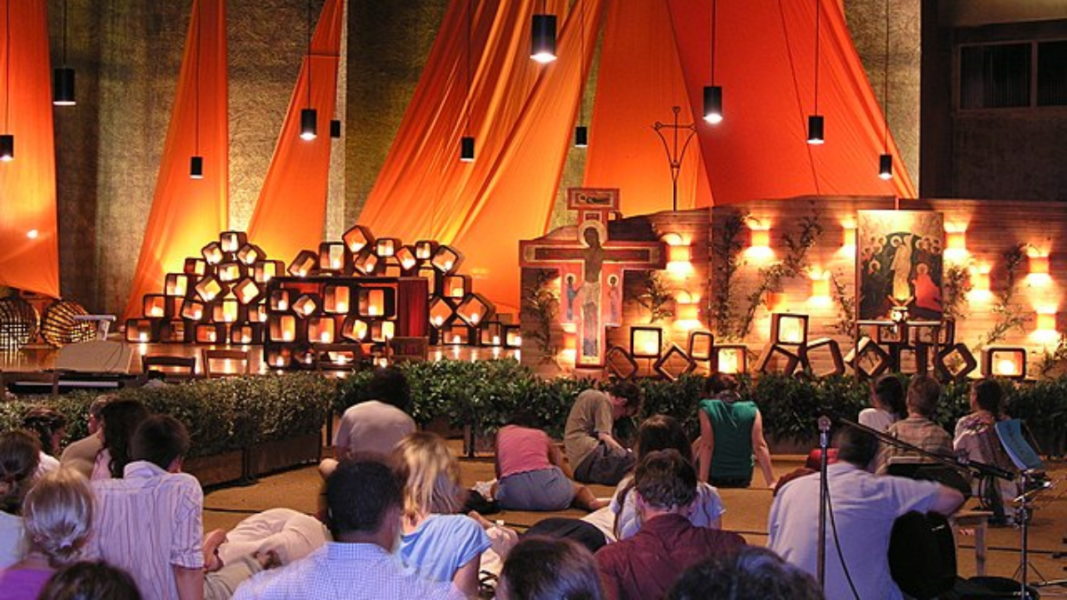
The 48th European Youth Meeting, which is being held from December 28 in Paris and the Île-de-France region and will conclude on January 1, once again places the Taizé Community at the center of ecclesial debate, a reality with great convening power among young Christians—including Catholics—but whose ecumenical and non-Catholic nature continues to be a source of confusion and requires necessary clarification.
Taizé is not a Catholic community. Founded in 1940 by Brother Roger Schutz, of Reformed Protestant origin, it defines itself as an ecumenical community, made up of brothers from different Christian confessions. It is not a Catholic religious order, it is not canonically erected by the Church nor does it depend on the authority of a bishop or the Holy See, although it maintains a cordial relationship and pastoral closeness with Catholicism and regularly welcomes Catholic faithful to its meetings.
A common spirituality without explicit doctrinal confession
Taizé’s proposal centers on shared prayer, silence, simplicity of life, and welcome, with a spiritual language carefully formulated to avoid expressing clear confessional definitions. Its celebrations are not Catholic or Protestant liturgies in the strict sense, but rather prayer gatherings designed to be acceptable to Christians from diverse traditions.
This approach has demonstrated notable attraction for young people in spiritual search, and explains the massive participation in the European meetings that the community organizes each year in different cities on the continent. However, that same vagueness is what raises a fundamental problem from the Catholic perspective: Christian unity cannot be built by disregarding the confessed truth.
Lived ecumenism and doctrinal limits
Taizé proposes an ecumenism based on shared experience, more than on theological dialogue or doctrinal clarification. Differences between confessions are not formally denied, but they are considered secondary compared to the shared experience of prayer and fraternity. The evident risk of this model is that communion ends up relying on a shared spiritual minimum, leaving essential questions of faith in the shadows.
From the Catholic tradition, authentic ecumenism does not consist of silencing what divides, but of walking toward unity in the truth, not apart from it. Ecclesial communion is not just feeling together, but believing together, professing the same faith received from the apostles.
The Pope’s message and the ecclesial context
On the occasion of the meeting, Pope Leo XIV has addressed a message to the participants, transmitted by the Cardinal Secretary of State, Pietro Parolin, and disseminated by the Holy See Bulletin. In it, far from being a warning, the Pontiff expresses his spiritual closeness to the young people gathered in Paris and encourages them to take seriously the question proposed this year by the prior of Taizé, “What do you seek?”, inviting them to bring it to prayer and silence.
The Pope places the meeting in a significant ecclesial context, marked by the recent closing of the Jubilee Year and the commemoration of the 1700th anniversary of the Council of Nicaea. This reference is not minor: Nicaea represents the moment when the Church preserved its unity through a clear affirmation of the faith, not through ambiguous formulas or minimal consensuses.
Youth attraction and necessary discernment
That Taizé is gathering thousands of young Europeans these days is a fact that challenges the Church and reveals a real spiritual thirst in a deeply secularized continent. But that same attraction demands pastoral and doctrinal discernment. Not every spiritual experience is necessarily formative, nor is every form of unity ecclesially sufficient.
Taizé can be a prayer experience that helps some, but the real risk for a Catholic—especially a young one—is that ecumenism unwittingly turns into practical indifferentism and sacramental confusion, especially around the Eucharist.
While the youth meeting continues in Paris until the start of the new year, the question directed to the young people—“What do you seek?”—should be accompanied by another equally decisive one for the Church: what ecumenism it allows and endorses and what its limits are when the integrity of the Catholic faith is at stake.