


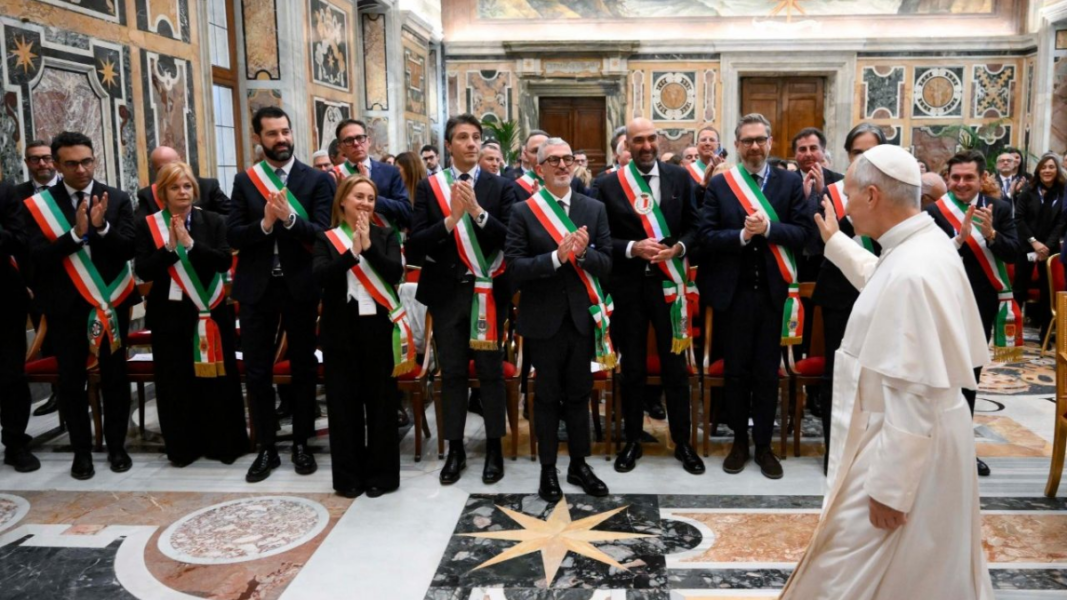
In the framework of an audience held in the Vatican Apostolic Palace, Pope Leo XIV received the members of the National Association of Italian Municipalities (ANCI), to whom he delivered a speech centered on the meaning of power as service and responsibility. In his intervention, the Pontiff contrasted the logic of dehumanized power, symbolized in the figure of Herod and the massacre of the innocents, with authority understood as attention to the dignity of the person and the common good.
Leo XIV called on public officials to listen to the most fragile, face social challenges—such as the demographic crisis, poverty, loneliness, and the rise of gambling—and promote a social alliance for hope, emphasizing that political action must be oriented toward an integral human promotion that also takes into account the cultural and spiritual dimension of communities.
We leave below the complete message of Leo XIV:
Eminence, dear brothers and sisters, good morning and welcome.
I am pleased to meet all of you, who represent the National Association of Italian Municipalities. We are experiencing this encounter during the Christmas season and at the conclusion of a Jubilee year: the grace of these days certainly also illuminates your service and your responsibilities.
The incarnation of the Son of God leads us to encounter a Child, whose gentle fragility confronts the overbearing power of King Herod. In particular, the massacre of the innocents that he ordered does not mean only the loss of the future for society, but is a manifestation of a dehumanized power, which does not know the beauty of love because it ignores the dignity of human life.
On the contrary, the birth of the Lord reveals the most authentic aspect of all power, which is above all responsibility and service. For any authority to express these characteristics, it is necessary to embody the virtues of humility, honesty, and the capacity to share. In your public commitment, in particular, you are aware of how important listening is, as a social dynamic that activates these virtues. Indeed, it is a matter of paying attention to the needs of families and people, caring especially for the most fragile, for the good of all.
The demographic crisis and the difficulties of families and young people, the loneliness of the elderly and the silent cry of the poor, environmental pollution and social conflicts are realities that do not leave you indifferent. While you try to provide responses, you know well that our cities are not anonymous places, but faces and stories that must be safeguarded as precious treasures. In this work, one becomes a mayor day by day, growing as a just and reliable administrator.
In this regard, may the venerable Giorgio La Pira serve as an example for you, who, in a speech to the municipal councilors of Florence, stated: “You have with me only one right: that of denying me your trust. But you have no right to tell me: Mr. Mayor, do not concern yourself with people without work (the dismissed or unemployed), without a home (the evicted), without assistance (the elderly, the sick, the children). It is my fundamental duty. If there is someone who suffers, I have a precise duty: to intervene in every way, with all the means that love suggests and that the law provides, so that that suffering is either diminished or alleviated. There is no other norm of conduct for a mayor in general and for a Christian mayor in particular” (Writings, VI, p. 83).
Social cohesion and civic harmony require above all listening to the smallest and the poor: without this commitment, “democracy atrophies, it becomes nominalism, a formality, it loses representativeness and becomes disembodied, because it leaves out the people in their daily struggle for dignity, in the construction of their own destiny” (Francis, Address, November 5, 2016). Both in the face of difficulties and opportunities for development, I exhort you to become masters of dedication to the common good, promoting a social alliance for hope.
At the end of the Jubilee, I gladly share with you this important theme, which my beloved predecessor, Pope Francis, indicated in the Bull of convocation. All, he wrote, “need to recover the joy of living, because the human being, created in the image and likeness of God (cf. Gn 1:26), cannot be content with surviving or living badly, with adapting to the present by letting himself be satisfied by realities that are solely material. This encloses one in individualism and corrodes hope, generating a sadness that nests in the heart, making us bitter and intolerant” (Spes non confundit, 9).
Our cities, unfortunately, know forms of marginalization, violence, and loneliness that demand to be addressed. I would like to draw particular attention to the plague of gambling, which ruins many families. Statistics record a strong increase in Italy in recent years. As Cáritas Italiana emphasizes in its latest Report on poverty and social exclusion, it is a serious educational, mental health, and social trust problem. We cannot forget other forms of loneliness that many people suffer: psychic disorders, depressions, cultural and spiritual poverty, social abandonment. These are signs that indicate how much need there is for hope. To testify to it effectively, politics is called to weave authentically human relationships among citizens, promoting social peace.
Don Primo Mazzolari, a priest attentive to the life of his people, wrote that “the country does not need only sewers, houses, roads, aqueducts, sidewalks. The country also needs a way of feeling, of living, a way of looking at each other, a way of becoming brothers” (Discourses, Bologna 2006, p. 470). Administrative activity thus finds its full realization, because it grows the talents of people, giving cultural and spiritual consistency to the cities.
Dearest ones, therefore, have the courage to offer hope to people, projecting together the best future for your lands, according to the logic of an integral human promotion. While I thank you for your availability to serve the community, I accompany you with prayer, so that, with God’s help, you may effectively face your responsibilities, sharing the commitment with your collaborators and fellow citizens. To you and your families, I impart from the heart the apostolic blessing and express my best wishes for the new year. Thank you!