


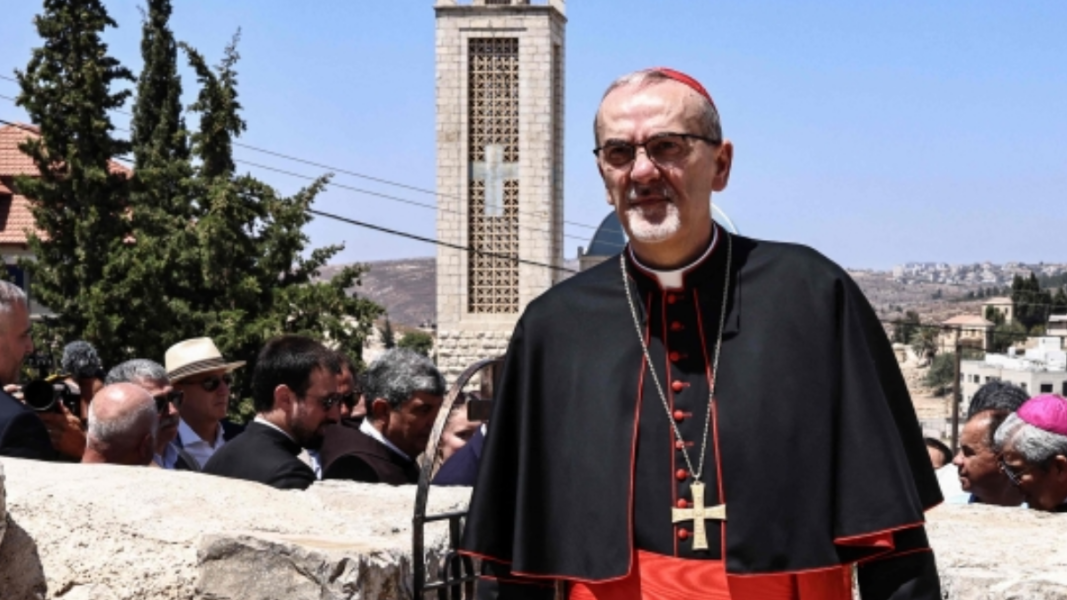
In an interview granted to the English medium The Catholic Herald, Cardinal Pierbattista Pizzaballa, Latin Patriarch of Jerusalem, has stated that the situation of Christians in the Holy Land has barely improved after the ceasefire reached in October, and that living conditions remain very complicated, especially in Gaza and the West Bank.
A ceasefire without real improvements
The cardinal explains that, although the fighting has stopped, everyday life has not changed significantly. Social, economic, and political difficulties continue, and there persists a strong uncertainty about the future. In this context, Christians, like the rest of the population, continue to face a situation marked by precariousness and lack of stability.
The only partial exception occurred in Bethlehem during the Christmas season. There, they chose to celebrate the holidays in a visible and festive manner, with lights and music, to offer a moment of relief to the population. According to Pizzaballa, people need hope and “light” amid a prolonged situation of suffering.
The Pope’s visit to Lebanon
The Latin Patriarch also refers to Pope Leo XIV’s recent visit to Lebanon, which he was able to follow closely. He particularly highlights the enthusiastic welcome from the Lebanese people, both Christians and non-Christians, and emphasizes that the papal trip generated a climate of hope in a country that has been carrying deep wounds for years.
Pizzaballa notes that the Pope consistently insisted on messages of peace and hope, and particularly highlights the meeting with young people, whom he describes as full of enthusiasm despite the difficulties they face.
Relations between Catholics and Orthodox
Regarding ecumenism, the cardinal states that relations between Catholics and Orthodox in the Holy Land are, in general, good, both at the institutional level and in everyday life. He recalls that the majority of Christian families are of mixed confession and that coexistence between the Churches is a daily reality.
For this reason, he emphasizes that for Christians in the region, the relationship between the Churches is above all a pastoral issue, rather than a theological debate.
The German Synodal Way, out of context
Pizzaballa considers that many debates occupying some Western Churches have no relevance in the Holy Land. In this sense, he states that the German Synodal Way is alien to the reality of Christians in the Middle East, not as a value judgment, but as a statement of very different contexts.
As he explains, the Christian communities in the region are traditional and live their faith around the community. For them, the priority is to strengthen unity between the Churches and ensure harmonious coexistence.
Concrete cooperation between the Churches
As an example of this unity, the cardinal mentions the cooperation between Catholics and Orthodox in areas such as humanitarian aid, education, and pastoral care, especially in Gaza. He highlights that both Churches work together in parishes, schools, and liturgical activities, and even use common catechetical materials.
This collaboration, he notes, has grown over time and responds to the real needs of increasingly small Christian communities.
Hope and perseverance
Finally, the Latin Patriarch expresses his desire that Christians in the Holy Land may have better living conditions and greater social and political stability. At the same time, he encourages preserving the unity and resilience of the Christian community, warning that hope should not be confused with an immediate political solution.
We provide below the full and translated interview. Originally published in The Catholic Herald
Your Eminence, has the situation of Christians in the Holy Land improved since the October ceasefire?
The living conditions of Christians, and many others, have not improved significantly. The main difference has to do with the war itself. There are no active combats as in recent months, but living conditions are exactly the same. Perhaps the situation is different in the Bethlehem area due to Christmas. We decided to celebrate Christmas in a normal and festive way, with lights and music, so that people can breathe again for a moment. People need light in their lives. But especially in Gaza and the West Bank, living conditions remain very difficult, both socially and economically and politically. It is not clear what government will come next.
You recently experienced the Pope’s visit to Lebanon firsthand. What impressed you the most there?
The first thing that impressed me was the enthusiasm of the Lebanese people, everyone, not just Catholics but also non-Christians. For many years, people felt forgotten, even after the Lebanon war, especially in the south. There are many wounds there. With the Pope’s visit, a new spirit entered the community, and this was felt everywhere during the visit. The meeting with the young people, which I attended, was also a great gift for me. The young people were not only happy but also full of hope. Pope Leo placed particular emphasis on this. Hope and peace were themes that ran through his speeches like a common thread. The overall atmosphere was very positive.
During his apostolic journey, the Holy Father made a strong call for the unity of Christians. What could be the next step for Christians on their common path?
It is important that we continue advancing on this path. We know we still have a long way to go. We must not be naive and think that this can be achieved quickly. First, we must recognize what we already share, especially in the Middle East, where Christians of different denominations already live together. Families are confessionally mixed, and Christians work together in schools and many other areas. This must be recognized and strengthened pastorally. We also need to find a common voice on international and universal issues like peace, justice, and human dignity. These unite us regardless of our differences and denominations. We must continue working on it and gradually improve our everyday pastoral relations within our communities. Perhaps one day we will even have a common calendar. We must take our time. What is important to me is that, in the meantime, we do not neglect the small steps, to be able to achieve greater things.
How are ecumenical relations between Catholics and Orthodox Christians in the Holy Land?
Our relations at the institutional level are very good, and at the grassroots level they also work well. I openly recognize that on both sides there are some priests who tend to be overly rigorous, but fundamentally the relations are good. I would like to emphasize again that ninety percent of Christian families among us are confessionally mixed. Catholics and Orthodox marry each other. Relations between the Churches are for us a pastoral issue, not theological.
How does the Holy Father’s work for peace affect the Holy Land, also in relation to religious leaders?
The Holy Father’s work for peace is very important. Especially in this time of war, with all its human devastation, when we sometimes feel lost, we need points of reference, someone to help us look beyond our own horizons and give us orientation. In this sense, the Pope, as a recognized leader, can help us with his words to shape our Christian narrative in this such complex environment.
You recently said in an interview with the National Catholic Register that the German Synodal Way is irrelevant to the life of Christians in the Holy Land. What theological debates do you personally consider important for the reform of the Church?
The issues of the Synodal Way in Germany, and many other topics in Western countries, do not resonate particularly in the Middle East. We live in a completely different reality. This is not a judgment, it is simply a fact. That is the reality. Theology is not lived here in such a dramatic way. Our Churches are traditional, and we live in and through the community of the Church. For us, the most important thing is to strengthen relations between the Churches. For Christians here, harmonious coexistence between the Churches is the priority.
Can you give examples of joint projects or institutions that you consider positive examples of these efforts?
There are many examples. I will start with the most dramatic context today, Gaza. Orthodox and Catholic parishes work together everywhere, not only in humanitarian aid but also in schools and pastoral activities. They also coordinate liturgical activities so that they do not interfere with each other. That did not happen a few years ago. In villages where there are Catholic and Orthodox schools, we try to cooperate. Since, unfortunately, we have fewer Christian students, we organize things so that one Church takes charge of primary school and the other secondary school, or vice versa. In this way, we offer the same education. Orthodox and Catholic schools use the same catechetical books, which we develop together. There are many more examples.
In these schools, how are the classes composed?
That depends on the school, but generally around half of the students are Christians. In some schools, Muslims make up the majority of students, depending on the location. In all our schools, the presence of non-Christians is very important, not only numerically but also in terms of mission.
What do you hope for your flock in the Holy Land?
I hope for better political and social living conditions for us. I hope that the community preserves its unity, its commitment to life, and its resilience in this such complicated situation. But that requires greater patience. We must not confuse hope with a political solution.