


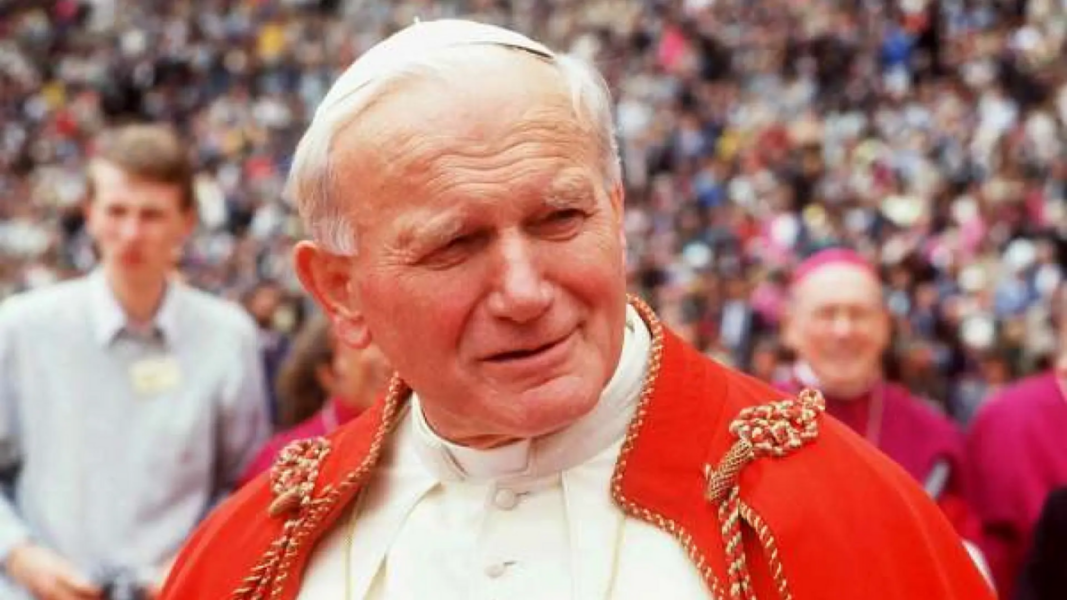
The defense of human life from the moment of conception was one of the constant axes of the pontificate of Saint John Paul II. It was not a secondary issue nor a situational stance, but an inalienable moral principle, reiterated in magisterial documents, public speeches, and apostolic journeys. For the Polish Pope, the life of the unborn was not a theoretical abstraction, but the decisive test of the moral coherence of modern societies.
On this day of the Holy Innocents, we recall his first apostolic visit to Spain, where John Paul II expressed himself with a clarity that continues to challenge decades later. In the face of a culture increasingly willing to relativize the value of human life, the Pope posed a direct question, without euphemisms or ambiguities:
«Who would deny defense to the most innocent and weakest human person? To the person already conceived, although not yet born».
A moral issue, not ideological
In that same speech, John Paul II described abortion as what it is from a moral perspective: «a grave violation of the moral order». He did not appeal to a closed confessional position, but to a basic rational principle: the direct death of an innocent can never be legitimized. For the Pontiff, any legal or political system that consents to, facilitates, or promotes the elimination of defenseless human lives incurs a radical contradiction.
The Pope went even further in pointing out the inconsistency of those who proclaim human dignity while denying protection to the most vulnerable:
«What sense would it make to speak of the dignity of man, of his fundamental rights, if an innocent is not protected?».
The question was not rhetorical. John Paul II warned that a society that justifies abortion undermines from within the very concept of human rights, reducing them to concessions of power and not to objective demands of justice.
The responsibility of the State and institutions
The Pope’s speech also pointed to a concrete responsibility: that of public authorities. When the State not only decriminalizes abortion, but finances it, regulates it as a “service,” or integrates it into health systems, it becomes an active agent of grave injustice. This is how John Paul II expressed it when denouncing those who «facilitate the means, private or public services to destroy defenseless human lives».
This denunciation was not limited to the individual level. It pointed to a structural drift: the legal and cultural normalization of the elimination of the unborn as a solution to social, economic, or personal problems.
A living magisterium
The words spoken by John Paul II in Spain do not belong to the past. They form part of a coherent magisterium that the Pope developed later in documents such as Evangelium vitae, where he affirmed that the right to life is the foundation of all other rights.
In a cultural context marked by the expansion of abortion, euthanasia, and other forms of contempt for human life, the teaching of Saint John Paul II remains fully relevant. His message continues to be clear, and it is clear because it is based on an elementary truth: without the protection of the weakest, there is no authentic human dignity or true justice.