


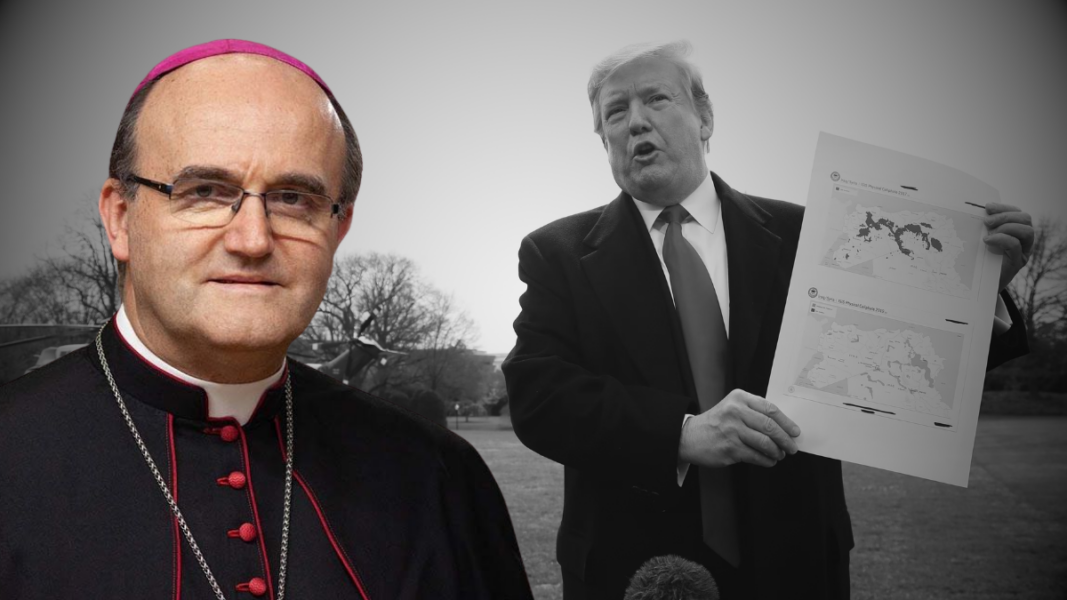
There is something particularly obscene—intellectually and morally obscene—in watching a bishop pontificate on the Gospel with the twisted rod of ideology. And that’s exactly what Munilla does here: he doesn’t judge the facts, he judges the man; he doesn’t discern a concrete action, he settles scores with Trump. The rest is pious rhetoric, spiritual wrapping, and an imposed moral superiority that grates from the first line.
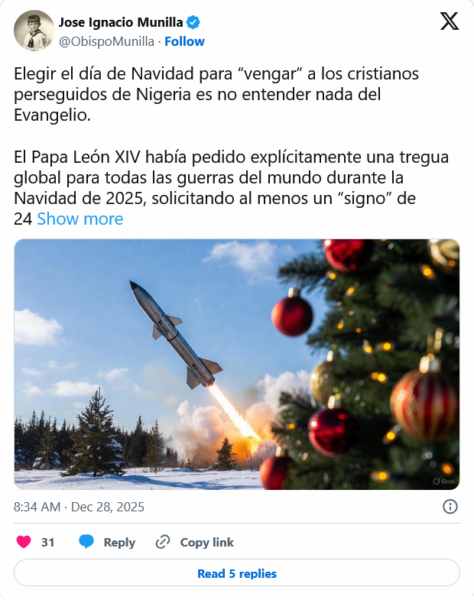
Because it must be said clearly: Munilla is not scandalized by the violence, he is scandalized by who exercises it. The problem is not the bombing of ISIS; the problem is that Trump does it. If tomorrow the same operation were signed by a leader with a progressive card, therapeutic language, and the blessing of La Civiltà Cattolica, there would be no tweet here, no evangelical reproach, no sudden Christmas sensitivity.
Munilla has spent years demanding that the West do something about the systematic slaughter of Christians in Nigeria, Mozambique, Syria, or Iraq. Years denouncing—with reason—the cowardly passivity of Western democracies. But when someone, for once, acts and strikes militarily at jihadism, then it turns out that «nothing is understood about the Gospel.» Curious late revelation.
The Gospel According to Sentimental Geopolitics
The argument is as old as it is predictable: Christmas, truce, pang of conscience, innocent victims, Christmas spirit. All very correct, very episcopal, very much like a homily broadcast with a grave voice. But deeply dishonest. Because no one—absolutely no one—has claimed that bombing ISIS is a pious act or a work of spiritual mercy. It is, simply, legitimate armed defense against an organization that beheads Christians, rapes girls, and burns entire villages to the cry of Allah—and which, we can add, carries out many of these slaughters at Christmas.
Munilla knows this. He knows it perfectly well. And yet he chooses to caricature the action as «vengeance,» a morally loaded word, almost obscene, that does not describe the facts but deforms them to fit his narrative. It is not analysis: it is propaganda with a clerical collar.
And then there is the selective indignation over Trump’s tweet. That is the real trigger. Not the missile, but the sarcasm. Not the military operation, but the tone. Munilla cannot stand Trump because he does not speak like a pious technocrat, because he does not express himself in ecclesiastical language nor kneel before global progressive sensitivity. Trump does not ask for forgiveness before acting, he does not flagellate himself in public, he does not disguise the enemy. And that, for certain bishops, is unforgivable.
Moralism Without Victims
The most serious thing, however, is not the judgment against Trump, but the silence about the Christian victims. In Munilla’s entire text, there is more space for the attacker’s conscience than for the blood of the attacked. More empathy with the «collateral damage» than with the concrete martyrs, with name, face, and family, who have been massacred precisely at Christmas.
That is the bias. That is the ideology. A worldview in which evil is always «complex,» «contextual,» «problematic,» but the response to evil must always be aseptic, neutralized, almost symbolic. A Church that talks a lot about peace and very little about justice; that understands the executioner better than the victim; that demands from the defender a moral purity that it never demands from the murderer.
Munilla is not being evangelical. He is being predictable. He is reading the Gospel through the glasses of anti-Trumpism, and when one does that, one no longer sees the manger or the cross, but only one’s own morally satisfied reflection.
And the most ironic thing of all is that the one who accuses others of «ideological applause» has long been reaping it in the same circles that have never lifted a finger for the persecuted Christians. That is the real degeneration. Not of the spirit of Christmas, but of episcopal judgment.