


By Fr. Thomas G. Weinandy, OFM, Cap.
The Gospel of Saint Luke offers a fairly detailed account of the birth of Jesus. Since Mary «kept all these things, pondering them in her heart», she must have given Luke her testimony as an eyewitness. Therefore, the historicity of what is proclaimed must not be doubted. In the written words of Luke, we hear the words spoken by Mary.
Thus, Luke/Mary presents the historical context of what was about to happen. Caesar Augustus decreed that a census should be taken throughout the Roman Empire. Everyone was to register in their city of origin. For that reason, «Joseph went up from Galilee, from the city of Nazareth, to Judea, to the city of David, called Bethlehem, because he was of the house and lineage of David, to register with Mary, his betrothed, who was with child».
Joseph’s lineage is theologically significant. He is of «the house of David», and therefore must register «in the city of David», Bethlehem. It was there that David was born, and there God told Samuel to anoint David as king. «Samuel took the horn of oil and anointed him in the midst of his brothers; and from that day forward the spirit of the Lord came with power upon David» (1 Samuel 16:13).
Moreover, God later declared, speaking through Samuel: «When your days [David’s] are fulfilled and you rest with your fathers, I will raise up your offspring after you, who will come from your own body, and I will establish his kingdom. He shall build a house for my name, and I will establish the throne of his kingdom forever» (2 Samuel 7:12-13).
These prophetic promises are now being fulfilled as Joseph travels to Bethlehem to register. The son who is to be born of Mary in the city of David is the Lord’s Anointed, the one who is filled with the Holy Spirit, for he has been conceived by the action of the Holy Spirit. He is the king of the eternal Davidic kingdom, and his throne will endure forever.
All of this is grounded in Joseph’s royal lineage, for he is of the house of David. Thus, Joseph has fundamental theological importance, because without him the child to be born of Mary would not be the fulfillment of God’s ancient prophecies. He would not be the king of God’s eternal Davidic kingdom.
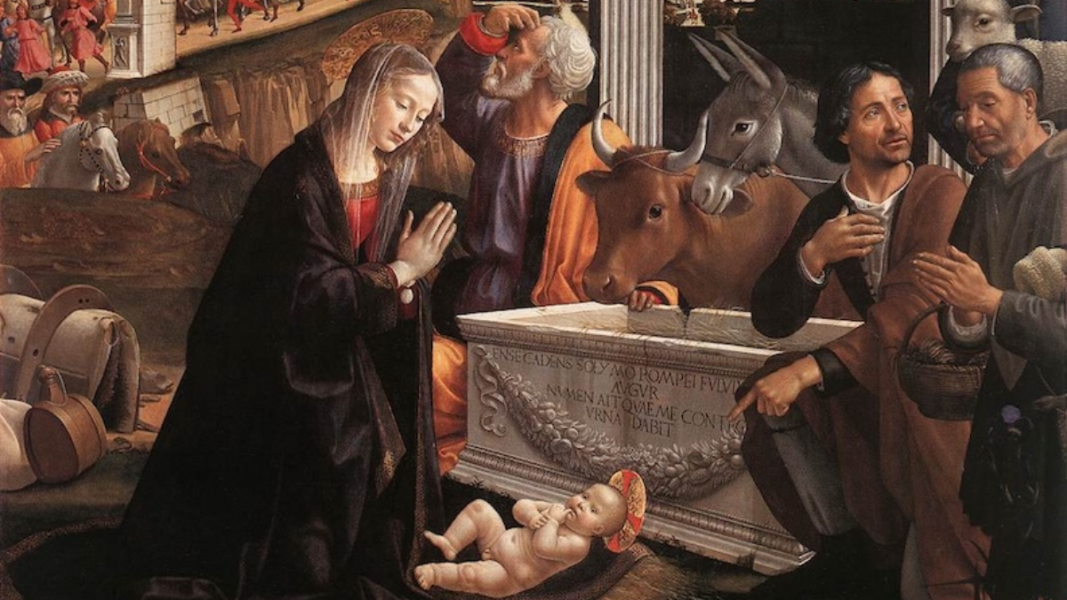
Now, while Joseph and Mary were in Bethlehem, «the time came for her to be delivered. And she gave birth to her firstborn son, and wrapped him in swaddling cloths, and laid him in a manger, because there was no room for them in the inn». There was nothing miraculous about the manner of his birth. If there had been, Mary would have informed Luke, and he would have explained the nature of the miracle.
What is unusual is that, not finding room in the inn, Mary gave birth to Jesus in a stable, and therefore laid him in a manger. He who will sit on the royal throne as king of the eternal Davidic kingdom is born in humble simplicity and quiet poverty.
All of the above is implicit in the context of Joseph’s lineage as belonging to the house of David. No one has yet proclaimed his royalty or spoken of his identity. Everything up to this point in Luke’s narrative is simply normal: a child has been born of Mary in a Bethlehem stable. Yet, in the midst of this normalcy, something extraordinary will now be announced.
«And in that region there were shepherds out in the field, keeping watch over their flock by night». This too is normal. That is what shepherds do. However, «an angel of the Lord appeared to them, and the glory of the Lord shone around them, and they were filled with fear».
What has occurred on earth may have seemed normal, but the heavenly realm knew it was not. One of the Lord’s angels, wrapped in the Lord’s glory, appeared to the shepherds. Although they were filled with fear at beholding such an imposing sight, the angel said to them:
Fear not; for behold, I bring you good news of a great joy which will come to all the people: for to you is born this day in the city of David a Savior, who is Christ the Lord.
Instead of fearing, the shepherds are to welcome the good news that the angel brings them, news that will fill them with great joy. That very night, in the city of David, a Savior has been born, and He is the Christ anointed by the Spirit, the divine Lord of heaven and earth.
How will the shepherds know which child it is? «And this will be a sign for you: you will find a baby wrapped in swaddling cloths and lying in a manger». Note again the contrast. A Savior has been born, who is Christ the Lord, and yet the shepherds will recognize him by humble signs, hardly what one would expect of the one who is Christ the Lord.
At that moment, a multitude of the heavenly host sang: «Glory to God in the highest, and on earth peace among men with whom he is pleased». The transcendent God is to be glorified for such a wonderful event, for he is bringing peace to the humanity with which he is pleased.
Thus, the shepherds hurried to Bethlehem. «And the shepherds returned, glorifying and praising God for all they had heard and seen, as it had been told them».
This Christmas, all Christians are called to echo the words of the angel and the shepherds. We are called to proclaim, for the glory of God, that the child born in Bethlehem so long ago is the Davidic king of God’s eternal kingdom, for he is Christ the Lord, the incarnate Son of the Father.
The shepherds did not know his name. It was only given to him at his circumcision, eight days later. We do know his name: Jesus, YHWH saves. It is he whom we profess, and it is he whom we proclaim this Christmas, for we are saved by no other name but his alone.
This is the truth and joy of Christmas!
About the author
Thomas G. Weinandy, OFM, prolific writer and one of the most prominent living theologians, is a former member of the Vatican’s International Theological Commission. His most recent book is the third volume of Jesus Becoming Jesus: A Theological Interpretation of the Gospel of John: The Book of Glory and the Passion and Resurrection Narratives.