


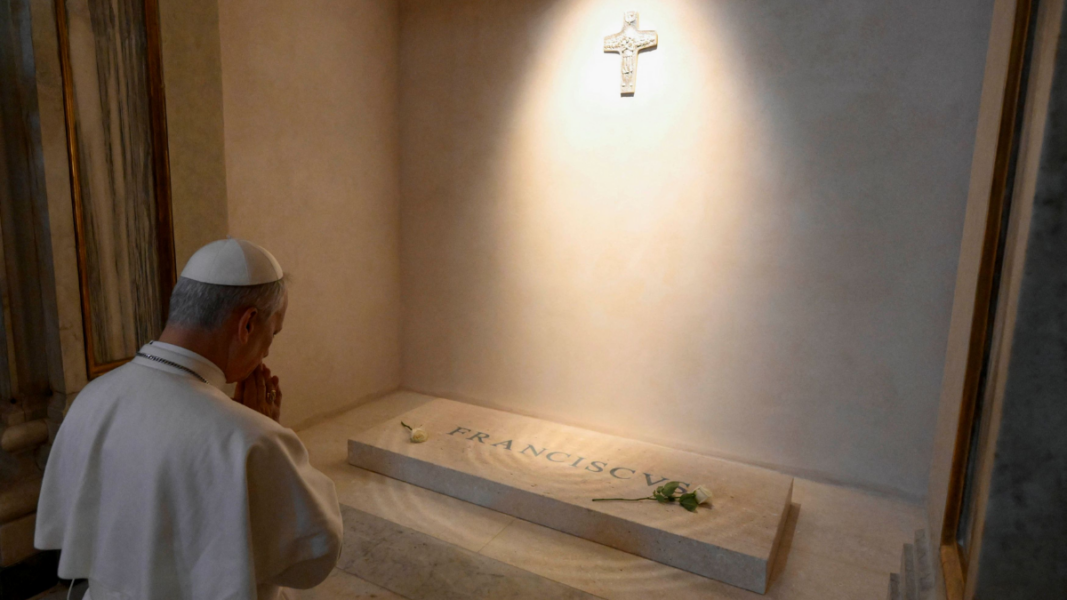
Several months have already passed since the death of Pope Francis. The time elapsed now allows for a more serene—and more revealing—reading of the social, media, and cultural reactions that accompanied that event. It is not so much about evaluating a pontificate as about observing what the way in which the death of a Pope was lived and narrated says about our era.
An analysis published by Il Mondo Nuovo proposes an in-depth reflection that retains all its relevance: beyond the immediate moment, the collective reaction to the death of Francis revealed to what extent the process of secularization has eroded the sense of the sacred in contemporary Western society.
From spiritual event to information flow
Traditionally, the death of a Pontiff had been experienced as a time of suspension, prayer, and recollection. However, what occurred in April 2025 showed a different dynamic. Instead of opening a prolonged space for contemplation and silence, the event was absorbed almost immediately by the rhythm of the news cycle.
The liturgy of mourning was quickly relegated in favor of continuous reporting; reflection gave way to instant commentary; mystery was replaced by the constant updating of data, images, and reactions. Viewed from the distance of months, this behavior does not seem like a mere situational excess, but the reflection of a deeper difficulty: the cultural inability to recognize death—and, in particular, the death of a spiritual figure—as an event laden with transcendent meaning.
Emptied ritual and sacred turned into spectacle
Another feature that becomes more evident with the passage of time is the transformation of religious ritual into media spectacle. During those days, public attention focused disproportionately on secondary aspects: protocols, logistical details, personal curiosities, predictions about the Conclave, tourist flows, and even commercial initiatives associated with the event.
None of this was entirely new. What was truly significant was the way these elements were consumed: not as signs referring to a higher reality, but as interchangeable content within the information circuit. The faithful tended to become spectators; the sacred event, a manageable experience; mourning, a visible but ephemeral passage.
Over time, the impression remains that the Pope’s death did not open a space of lasting meaning, but rather dissolved quickly into a succession of stimuli without sedimentation.
The Pope reduced to a functional figure
That same logic was manifested in the treatment of the papal succession. In the weeks following Francis’s death, the Conclave was analyzed predominantly with categories proper to the political or business world: candidates, odds, geographical balances, ideological profiles, media acceptance.
The Pope thus appeared reduced, in many public discourses, to a functional figure, evaluated according to criteria of efficiency, representativeness, or communicative impact. The theological dimension—vocation, discernment, holiness—was frequently relegated to the background.
In the face of this drift, Il Mondo Nuovo opportunely recalled the warnings of St. John Paul II in the apostolic constitution Universi Dominici Gregis, where it is insisted that the election of the Successor of Peter cannot be conditioned by external pressures, personal sympathies, or the search for popularity, but must be oriented exclusively toward the glory of God and the good of the Church.
The tension between mystery and visibility
Eight months later, the question has not lost its relevance. The death of a Pope should have been an occasion to remember that the Church is not governed by the logic of spectacle or the rhythm of current events, but by God’s time. However, what occurred showed to what extent even the most sacred events can become trapped in a culture incapable of silence, waiting, and prayer.
This is not about nostalgia or idealizing the past, but about noting a fact: when the death of the Successor of Peter becomes just another episode in the information flow, something essential has been lost. Not only in society, but also in the way the Church is publicly perceived.