


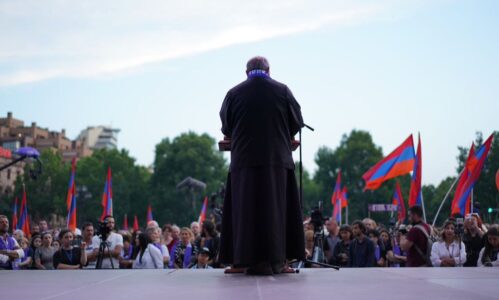
The relationship between the Armenian State and the Armenian Apostolic Church is going through one of the most delicate moments since the country’s independence. Various analysts warn that the current Government, led by Prime Minister Nikol Pashinyan, is advancing toward a political subordination of the Church, with possible effects on religious freedom and on a central element of Armenian national identity.
The Apostolic Church is not just another institution in Armenia: it constitutes a historical, spiritual, and cultural core of the highest order. Armenia was the first country in the world to officially adopt Christianity, and belonging to the Church has played a decisive role in the continuity of the Armenian nation in the face of invasions, persecutions, and historical tragedies. Therefore, any attempt to limit its independence goes beyond the purely religious and acquires social and political relevance.
According to historian and analyst José Luis Orella, this tension is inscribed in the geopolitical reorientation driven by the Government: a rapprochement with the United States and a distancing from Russia, Armenia’s traditional military support. Orella links this shift to a particularly painful consequence: the loss of Nagorno-Karabakh following the Azerbaijani offensive in 2023 and the displacement of the majority of the Armenian population from the enclave.
This strategic repositioning has provoked strong internal rejection. Catholicos Karekin II, the supreme spiritual authority of the Armenian Apostolic Church, even called for the prime minister’s resignation. The mobilizations have featured Archbishop Bagrat Galstanian, religious leader of the Tavush region, as a prominent figure, and the conflict intensified with the detention of Galstanian himself and other clerics on charges of conspiracy against the State.
For Orella, these events cannot be analyzed in isolation. In his reading, the pressure on the Church responds to the need to weaken a moral and social resistance to highly controversial political decisions: the recognition of Azerbaijani sovereignty over Nagorno-Karabakh, possible constitutional reforms demanded by Baku, or the construction of a strategic corridor connecting Azerbaijan with Nakhchivan and Turkey, altering the regional balance.
The analyst also warns of an attempt to reconfigure the Church from within, promoting ecclesial voices aligned with political power and eroding its institutional autonomy. That pattern—he argues—recalls processes observed in some European countries where historic churches have ended up integrated into the State’s agenda, with a progressive loss of independence.
The issue takes on an even more sensitive dimension if one considers that around 92% of the Armenian population declares itself faithful to the Apostolic Church. Political interference in the Church’s internal life would not affect only a religious institution but could compromise fundamental rights and exacerbate social fractures.
In this context, José Luis Orella’s warning is clear: subjugating the Armenian Apostolic Church is not a simple modernizing reform, but a move that strikes at one of the central pillars of Armenian identity and tests the quality of the country’s democracy. The evolution of this conflict will be determinant in understanding Armenia’s political, cultural, and spiritual future.