


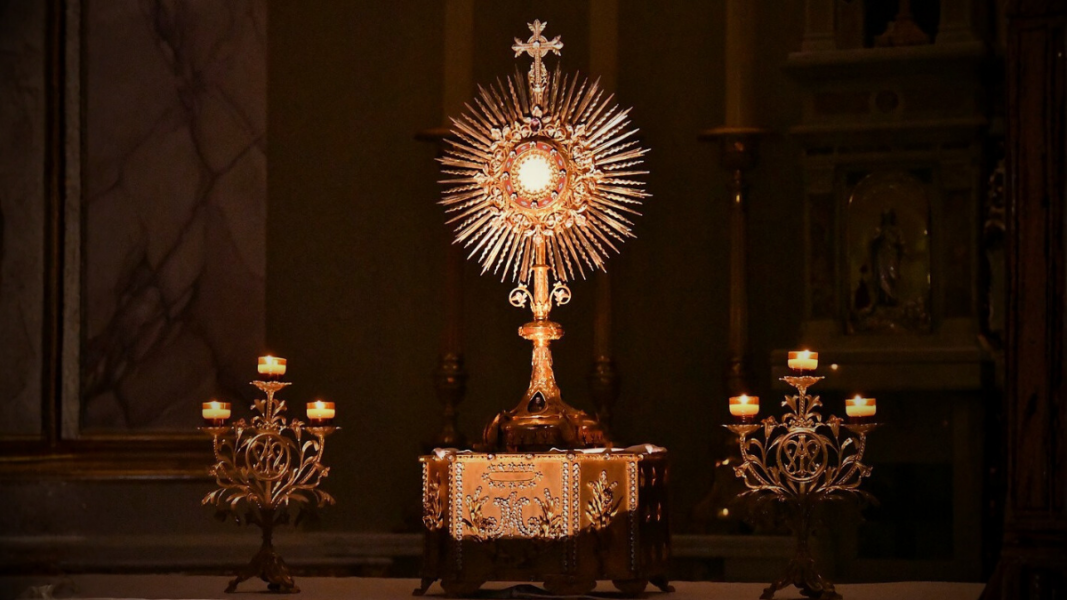
That an openly atheist intellectual like Juan José Millás writes in El País a column recognizing, even if with irony, the ontological magnitude of the Eucharistic miracle should provoke something more than an embarrassed smile in the Catholic world. It should force us to stop and ask ourselves what is failing when even an external observer detects a deep dissonance between what the Church claims to believe and the way that mystery is lived—or trivialized—in practice.
Millás does not write as a believer nor pretends to be one. Precisely for that reason, his diagnosis is so revealing. He starts from a correct doctrinal premise: the Church teaches that in the consecration a real, literal, substantial change occurs. Not symbolic. Not metaphorical. A first-order miracle. And yet, he notes something that anyone can verify: the usual scene in many liturgical celebrations does not remotely reflect the transcendence of what happens there. Tired gestures, widespread distraction, routine. As if nothing extraordinary were occurring.
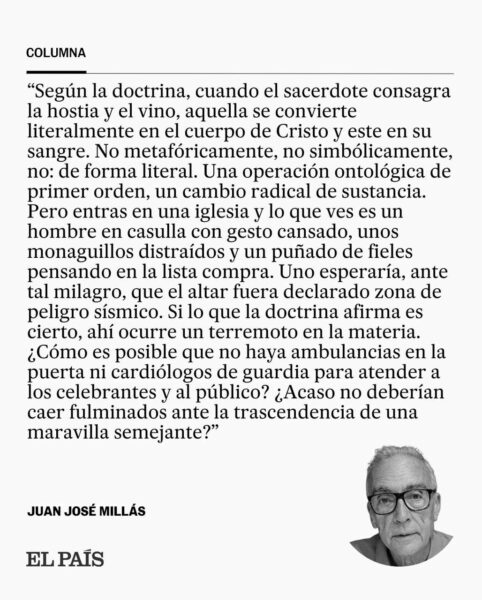
The question he poses—with sarcasm, but with logic—is devastating: if we really believe what we say we believe, why don’t we act accordingly? Why is there no trembling, awe, reverential fear? Why doesn’t the altar seem like a sacred zone, separated, guarded?
Here is where the external observation turns into an internal accusation. It is not the atheist who banalizes the mystery. It is us. Or, at least, a way of living the liturgy that has progressively eroded the sense of the sacred until making it almost invisible.
It is not about demanding theatricality or religious hysteria. It is about coherence. The Church always knew that the mystery demands custody. For centuries, both in the East and in the West, concrete forms were developed to protect the sacred: separation of the presbytery, precise gestures, silence, veils, signs of distance. Not out of contempt for the people, but out of awareness of the mystery.
In the West, that awareness has been weakening. And what was lost was not closeness, but awe. Not participation, but reverence. When everything is shown, everything is banalized. When nothing is protected, nothing is venerated.
That is why it is significant—and worrying—that it is a non-believer who points out the incoherence, because he perceives an evident fissure: a Church that proclaims the greatest of miracles and celebrates it as if it were a formality.
The problem is not that the world does not believe in the Eucharist. The problem is that many times it does not seem that the Church itself truly believes in what it custodies. And when the mystery stops structuring the liturgy, it ends up diluting the faith as well.
Perhaps this is one of those occasions when it is advisable to listen even to those who speak from outside. To recognize that the crack is so visible that it no longer goes unnoticed. When even atheists perceive the contradiction, it is a sign that something essential needs to be corrected.
The final question is not rhetorical: do we want to continue explaining the mystery or return to kneeling before it? Because faith is not sustained only with correct words, but with gestures that make them credible.