


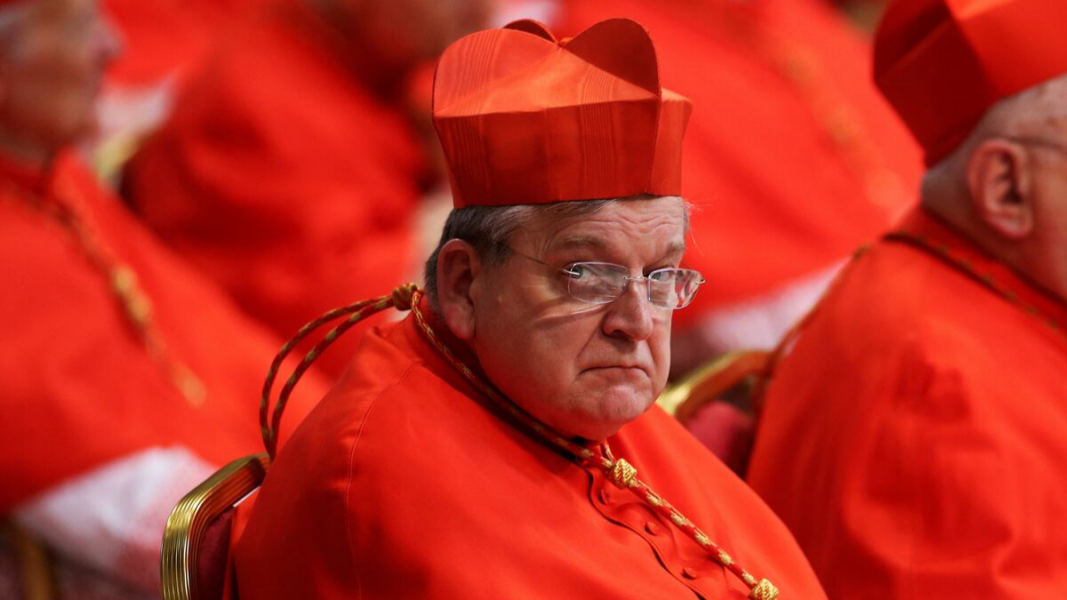
In an extensive interview granted to The Catholic Herald on the occasion of Christmas, Cardinal Raymond Leo Burke has offered an in-depth reflection on faith, liturgy, the mission of the Church, and the current ecclesial moment, marked—according to his acknowledgment—by doctrinal confusion, internal tensions, and a culture increasingly hostile to Christianity.
Far from reducing Christmas to a cultural or sentimental symbol, the American cardinal places the center of the celebration in the mystery of the Incarnation: God made man, alive and present in his Church. For Burke, this fundamental truth is the ultimate source of Christian hope, even amid wars, civil conflicts, and grave moral crises affecting the contemporary world.
Christmas, faith, and perseverance
The cardinal emphasizes that the current context can induce discouragement even among the most committed believers, but he reminds us that the Christian is not called to flee the world, but to remain in it with hope and courage. In the cardinal’s words, the mission consists in “fighting the good fight,” persevering, and announcing with one’s own life the truth of Christmas: that Christ has come, remains with us, and will return gloriously at the end of time.
In a more personal tone, Burke evokes his childhood memories linked to the Midnight Mass, experienced in family and with liturgical solemnity. Those celebrations—he affirms—deeply marked his faith and continue to be the model of how the Church transmits the Christian mystery not only with words, but through the beauty of worship.
The conclave and the election of Leo XIV
The cardinal also refers to his participation in the recent conclave that elected Pope Leo XIV, which he describes above all as a liturgical act, deeply rooted in prayer. Burke highlights the sense of responsibility felt by the electing cardinals, especially in a numerous and little-cohesive College after years without extraordinary consistories.
Without entering into confidential details, he expresses his confidence in the action of the Holy Spirit, recalling that his presence also demands human obedience. Regarding the new pontiff, he notes a natural affinity derived from his American origin, although he emphasizes that Leo XIV is also the fruit of a long pastoral experience in Latin America, which gives him a broad and complex ecclesial identity.
Traditional liturgy and young people
One of the central axes of the interview is the liturgy. Burke clearly defends Benedict XVI’s vision of the coexistence of the two forms of the Roman rite, recalling that the traditional form, used for centuries, has nourished the spiritual life of countless saints and cannot be considered a relic of the past.
The cardinal also observes a phenomenon he considers decisive: the growing interest of young Catholics in traditional liturgy. Far from seeking novelties or spectacle, many young people discover in tradition a source of truth, beauty, and spiritual stability. In his view, recovering Benedict XVI’s “liturgical wisdom” could restore to the Church a necessary liturgical peace and abundant pastoral fruits.
A generation seeking what was lost
Burke is not surprised by the conservative turn of many young people, especially those of the so-called Generation Z. In his understanding, it is a natural reaction to a morally and spiritually empty society. After experiencing the limits of a life lived “as if God did not exist,” young people seek something solid, and they find it in the living tradition of the Church, in its doctrine, its morality, and its worship.
This rediscovery—he adds—also challenges parents and grandparents, who rediscover the responsibility to transmit a treasure that for decades was neglected or diluted.
Faith, politics, and the mission of the Church
Finally, the cardinal warns against the temptation to reduce faith to political or sociological categories. The Church—he affirms—is not a political program or an ideological movement, but the instrument of Christ’s saving work. The social and political action of the Christian must flow from fully lived faith, not substitute it.
When faith becomes ideology, it loses its transformative power. On the contrary, when it is lived in liturgy, in morality, and in charity, it becomes true leaven in society. For Burke, the great current challenge is solid, non-sentimental catechesis, capable of forming consciences and showing that fidelity to God’s law is the authentic source of freedom and joy.
The interview concludes on a relaxed note, when the cardinal confesses his predilection for the Coventry Carol. But the entirety of his words leaves a clear message: without tradition, without liturgy, and without doctrinal clarity, the Church impoverishes itself; when it recovers them, it is reborn, especially among the youngest.
Below we provide the full translation of the interview conducted by The Catholic Herald:
Catholic Herald: Eminence, Christmas is approaching and at its center is the mystery of the Word made flesh. As the Church prepares to celebrate the Nativity in a moment marked by cultural anxiety and ecclesial tension, what do you believe Catholics are especially called to remember, or perhaps to recover, today?
Cardinal Burke: I believe we are called above all to remember the simple and fundamental truth that the Son of God has become man. In the Incarnation, He has united our human nature to his divine nature. He has suffered, died, risen from the dead, ascended to the right hand of the Father, and is alive with us now, present in the Church and active in the world.
For that reason, Catholics should be filled with hope. At the same time, we must resist the temptation of discouragement, or even of abandoning the living of our Catholic faith and Christian life. Today’s world presents so many trials, wars and civil conflicts, along with very grave moral problems. In such circumstances, even good Christians can become discouraged or feel tempted to withdraw from the world completely.
But we know that Our Lord is with us. We are in the world and we are called, with hope and with courage, to persevere. As St. Paul exhorts us, we must “fight the good fight,” stand firm, and be heralds of the truth of Christmas in everything we say and do: that Christ has come, that he remains with us, and that he will be with us until he returns in glory on the last day.
CH: If I may move from the universal to the personal for a moment: when you think of your own childhood, is there any particular Christmas tradition or memory that has remained with you, something that still shapes the way you live the feast today?
CB: When I think of my childhood, there is one memory that stands out very clearly: going to Midnight Mass. There was always great anticipation at home. I was the youngest of six children and, thank God, we were raised by devout Catholic parents.
We always opened presents on Christmas Eve before going to Mass, as you can imagine, something the children think about quite a bit [laughs]. And then we all went together to Midnight Mass. It was always very beautiful, even in our rural community. The local church, the music, the ceremony, all of it left a deep impression on me. Those Midnight Mass celebrations remain my dearest Christmas memories.
CH: Without breaching the confidentiality of the conclave, could you reflect on your experience of participating in the election of Pope Leo XIV? What impressed you most about the spiritual atmosphere of that moment and how did it influence your sense of responsibility as an electing cardinal?
CB: As you know, the conclave itself is fundamentally a liturgical act. The cardinals wear the full choir habit, as appropriate, and the entire process is framed by prayer. We began by celebrating Holy Mass together and, during the conclave itself, in the Sistine Chapel, we prayed the hours of the Divine Office.
At the very beginning of the conclave there is also a formal exhortation. On this occasion it was delivered by the former preacher of the Pontifical Household, Father Raniero Cantalamessa. What impressed me most deeply was the gravity of the responsibility entrusted to us: the task of electing a successor to St. Peter.
That gravity was felt especially intensely due to the particular circumstances of this conclave. The College of Cardinals had become very numerous, thirteen above the normative number of 120, from which Pope Francis had dispensed to create additional cardinals. At the same time, we had not held an extraordinary consistory in more than ten years. Those consistories are usually the occasions when the cardinals get to know each other better and exercise their function as counselors to the pope, sometimes described as a kind of “papal senate.”
As a result, many of us did not know each other well. That fact intensified the sense of responsibility, and it was something many cardinals commented on. I myself felt it very strongly. Even so, we trust, and continue to trust, in the presence of the Holy Spirit in the conclave. And, of course, as we often say, one thing is for the Holy Spirit to be present; another is for the cardinals to be obedient to him. We trust that such obedience was given.
CH: When Benedict XVI was elected, I remember feeling especially close to him, not only because he was German, but also because we had followed him for years and he was not a new name to us. Do you feel a similar closeness to Pope Leo XIV because he is American?
CB: You see, some stories circulated on social media suggesting that we met frequently or that I was especially close to Pope Leo. That simply was not the case. I had met him once briefly after he concluded his term as prior general of the Augustinians, and then once more here in Rome, after he became prefect of the Dicastery for Bishops.
That said, yes, I do feel a natural affinity with him. He was raised in south Chicago, in the Midwest, where I also come from, although I come from a farming background and he from the city, and he is several years younger than I am. Even so, we share something of the same cultural and ecclesial background.
It is also important to remember that, although Pope Leo was born and raised in the United States and received his first seminary formation there, he spent about thirty years in Peru, both as a missionary and later as a bishop. In that sense, he is also deeply marked by South American ecclesial life. I think many South American cardinals consider him very much their own, just as I consider him American. His experience bridges both worlds.
CH: Many Catholics, and not a few young Catholics, remain concerned about the place of the traditional Latin Mass in the life of the Church today. How do you value its role and what pastoral approach do you consider most faithful both to tradition and to ecclesial unity?
CB: I believe that Pope Benedict XVI provided the most correct guidance and legislation for the relationship between the older use of the Roman Rite and the more recent use, often called the ordinary form of the Roman Rite. His guiding principle was that both forms should be celebrated in their integrity and according to their own nature as divine worship.
As Pope Benedict made clear in Summorum Pontificum, the older form of the Roman Rite, which was in use for approximately fifteen centuries, from the time of Pope St. Gregory the Great and even before, nourished the spiritual life of countless saints, confessors, martyrs, great theologians, great spiritual writers, and all the faithful. This heritage can never be lost. In all its beauty and goodness, it is a treasure that the Church must always preserve and promote.
What we see today is very eloquent. Many young people, who did not grow up with this older use, discover it later in life and find it deeply nourishing spiritually, both for them and for their families. My hope, therefore, is that the wisdom of Pope Benedict XVI be recovered, so to speak, and that there may again be a wider use of both forms of the Roman Rite, always celebrated with reverence, always understood as the action of Christ himself, who sacramentally renews his sacrifice on Calvary. I am convinced that this will bring great blessings to the Church.
CH: Under Benedict XVI, many Catholics felt there was something like a period of “liturgical peace.” Perhaps we can hope for that again?
CB: Yes, indeed. That peace was experienced in many places and can be restored.
CH: Recent studies suggest that the so-called “Generation Z,” those born roughly from the mid-1990s to the mid-2010s, is more religiously and morally conservative than previous generations. This is evidenced in the increase in church attendance, not only in the United States but internationally. In England, for example, practicing Catholics now outnumber practicing Anglicans. Five hundred years have passed, but we’re back. How do you interpret this phenomenon? Does it surprise you?
CB: It doesn’t surprise me at all. This generation has grown up in a society that is morally and spiritually bankrupt. They have seen the fruits of living as if God did not exist, of living, as St. John Paul II said, according to what we feel like at each moment rather than according to what God asks of us.
Young people have experienced the emptiness of that way of life. And that’s why they seek something solid, the truth, beauty, and goodness. Naturally, they are drawn to the living tradition of the Church: the faith handed down from the Apostles, the divine worship of the Church, and its moral teaching.
My own generation had the blessing of growing up in a time of greater stability in these areas. It wasn’t a perfect time, it never is, but divine worship, moral teaching, and doctrinal clarity were largely taken for granted. Over time, many of these treasures were neglected or abandoned, to the impoverishment of subsequent generations.
Now young people want to recover what was lost. I see this as an expression of baptismal grace, the work of the Holy Spirit who moves the heart that longs to know God, love him, and serve him. As St. Augustine prayed to Our Lord in his Confessions: “our heart is restless until it rests in You.”
CH: What strikes me is that this rediscovery among young people also creates a kind of responsibility that flows backward. Parents and grandparents suddenly realize that they possess something precious, something the younger generation desires, and that they have a duty to pass it on.
CB: Absolutely.
CH: Many people read interviews like this with a polemical spirit, especially when issues of Church and politics arise. How can the Church best respond to young Catholics today without reducing faith to political or sociological categories? At the same time, Christians must live in society, engage in public life, and be, as Our Lord says, the salt of the earth. How should that balance be achieved?
CB: The Church must always begin with what it is: the instrument of Christ’s saving work. Faith can never be reduced to a political program or a sociological movement. At the same time, faith necessarily shapes the way we live in the world, how we act in society, how we seek justice, and how we defend human dignity.
The balance is achieved when politics is understood as something that flows from faith, not that replaces it. When faith is reduced to ideology, it is emptied of its power. But when faith is fully lived, in worship, in moral life, and in charity, it naturally becomes leaven in society. That’s how Christians truly transform the world: not by politicizing the Gospel, but by living it.
CH: On one hand, we must not turn faith into politics; on the other, Christians live in society, participate in public life, and are called to be leaven and salt of the earth. How can that balance be achieved today? How can the Church best respond to young Catholics without reducing faith to political or sociological categories? In other words, how does the Church achieve the right balance? Is there any element that you consider particularly important or striking from your own experience?
CB: I believe the most important task we have before us is to deepen our understanding of the truths of the faith as they have been taught, in an unbroken line, throughout the Christian centuries. Today, many people are very poorly catechized. For decades, catechesis has often been reduced to what might be called a “feel-good” approach, but without content. Why should I feel good? I should feel good because I know God’s law and strive to live according to it.
At the same time, we now have a powerful tool in social media. It can be used for very harmful purposes, to spread falsehoods and confusion, but it can also be used very positively: to help people deepen their understanding of the Church’s teaching and to apply that teaching to the concrete circumstances of life.
It’s not about sentimentalism or emotionally aligning with one political party or movement or another. Our loyalty is to Christ the King. And we strive, then, to be faithful subjects of Christ in the concrete circumstances in which we live.
However, instead of turning to this rich teaching, public debate often degenerates into emotional outbursts or diatribes against one politician or another. If we truly apply the Church’s teaching, we will arrive at solutions that are just for all involved.
CH: I have to ask a controversial question at the end: what is your favorite carol?
CB: [laughs] It’s a very good question. I have a particular affection for the Coventry Carol. Of course, there are many others we’ve sung for years, Silent Night, Hallelujah to the world and so on, but Christmas music is extraordinarily rich. Even so, I think I would choose the Coventry Carol, which should be pleasing here in England.