


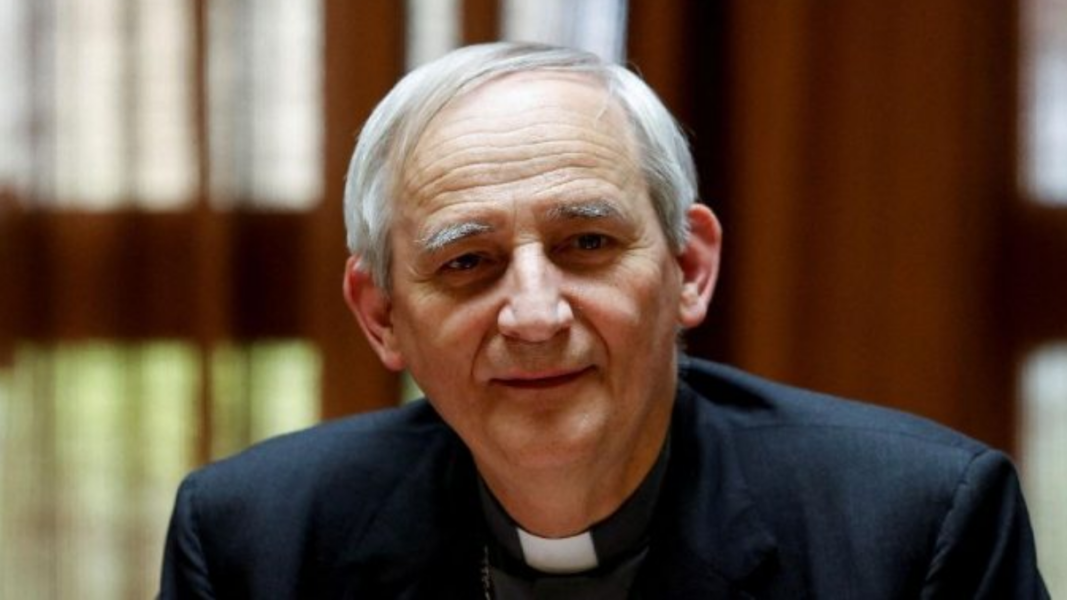
The interview granted by Cardinal Matteo Zuppi to Corriere della Sera offers a broad overview of the major political debates of the moment. Ukraine, Trump, European rearmament, immigration, differentiated autonomy, legislation on end-of-life issues, the homosexual question. Everything is there. However, there is an absence that is as eloquent as it is unsettling: the name of Jesus Christ does not appear even once.
It is not a minor detail. In an interview published in the Christmas context, the president of the Italian Episcopal Conference describes Christmas as a symbol of universal human values—humility, fragility, dignity—but completely dispenses with the Baby Jesus. It is a Christmas stripped of its Christological core, reduced to a cultural and ethical category. Nothing new in Zuppi, whose way of expressing himself has long revealed a persistent inclination toward markedly secular language.
A cardinal as a political analyst
Throughout the interview, Zuppi moves with ease in the strictly political terrain. He opines on the war in Ukraine, the role of Donald Trump, the rearmament of the European Union, migration policies, the so-called “Albania model,” differentiated autonomy, and end-of-life legislation. He does so with a tone that would not be out of place in the mouth of a political leader or a secular analyst.
Particularly significant is his explicit defense of European rearmament, presented as a prerequisite for security and, consequently, for peace. “The EU needs effective unitary coordination, a prerequisite for a European army. Rearmament must be proportional to the real risks to security,” he states. It is a clear position, aligned with the dominant discourse in Brussels, formulated with hardly any reference to the classic principles of the Church’s social doctrine on war, peace, and the international order.
End-of-life issues and constitutional logic
In bioethical matters, the cardinal shows himself favorable to the approval of a law on end-of-life issues, as long as it follows the rulings of the Italian Constitutional Court. “We hope that the legislator abides by the rulings of the Constitutional Court,” he notes. Although he formally rejects euthanasia and assisted suicide, the frame of reference is not natural moral law or the magisterium, but constitutional jurisprudence and political consensus.
Something similar occurs with the homosexual question. Zuppi defends the recognition and accompaniment of homosexual and transgender people, insisting on the fight against discrimination. Although he states that the Catechism “remains the same,” the emphasis of the discourse is placed on contemporary sociopolitical categories rather than on a clear and demanding Christian anthropology.
Assumed secularization, diluted faith
Perhaps the most worrying aspect of the interview is the implicit acceptance of secularization as an irreversible and even positive process. Zuppi maintains that Christendom has ended and that Christianity must adapt to this new context. The problem is not in noting a historical fact, but in assuming it without critical spirit, as if there were no other response than accommodation.
Insisting on combining so-called “non-negotiable” principles with the dominant democratic pluralism, without clearly affirming their binding character and transcendent origin, leads nowhere. On the contrary, it contributes to confusion and the progressive irrelevance of Christian discourse in public life.
The Corriere della Sera interview reveals not so much a pastoral strategy as a secular political stance on secular issues. That it is a cardinal who formulates it should, at least, provoke serious reflection. Because a Church that speaks like the world ends up, inevitably, saying the same as the world. And a Christmas without Jesus Christ is not Christmas, no matter how many human values are invoked.
Sources: Corriere della Sera, Specola