


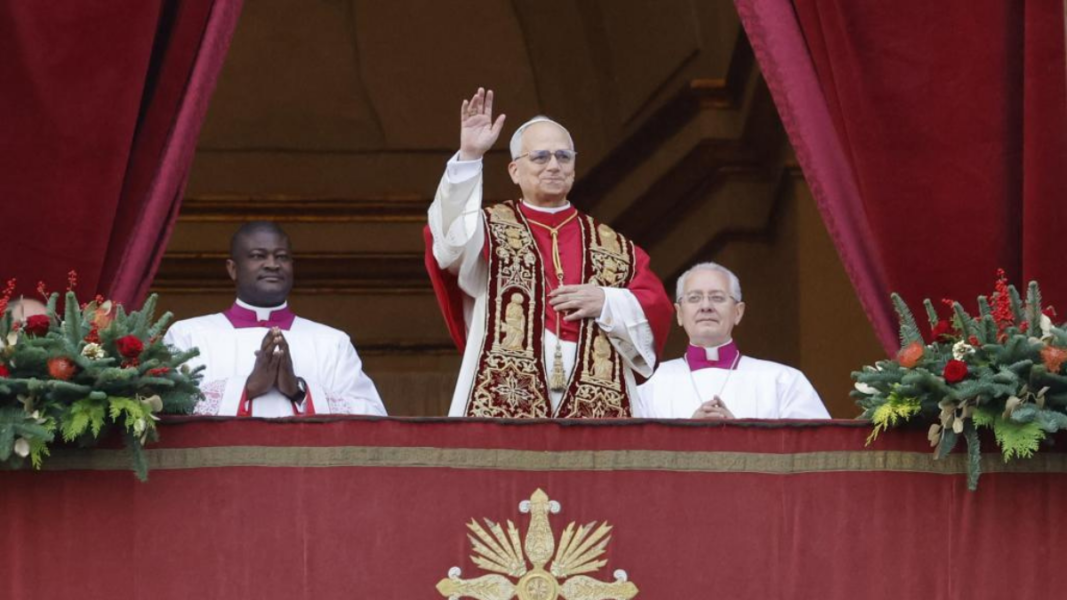
On the solemnity of the Lord’s Birth, Pope Leo XIV delivered this December 25, 2025, his first Christmas Message and the Urbi et Orbi blessing from the central loggia of St. Peter’s Basilica, before the faithful gathered in the Square and millions of people connected through the media. The Pontiff presented the mystery of the Incarnation as the authentic foundation of peace, insisting that only a heart freed from sin can become a true builder of reconciliation, both in personal life and in the social and international sphere.
From the birth of Christ in poverty and rejection, Leo XIV emphasized the moral responsibility of each person in the face of evil, violence, and indifference, recalling that God saves man with his grace, but not without his free response. On the threshold of the end of the Jubilee of Hope, the Holy Father concluded by reaffirming that Christ is the “Door always open” and that Christmas, today as always, is inseparably the announcement of salvation and true peace.
We leave below the full message of Leo XIV:
Dear brothers and sisters,
“Let us all rejoice in the Lord, for our Savior has been born into the world. Today, from heaven, peace has descended upon us” (Entrance Antiphon of the Midnight Mass on the Nativity of the Lord). Thus sings the liturgy on Christmas night, and thus resounds in the Church the announcement of Bethlehem: the Child born of the Virgin Mary is Christ the Lord, sent by the Father to save us from sin and death. He is our peace, the One who conquered hatred and enmity with the merciful love of God. Therefore, “the birth of the Lord is the birth of peace” (S. Leo the Great, Sermon 26).
Jesus was born in a stable because there was no room for him in the inn. As soon as he was born, his mother Mary “wrapped him in swaddling clothes and laid him in a manger” (Lk 2:7). The Son of God, through whom all things were made, is not welcomed and his cradle is a poor animal feeding trough.
The eternal Word of the Father, whom the heavens cannot contain, has chosen to come into the world in this way. Out of love he wanted to be born of a woman, to share our humanity; out of love he accepted poverty and rejection and identified with those who are marginalized and excluded.
In the birth of Jesus, the fundamental choice that will guide the entire life of the Son of God until his death on the cross is already outlined: the choice not to let us bear the weight of sin, but to bear it himself for us, to take charge of it. This only he could do. And at the same time, he showed us what only we can do, that is, to assume each one our share of responsibility. Yes, because God, who created us without us, cannot save us without us (cf. S. Augustine, Sermon 169, 11. 13), that is, without our free will to love. Whoever does not love is not saved, is lost. And whoever does not love his brother whom he sees, cannot love God whom he does not see (cf. 1 Jn 4:20).
Brothers and sisters, this is the path to peace: responsibility. If each one of us, at all levels, instead of accusing others, first recognized his own faults and asked forgiveness from God, and at the same time put himself in the place of those who suffer, were in solidarity with the weakest and oppressed, then the world would change.
Jesus Christ is our peace, first of all because he frees us from sin and, then, because he shows us the way to follow to overcome conflicts, all conflicts, from interpersonal to international ones. Without a heart free from sin, a forgiven heart, one cannot be peaceful men and women and builders of peace. For this reason Jesus was born in Bethlehem and died on the cross: to free us from sin. He is the Savior. With his grace, each one of us can and must do what corresponds to him to reject hatred, violence, and confrontation, and to practice dialogue, peace, and reconciliation.
On this feast day, I wish to send an effusive and paternal greeting to all Christians living in the Middle East, whom I wanted to meet recently on my first apostolic journey. I have heard their fears and I know well their feeling of helplessness in the face of power dynamics that overwhelm them. The Child who is born today in Bethlehem is the same Jesus who says: “I have told you this so that you might have peace in me. In the world you will have trouble, but take courage, I have conquered the world” (Jn 16:33).
To him we implore justice, peace, and stability for Lebanon, Palestine, Israel, and Syria, trusting in these divine words: “The work of justice will be peace, and the effect of justice, quiet and confidence forever” (Is 32:17).
We entrust to the Prince of Peace the entire European continent, asking him to continue inspiring in it a spirit of community and collaboration, faithful to its Christian roots and history, in solidarity and welcoming to those in need. Let us pray in a special way for the afflicted Ukrainian people, that the clamor of arms may cease and the parties involved, with the support of the international community, may find the courage to dialogue in a sincere, direct, and respectful manner.
To the Child of Bethlehem we implore peace and consolation for the victims of all the wars being waged in the world, especially the forgotten ones; and for those who suffer because of injustice, political instability, religious persecution, and terrorism. I remember in a special way the brothers and sisters of Sudan, South Sudan, Mali, Burkina Faso, and the Democratic Republic of the Congo.
In these last days of the Jubilee of Hope, let us ask the God made man for the dear people of Haiti, that all forms of violence may cease in the Country and it may advance on the path of peace and reconciliation.
May the Child Jesus inspire those with political responsibilities in Latin America to make room for dialogue for the common good and not for ideological and partisan exclusions, as they face the numerous challenges.
We ask the Prince of Peace to illuminate Myanmar with the light of a future of reconciliation, to restore hope to the young generations, to guide the entire Burmese people on the paths of peace, and to accompany those who live without a home, without security, and without trust in tomorrow.
To him we implore that the ancient friendship between Thailand and Cambodia be restored and that the parties involved continue to strive for reconciliation and peace.
To him we also entrust the peoples of South Asia and Oceania, hard hit by the recent and devastating natural disasters that have gravely affected entire populations. In the face of such trials, I invite everyone to renew with conviction the common commitment to help those who suffer.
Dear brothers and sisters:
In the darkness of the night appeared “the true light that, coming into this world, enlightens everyone” (Jn 1:9), but “his own did not accept him” (Jn 1:11). Let us not allow indifference toward those who suffer to overcome us, because God is not indifferent to our miseries.
By becoming man, Jesus takes upon himself our fragility, identifies with each one of us: with those who no longer have anything and have lost everything, like the inhabitants of Gaza; with those who suffer hunger and poverty, like the Yemeni people; with those who flee their land in search of a future elsewhere, like the numerous refugees and migrants who cross the Mediterranean or travel the American continent; with those who have lost their jobs and with those who seek them, like so many young people who have difficulty finding employment; with those who are exploited, like the countless poorly paid workers; with those who are in prison and often live in inhuman conditions.
To the heart of God comes the invocation of peace that springs from every land, as a poet writes:
“Not the one of a ceasefire nor the one of the vision of the wolf with the lamb, but the one of the heart when the agitation ends and we speak of a great weariness.
May it be like wildflowers, suddenly, by the necessity of the field: a wild peace.”
On this holy day, let us open our hearts to our brothers and sisters who are in need and suffer. By doing so, we open them to the Child Jesus who, with his arms open, welcomes us and reveals his divinity: “But to all who received him […], he gave power to become children of God” (Jn 1:12).
In a few days the Jubilee Year will end. The Holy Doors will close, but Christ, our hope, remains always with us. He is the Door always open, which introduces us to divine life. The joyful news of this day is that the Child who has been born is God made man; that he does not come to condemn, but to save; his is not a fleeting appearance, for he comes to stay and give himself. In him every wound is healed and every heart finds rest and peace. “The Birth of the Lord is the Birth of peace.”
To all, I wish from the heart a serene Christmas.