


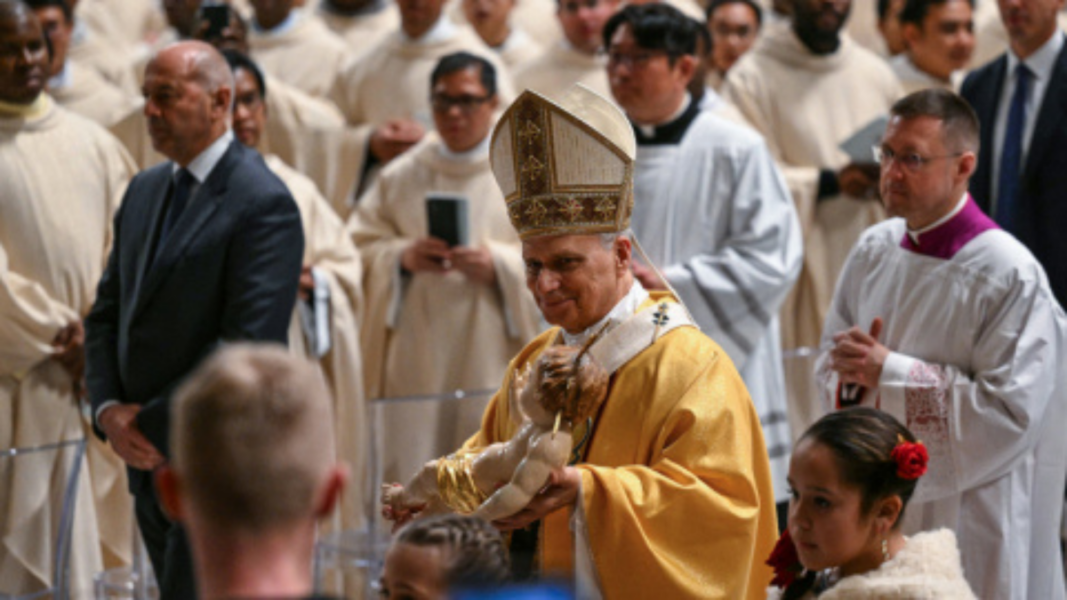
In the Christmas Eve Mass, celebrated on the night of December 24 in St. Peter’s Basilica, the Pope used the Roman Canon (Eucharistic Prayer I), the historic eucharistic prayer of the Latin rite. It is an option fully provided for by the Roman Missal, but not particularly frequent in recent pontifical celebrations, which gives the gesture particular interest, especially as it occurs on the eve of a consistory of cardinals in which the liturgy will play a relevant role.
It is also worth recalling that in last year’s Christmas Eve Mass, also celebrated in St. Peter’s Basilica, the dean of the College of Cardinals, Cardinal Giovanni Battista Re, presided with the presence of a visibly very weakened Pope Francis. On that occasion, the Eucharistic Prayer III was chosen, one of the formulas most used in recent solemn celebrations.
The Christmas Eve Mass is not just any celebration. It is one of the most visible and symbolic liturgies of the year, followed worldwide and laden with theological and pastoral meaning. In it, the Church celebrates the mystery of the Incarnation of the Word, the birth of Christ in Bethlehem, the center of the Christian proclamation. That this mystery was celebrated by resorting to the Roman Canon in Latin introduces an element of liturgical continuity that deserves to be noted.
The Roman Canon is the oldest eucharistic prayer of the Latin Church, with a sober structure and precise language, marked by a clear sacrificial orientation and by the explicit reference to the communion of saints and to the Church spread throughout the earth. For centuries it was the only eucharistic prayer of the Roman rite, and it remains today a particularly accomplished expression of its theology.
Following the liturgical reform after the Second Vatican Council, new eucharistic prayers were introduced which, over time, have become the most used, in part due to their greater brevity and a more direct style. However, various authors and liturgists have pointed out that some of these modern prayers, although legitimate and valid, present a lesser theological density and a more attenuated formulation of certain central aspects of the Eucharist, such as its sacrificial character and its martyrial rooting.
In this context, the use of the Roman Canon in the Christmas Eve Mass can be read as more than a simple practical choice. Without the need for maximalist interpretations, it does seem an option coherent with an ecclesial moment in which reflection is invited on the liturgy, its form, its language, and its capacity to adequately express the Mystery it celebrates.