


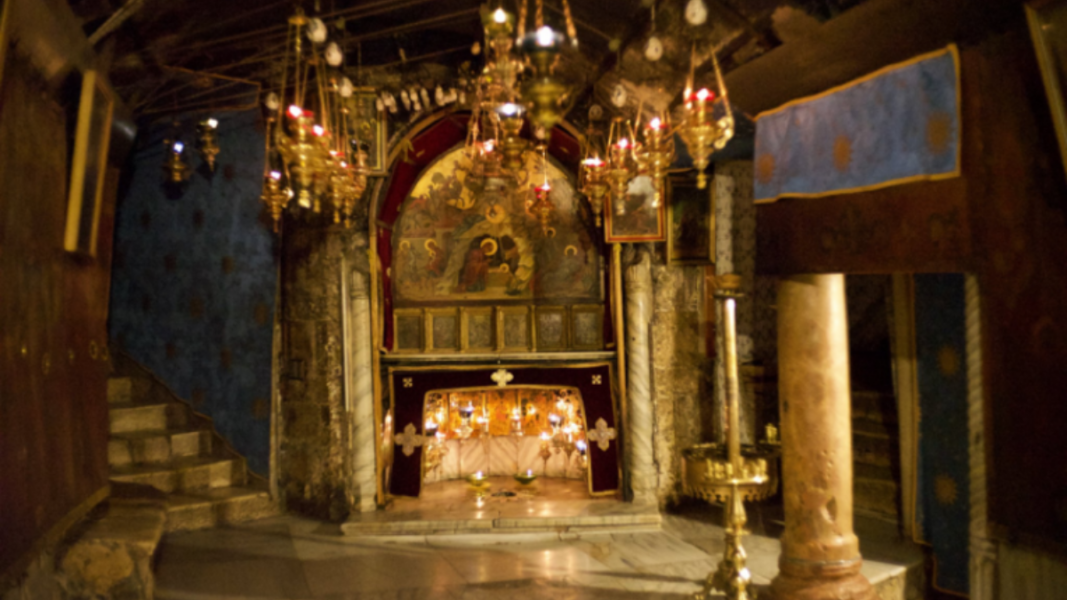
Bethlehem, small village of Judah, was witness to the sublime and paradoxical event: the birth of the King of Kings. That newborn child, wrapped in swaddling clothes and laid in a manger, was the eternal Word of God made flesh (cf. Jn 1:14). There was no palace or processions, but an animal cave and some poor shepherds as witnesses. The Christian tradition has always seen in this scene the manifestation of “God’s logic,” so different from that of the world. Saint Augustine expresses it with astonishment: “Jesus lies in the manger, but holds the reins of the government of the world; he takes the breast, and feeds the angels; he is wrapped in swaddling clothes, and clothes us with immortality”. The infinite divine greatness was revealed in the fragility of a child.
That Christmas Eve, the Creator of the universe wanted to experience extreme poverty. There was no room at the inn for Joseph and Mary; therefore, the Son of God is born in a cold stable, among straw and animals. Saint Teresa of Jesus evokes this image with devotion: she speaks of the “glorious poor little child, son of the heavenly Father” born on Christmas night. At first glance, everything in Him showed lack and smallness. In fact –adds the saint of Ávila– to human eyes “he could more easily be judged as the son of poor people than as the Son of the heavenly Father”. However, faith allows us to recognize in that Child the true God, hidden in the humility most absolute. The angels announced it to the shepherds in this way, and they came to adore Him in the cave of Bethlehem. In that poverty shines a mystery: “Jesus was born in the humility of a stable, of a poor family; some simple shepherds are the first witnesses of the event”. The glory of God shone, then, in the simplicity of Christmas.
The Divine Lesson of Humility
From the early centuries, the Church has contemplated the birth of Christ as a lesson in humility and love destined to heal the pride of humanity. Saint Augustine preached that “the doctrine of humility is the great lesson of the mystery of Bethlehem”. God humbles Himself for us, taking our mortal condition, to teach us by example. “Consider, man, what God became for you; recognize the doctrine of such great humility even in a child who does not speak” –exclaims the Doctor of Hippo. The Omnipotent became weak, the Rich became poor, out of love for men. As Saint Paul says: “though he was rich, yet for your sake he became poor, so that by his poverty you might become rich” (cf. 2 Co 8:9). This kenosis (emptying) of the Son of God is a remedy against human pride. “The humility of Christ displeases the proud; but if it pleases you, Christian, imitate it” –urges Saint Augustine. We cannot imitate God in His omnipotence, but we can imitate His humility by embracing smallness and service to others.
Saint Thomas Aquinas, centuries later, reflected on why it was fitting for the Messiah to live poor and humble. The Angelic Doctor affirms clearly that “it was fitting that Christ should lead a poor life in this world”. God did not choose poverty by chance, but with a precise spiritual purpose. Saint Thomas teaches: “just as he accepted bodily death to give us spiritual life, in the same way he endured temporal poverty to give us spiritual riches”. Christ, by being born and living poor, brought us a heavenly treasure far superior to any material wealth: grace, the shared divine life. With His voluntary poverty, Jesus shows us where true good lies. Saint Thomas also warns that “the abundance of riches gives occasion to become proud”… therefore, “in one who is voluntarily poor, as Christ was, poverty itself is a sign of supreme humility”. The Lord, being owner of everything, preferred deprivation to teach us the supreme humility and to keep us away from pride, the root of so many evils. In the Bethlehem stable, the divine wisdom speaks to us with silent eloquence: “Learn from me, for I am gentle and humble in heart” (Mt 11:29).
The Riches of Christ’s Poverty
Saint Bernard of Clairvaux, the celebrated Cistercian abbot, exalts the paradoxical triumph of that holy night. He invites Mary to lay the Child in the manger and exclaims: “Lay him in the manger, wrap him in swaddling clothes; these swaddling clothes are our riches. The swaddling clothes of the Savior are worth more than all the velvets. The manger is more exalted than the golden thrones of kings. And the poverty of Christ surpasses, by far, all the riches [of] treasures together”. What an inconceivable contrast!: the throne of the King of Heaven is a humble stable, but that humility makes it even greater. For Saint Bernard, the rags and straw cradle of the Child God are more valuable than imperial purples, because there shines the incomparable virtue of divine humility. “What can be found more enriching and of greater value than humility?” –asks the holy abbot. And he concludes by pointing to the Bethlehem stable: “The birth of the Lord inculcates humility in you: you see him emptied, taking the condition of a slave and living as an ordinary man”. God emptied Himself (cf. Phil 2:7) for our salvation; the Most High descended to the lowest, to raise us to the heights of His Kingdom.
Saint Teresa of Jesus, mystic and Doctor of the Church, is also continually inspired by the Humanity of Christ, from His Nativity to the Cross. The founding Mother of the Discalced Carmelites enjoyed celebrating Christmas with tenderness and fervor. In her writings, she insists on the importance of contemplating the child Jesus, poor and needy, to grow in love and humility. She tells us that the first Discalced Carmelites, during Advent, prepared with simplicity a “stable” in their convents, arranging straw, swaddling clothes, and a cradle for the “Divine Infant”, so that their souls might be a living Bethlehem where the Savior could be born. Saint Teresa exhorted her nuns to meditate deeply on the mystery of this poverty: “the tears of the Child, the poverty of the Mother, the hardness of the manger, the rigor of the weather, and the discomforts of the stable”. Contemplating those scenes, the sisters felt filled with joy and desires to imitate the humble Jesus.
The Perennial Teaching of Bethlehem
Bethlehem is a permanent school of Christian life. The manger teaches us that true greatness is achieved through smallness, that the path to God passes through the virtue of humility. In contemplating the God made child, poor and humble for us, let us open our souls to His example and His grace. May each one, in the intimacy of his heart, welcome the question that this mystery whispers: Are we willing to follow the path of humility that the Son of God has traced for us? The answer remains in our hands, in the light of Bethlehem and under the loving gaze of Mary and Joseph. The Child Jesus, with His little arms open in the manger, seems to call us to that path. Before Him, in silent adoration, each soul can glimpse the true wealth that springs from the poverty embraced out of love. May this eternal message of Christmas find an echo in our hearts, and may the humble poverty of Christ the King inspire us to live in the truth, charity, and hope that never pass away.