


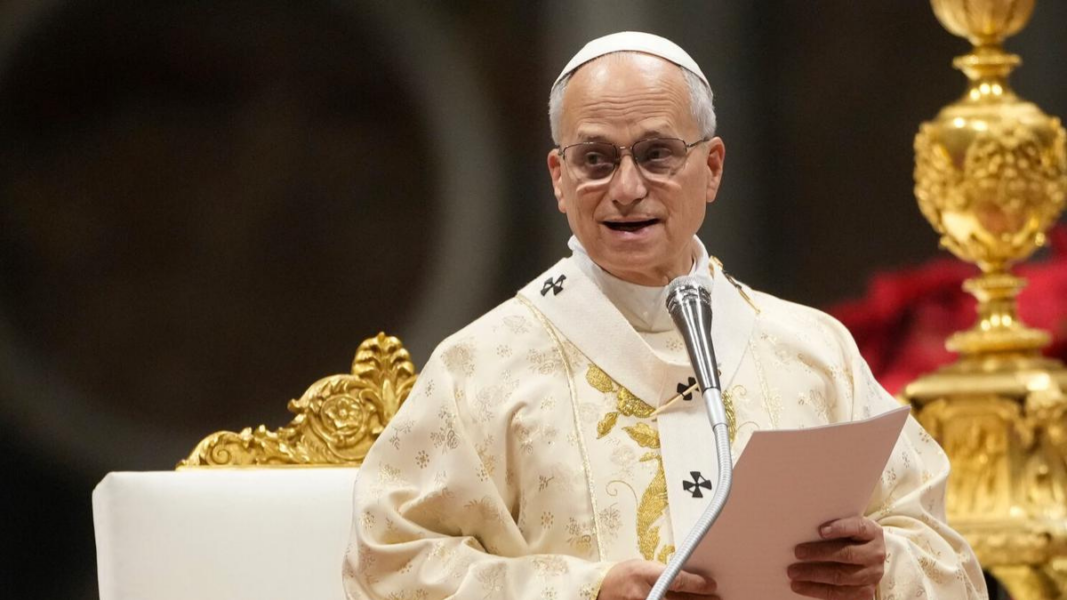
On the morning of December 25, the solemnity of the Birth of the Lord, Pope Leo XIV presided over the Christmas Day Mass in St. Peter’s Basilica. Drawing from the prophetic announcement of Isaiah and the prologue of the Gospel of St. John, the Pontiff stated that peace is not an idea or a slogan, but a presence already given: Christ himself, the Word made flesh, who enters history from fragility and poverty.
We leave below the complete homily of Leo XIV:
Dear brothers and sisters:
“Break forth together into singing” (Is 52:9), cries the messenger of peace to those he encounters amid the ruins of a city that must be completely rebuilt. His feet, still covered in dust and wounded, are beautiful—writes the prophet (cf. Is 52:7)—because, through long and difficult paths, they have brought a joyful announcement, in which everything now rebirths. It is a new day! We too participate in this decisive moment, in which it seems that no one yet believes: peace exists and is already in our midst.
“I leave you peace, I give you my peace, but not as the world gives” (Jn 14:27); thus spoke Jesus to his disciples—to those whose feet he had washed shortly before—, messengers of peace who from that moment should run through the world, untiringly, to reveal to all the “power to become children of God” (Jn 1:12). Today, therefore, we are not only surprised by the peace that is already here, but we celebrate how this gift has been given to us. In the how, in fact, shines the divine difference that makes us burst into songs of joy. Thus, throughout the world, Christmas is par excellence a feast of music and songs.
The prologue of the fourth Gospel is also a hymn and has as its protagonist the Word of God. The “word” is a term that indicates action. This is a characteristic of the Word of God: it never remains without effect. If we look closely, many of our words also produce effects, sometimes undesired. Yes, words act. But here is the surprise that the liturgy of Christmas places before us: the Word of God manifests himself and does not know how to speak, he comes to us as a newborn who only cries and sobs. “The Word became flesh” (Jn 1:14) and, although he will grow and one day learn the language of his people, what he now speaks is only his simple and fragile presence. “Flesh” is the radical nakedness of one who in Bethlehem and on Calvary also lacks a word; as so many brothers and sisters stripped of their dignity and reduced to silence lack a word. Human flesh requires care, seeks welcome and recognition, looks for hands capable of tenderness and minds disposed to attention, desires good words.
“He came to his own, and his own people did not accept him. But to all who did accept him […] he gave power to become children of God” (Jn 1:11-12). This is the paradoxical way in which peace is already among us: the gift of God is fascinating, seeks welcome and moves to self-giving. It surprises us because it exposes us to rejection, it attracts us because it snatches us from indifference. Becoming children of God is a true power; a power that remains buried as long as we remain indifferent to the crying of children and the fragility of the elderly, to the helpless silence of victims and the resigned melancholy of those who do the evil they do not want.
As the beloved Pope Francis wrote, to call us to the joy of the Gospel: “Sometimes we are tempted to be Christians while keeping a prudent distance from the wounds of the Lord. But Jesus wants us to touch human misery, to touch the suffering flesh of others. He hopes that we will give up looking for those personal or communal shelters that allow us to keep our distance from the knot of human turmoil, so that we may truly enter into contact with the concrete existence of others and know the power of tenderness” (Apostolic Exhortation Evangelii gaudium, 270).
Dear brothers and sisters, since the Word became flesh, now flesh speaks, cries out the divine desire to meet us. The Word has pitched his fragile tent among us. And how can we not think of the tents in Gaza, exposed for weeks to rain, wind, and cold, and those of so many other displaced persons and refugees on every continent, or the improvised shelters of thousands of homeless people in our cities? Fragile is the flesh of defenseless populations, tried by so many ongoing or ended wars that leave rubble and open wounds. Fragile are the minds and lives of young people forced to take up arms who, on the front lines, sense the foolishness of what is asked of them and the lie that permeates the bombastic speeches of those who send them to die.
When the fragility of others pierces our hearts, when the pain of others shatters our solid certainties, then peace already begins. The peace of God is born from a welcomed sob, from a heard cry; it is born among ruins that cry out for a new solidarity, born from dreams and visions that, like prophecies, reverse the course of history. Yes, all this exists, because Jesus is the Logos, the meaning from which everything has been formed. “All things were made through the Word, and without him nothing was made that has been made” (Jn 1:3). This mystery interpellates us from the cribs we have built, opens our eyes to a world where the Word still resounds, “in various ways and in different times” (cf. Hb 1:1), and continues to call us to conversion.
Certainly, the Gospel does not hide the resistance of the darkness to the light, it describes the path of the Word of God as a rugged journey, strewn with obstacles. To this day, authentic messengers of peace follow the Word on this path, which finally reaches hearts; restless hearts, which often desire precisely what they resist. In this way, Christmas remotivates a missionary Church, impelling it along the paths that the Word of God has traced for it. We are not at the service of a domineering word—these already resound everywhere—but of a presence that arouses good, that knows its efficacy, that does not claim a monopoly.
This is the path of mission: a path toward the other. In God every word is a spoken word, it is an invitation to dialogue, a word never identical to itself. It is the renewal that the Second Vatican Council has promoted and that we will see flourish only if we walk together with all humanity, never separating ourselves from it. Worldly is the opposite: having oneself as the center. The movement of the Incarnation is a dynamism of dialogue. There will be peace when our monologues are interrupted and, fecundated by listening, we fall to our knees before the naked flesh of others. The Virgin Mary is precisely in this the Mother of the Church, the Star of evangelization, the Queen of peace. In her we understand that nothing is born from the exhibitionism of strength and everything rebirths from the silent power of welcomed life.