


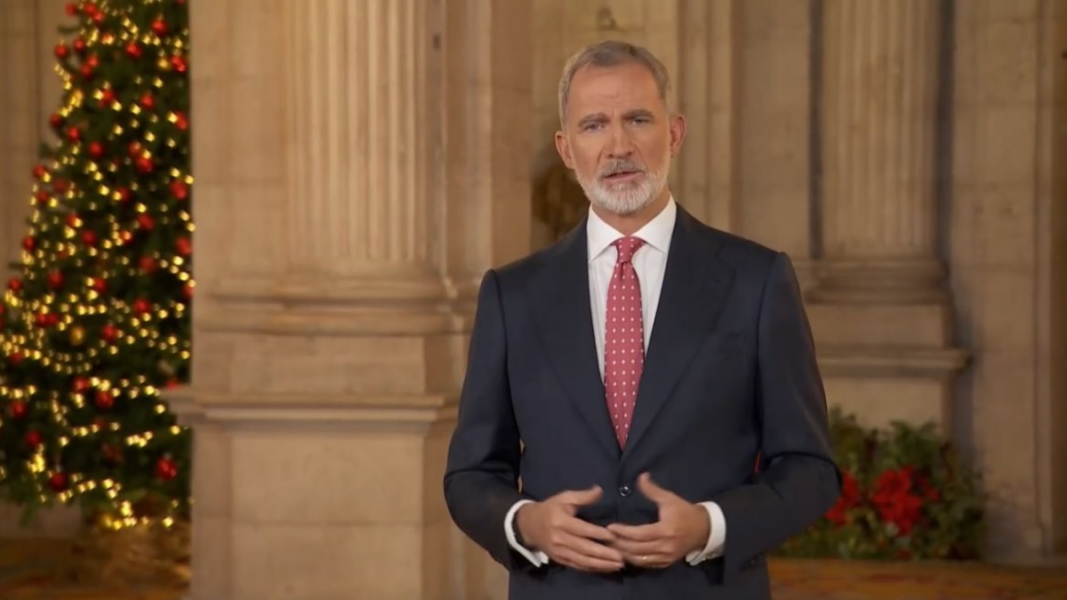
The King’s Christmas Eve message from Spain in 2025 has confirmed a trend that can no longer be dismissed as a mere oversight: the total and explicit omission of the birth of Jesus Christ on the very night when millions of Christians celebrate precisely that event.
Throughout the speech, matters of evident public interest were addressed—European Union, social challenges, environmental issues, common horizon—legitimate topics in an institutional address. But what is significant this time is not only what was said, but what was not said. There was not a single direct reference to the Christian event that gives Christmas its name. No explicit mention of Jesus. Not even a clear allusion to the religious meaning of Christmas Eve.
What is silenced is also a message
A head of state can opt for an inclusive and civic tone. But neutrality does not require absolute silence about the historical and cultural roots of Christmas in Spain. When naming what is commemorated is systematically avoided, Christmas is reduced to a mere temporal framework: a season of the year useful for sending generic good wishes and consensual values, interchangeable and decontextualized.
In practice, the result is a speech that could be delivered on any date on the calendar, with minimal adaptation. Christmas Eve thus becomes a protocolary support for correct and broad ideas, but disconnected from the reason for the celebration.
Aesthetics also communicate
The omission was not only verbal. It was also visual. The only traditionally Christian element present in the scene—a small and minimalist Nativity scene—appeared tucked away, with an almost residual presence. According to the staging, it was outside the main frame while the King spoke standing, turning it into a marginal detail, without centrality or prominence.
In institutional communication, this is not innocent: what is not shown clearly is not emphasized. And what is not emphasized, on a date with strong symbolic weight, ends up diluting.
Neutrality or aggressive secularization?
Those who defend this strategy often invoke religious plurality. However, the problem is not plurality, but invisibilization. One thing is not to impose faith; another, very different, is to deactivate constantly the signs and language that explain why Christmas exists.
When Christmas is reduced to the generic, the religious disappears and the cultural is impoverished: what remains is a shell of good wishes, but without the event that originated them.
The consequence is a impoverishment of meaning. Christmas ceases to be what it is—a specific commemoration, with specific content—to become a diffuse celebration, increasingly secular, where the Christian element is tolerated as peripheral decoration, not as central meaning.
A trend that is no longer anecdotal
Avoiding explicit mention of Christ’s birth on Christmas Eve is not a minor issue nor an exclusively confessional debate. It is, above all, a historical, cultural, and symbolic matter. Spain, with its contemporary plurality, remains a country whose calendar, traditions, and public language are deeply permeated by Christianity.
That is why the question is legitimate: does this communicative model really seek to integrate, or does it end up diluting the meaning of Christmas Eve until it is unrecognizable? Is it prudent for the institutional discourse, precisely that night, to renounce naming what for centuries has given sense, name, and content to Christmas?
Silencing is not always neutral. Sometimes, it is simply erasing.