


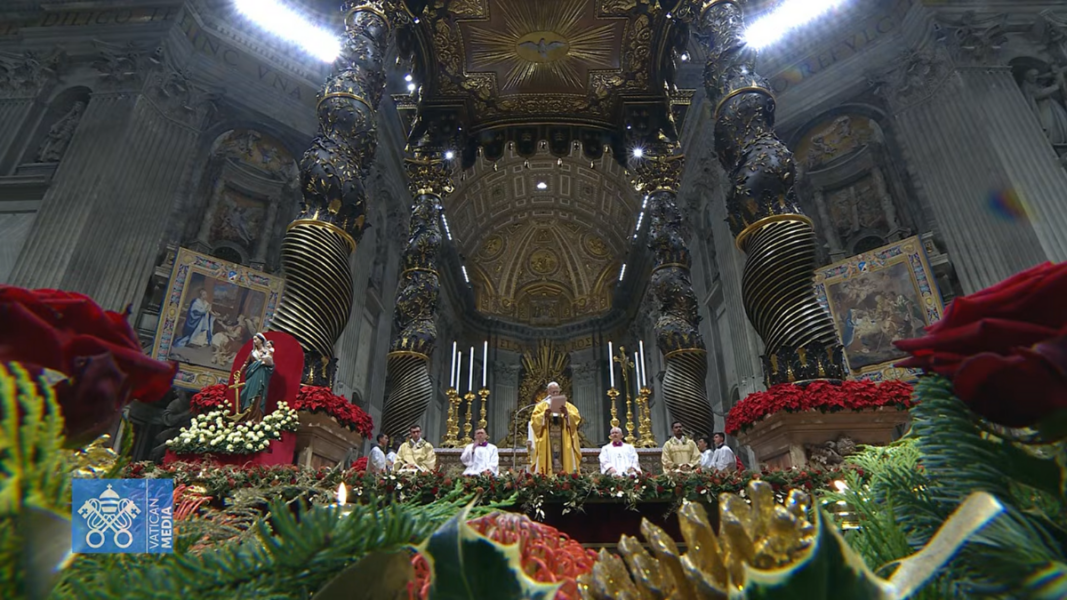
In the Christmas Eve Mass celebrated in St. Peter’s Basilica, the Holy Father Leo XIV delivered a homily centered on the mystery of the Incarnation as God’s response to the world’s darkness. Before the faithful gathered in the Vatican, the Pope presented the birth of Christ as the true light that illuminates all darkness, not from power or human greatness, but from the humility of a Child laid in a manger.
In his preaching, Leo XIV emphasized that Christmas reveals the inviolable dignity of every human person and unmasks the logics of domination, exclusion, and commodification of man. He recalled that there can be no place for God if there is no place for man—especially for the smallest, the poor, and the discarded—and exhorted the Church to welcome the gift received by becoming a witness of hope, charity, and peace in a world marked by the night of error and violence.
We leave below the complete homily of Leo XIV:
Dear brothers and sisters:
For millennia, all over the world, peoples have scanned the sky, giving names and forms to silent stars; in their imagination, they read in them the events of the future, seeking in the heights, among the stars, the truth that was missing below, among the houses. However, groping in that darkness, they remained confused by their own oracles. On this night, instead, «the people who walked in darkness have seen a great light: on those who dwelt in the land of darkness a light has shone» (Is 9,1).
Here is the star that surprises the world, a newly kindled spark radiant with life: «Today, in the city of David, a Savior has been born to you, who is the Messiah, the Lord» (Lk 2,11). In time and space, right where we are, comes He without whom we would never have existed. He lives among us who gives his life for us, illuminating our night with salvation. There is no darkness that this star does not illuminate, because in its light all humanity sees the dawn of a new and eternal existence.
It is the birth of Jesus, the Emmanuel. In the Son made man, God does not give us something, but himself, «to redeem us from all iniquity, purify us, and create for himself a chosen People» (Tt 2,14). He is born in the night who rescues us from the night: we no longer need to seek it far away, in the sidereal spaces, the trace of the dawning day, but by bowing our head in the nearby stable.
The clear sign given to the dark world is, in fact, «a newborn child wrapped in swaddling clothes and lying in a manger» (Lk 2,12). To find the Savior, we do not need to look up, but to gaze down: the omnipotence of God shines in the impotence of a newborn; the eloquence of the eternal Word resounds in the first cry of an infant; the holiness of the Spirit shines in that little clean body wrapped in swaddling clothes. It is divine the need for care and warmth that the Son of the Father shares with all his brothers in history. The divine light that radiates from this Child helps us to see man in every life that is born.
To illuminate our blindness, the Lord wanted to reveal himself to man as man, his true image, according to a plan of love begun with the creation of the world. As long as the night of error darkens this providential truth, «there is no room for others, for children, the poor, strangers» (Benedict XVI, Homily on Christmas Night, December 24, 2012). The words of Pope Benedict XVI, so relevant today, remind us that on earth there is no room for God if there is no room for man: not welcoming one means rejecting the other. Instead, where there is room for man, there is room for God; and then a stable can become more sacred than a temple and the womb of the Virgin Mary, the ark of the new covenant.
Let us admire, dear friends, the wisdom of Christmas. In the child Jesus, God gives the world a new life—his own—for all. It is not an idea that solves all problems, but a story of love that involves us. Before the expectations of peoples, He sends a child, so that he may be a word of hope; before the pain of the miserable, He sends a defenseless one, so that he may be strength to rise; before violence and oppression, He kindles a gentle light that illuminates with salvation all the children of this world. As St. Augustine pointed out, «human pride oppressed you so much that only divine humility could lift you up» (Sermo in Natale Domini,188, III, 3). Yes, while a distorted economy induces treating men as merchandise, God makes himself like us, revealing the infinite dignity of every person. While man wants to become God to dominate his neighbor, God wants to become man to free us from all slavery. Will this love be enough to change our history?
The answer comes as soon as we awaken, like the shepherds, from a deadly night, to the light of nascent life, contemplating the child Jesus. In the stable of Bethlehem, where Mary and Joseph, full of wonder, watch over the newborn, the starry sky becomes «a multitude of the heavenly host» (Lk 2,13). They are unarmed and disarming hosts, because they sing the glory of God, whose manifestation on earth is peace (cf. v. 14); in the heart of Christ, in fact, beats the bond that unites in love heaven and earth and the Creator with creatures.
That is why, exactly one year ago, Pope Francis affirmed that the birth of Jesus rekindles in us «the gift and task of bringing hope where it has been lost», because «with him joy flourishes, with him life changes, with him hope does not disappoint» (Homily on Christmas Night, December 24, 2024). With these words the Holy Year began. Now that the Jubilee comes to an end, Christmas is for us a time of gratitude and mission. Gratitude for the gift received, mission to bear witness to this gift to the world. As the psalmist proclaims: «Sing to the Lord, bless his Name, day after day proclaim his victory. Announce his glory among the nations, and his wonders among the peoples» (Ps 96,2-3).
Brothers and sisters, the contemplation of the Word made flesh gives rise in the whole Church to a new and true word: let us proclaim, then, the joy of Christmas, which is a feast of faith, charity, and hope. It is a feast of faith, because God becomes man, born of the Virgin. It is a feast of charity, because the gift of the redeeming Son is realized in fraternal giving. It is a feast of hope, because the child Jesus kindles it in us, making us messengers of peace. With these virtues in our hearts, without fearing the night, we can go to meet the dawn of the new day.