


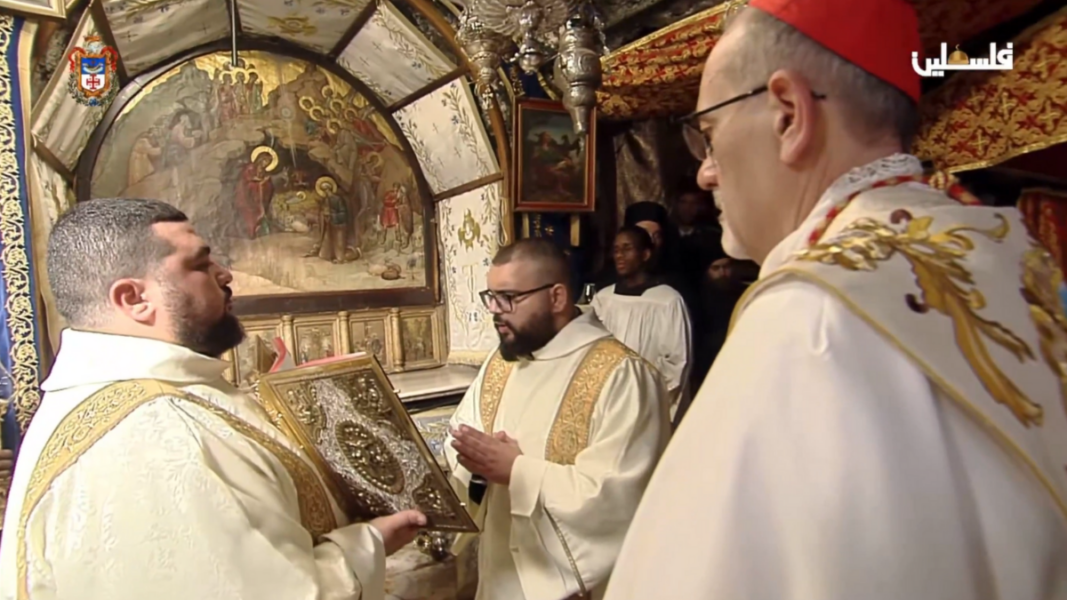
Every Christmas Eve, in the heart of Bethlehem, the Church relives the mystery of the Incarnation where Christian tradition places the birth of Jesus Christ. In the Grotto of the Nativity, under the altar that marks the place venerated since the early centuries, the Franciscan friars solemnly proclaim the Gospel of Saint Luke that narrates the birth of the Lord, culminating with the chant of Gloria in excelsis Deo.
It is a liturgical tradition documented and maintained uninterruptedly by the Franciscan Custody of the Holy Land.
A liturgy in the place of the Nativity
As explained by the Custody of the Holy Land, after the Midnight Mass celebrated in the Church of Saint Catherine—annexed to the Basilica of the Nativity—the Latin Patriarch of Jerusalem proceeds in procession to the Grotto accompanied by the Franciscan friars. There, the evangelical account from Luke (Lk 2:1-14) is proclaimed again, the same one that narrates how Mary gave birth to her Son and laid him in a manger.
The reading or chanting of the Gospel takes place exactly at the spot indicated by the silver star, which since the 18th century marks the traditional point of Christ’s birth. Upon reaching the words of the angelic announcement—“Glory to God in the highest”—the Franciscans intone the hymn Gloria in excelsis Deo, resuming the song of the angels in the very same setting where, according to Christian faith, it resounded for the first time.
A tradition with deep historical roots
This practice is rooted in Franciscan spirituality and in the liturgical history of the Holy Land. Already in the 13th century, Saint Francis of Assisi wanted to relive Christ’s birth in a tangible way, giving rise to the first living Nativity in Greccio. Medieval chronicles indicate that Saint Francis himself sang the Gospel of the Nativity during that celebration.
Since the Franciscan Order officially received custody of the Holy Places in 1342, the friars have maintained a constant liturgical presence in Bethlehem. Historical documents from the 17th and 19th centuries describe in detail how, every Christmas, the Gospel of the birth was sung again in the Grotto, followed by hymns and prayers proper to the liturgical season.