


By Robert Royal
Yesterday was the winter solstice, the moment when, due to variations in the way the Earth orbits around the Sun, the night is the longest, «the darkest day of the year.» (It is also my birthday and, for some who have followed me over the years, I suspect a dark day in more than an astronomical sense.) Perhaps because of that accident of birth, I have always been impressed by the line from Genesis: «And God said, ‘Let there be light,’ and there was light.» Even in my faltering efforts to learn biblical Hebrew, I have memorized the original: וַיֹּאמֶר אֱלֹהִים, יְהִי אוֹר; וַיְהִי-אוֹר. Vayomer Elohim yehi or, vayehi or. Before that (if that is the right way to say it, since time has not yet been created), God prepares to make the pitch, so to speak. And He does so in what follows: «And God saw that the light was good, and He separated the light from the darkness.»
Many things depend on that division, though—as we will see later—not, in the final analysis, in the sense that one might think. In a certain way, it is no surprise that it was a Jewish scientist, Albert Einstein, who first discovered the fundamental role of light in creation. Nothing can exceed the speed of light in our universe. Einstein’s personal religious beliefs are a matter of debate, but is it entirely accidental that someone steeped in the Jewish tradition could have arrived at that truth?
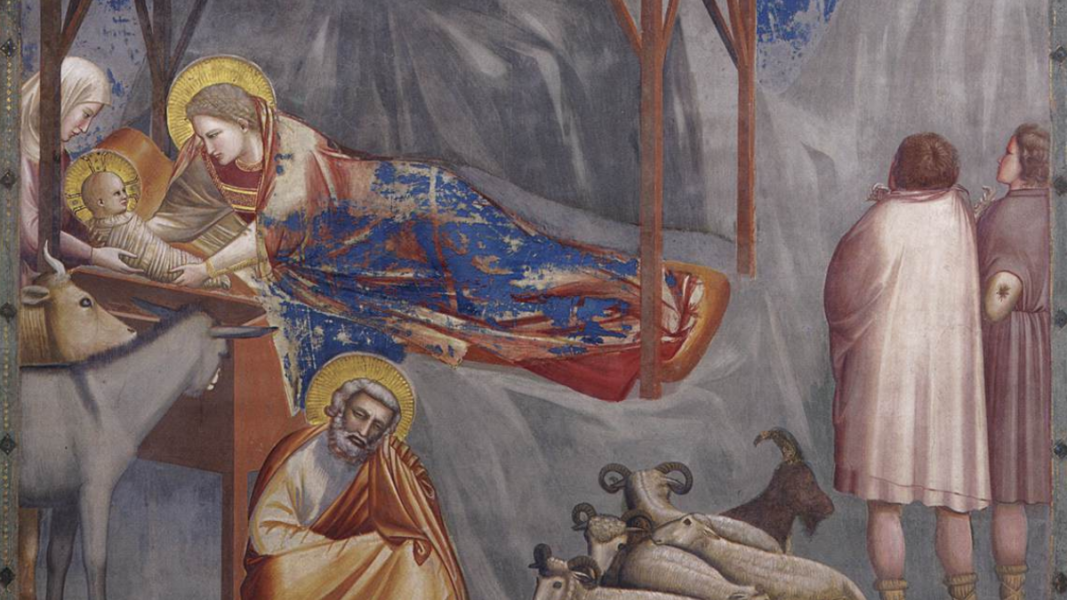
All of that tradition accompanies us deeply in this season. The birth of a child is—or should always be—a cause for celebration. But that this Child entered our world around its darkest days is, without doubt, more than a coincidence. Today people tend to dismiss such reflections as «medieval.» But, as with many of the paradoxes of faith, the darkness is not incidental or merely symbolic or even— we will return to it—something that is left behind. In a profound sense, the darkness is also the reason for the season. Would the light be so important without it?
If we think about it, why was Jesus born at night? We only know because the good Luke includes this detail: «There were shepherds in that region who lived in the open air and kept watch by turns at night over their flock» (Lk 2:8). It is fitting, because the Jewish prophetic tradition suggests that the night is the everyday reality in which we find ourselves.
In Handel’s Messiah, which you should make a point of listening to every year at this time both for your enjoyment and your edification, you will hear much about the glory of God and how we should thank Him for having redeemed us. «The people who walked in darkness have seen a great light» (Is 9:2). And why was He sitting in darkness?
In a live performance last week, the section that most impacted was «But who may abide the day of His coming?» which Handel took from the prophet Malachi (3:2). One would think that, after so much darkness and suffering in the world, we would all be delighted to see Him. But the turbid world that original sin and personal sins have placed upon us—and to which we are so attached—is a world we do not easily relinquish. The Christian tradition reminds us that many will fear Christ’s Second Coming. Even in His First Coming there were those, like Herod and later the Pharisees and Sadducees, who did not exactly jump for joy at seeing Him.
We like Christmas as it has become now, for obvious reasons: gifts, parties, food, drinks (Catholic), family, friends, good cheer, carols, and at least minimal gestures of goodwill toward men. Even a secularist, setting aside the rampant commercialism, can find all that as a welcome respite from the harshness of everyday life. It is all quite Dickensian. But for a Christian, the harshness goes much deeper. And that is why the joy is all the greater.
And yet, in the end, perhaps we should say a good word for the darkness. The darkness that surrounds us and that we carry within in our earthly existence is, in its way, part of God’s mercy. Like all the trials and tribulations that spring from sin, as we see in Scripture, the darkness is a stimulus to seek the light. At Easter we see why this Child is a great light. In the meantime, if we do not take full measure of the darkness in us and around us, and of why we need something to illuminate us from outside ourselves, the celebration is just another party.
But there is even more. One of the greatest Christian mystics, St. John of the Cross, wrote The Dark Night of the Soul, which takes the form of a poem and a commentary on the poem. Understood as part of a spiritual discipline, the darkness can be a kind of door that leads to what preceded even the creation of light, that is, to the Creator Himself. As St. John writes:
On a dark night,
kindled in love with yearnings—oh, happy chance!—
I went forth without being observed,
my house being now at rest. . . .
Oh guiding night!
Oh night far more lovely than the dawn!
Oh night that united
Lover with beloved,
beloved in the Lover transformed!
In the end, even the darkness is not just darkness for God, but the original Being and the contemplative silence to which we can now arrive, perhaps only through poetry.
As Charles Péguy has God say:
Oh sweet, oh great, oh holy, oh beautiful night, perhaps the holiest of my
daughters, night of the long garment, of the garment of stars.
You remind me of that great silence that there was in the world
before the beginning of the reign of man.
You announce the great silence that there will be
after the end of the reign of man, when I have taken back my scepter.
And sometimes I await it eagerly, because man really makes a lot of noise.
About the author
Robert Royal is editor-in-chief of The Catholic Thing and president of the Faith & Reason Institute in Washington, D.C. His most recent books are The Martyrs of the New Millennium: The Global Persecution of Christians in the Twenty-First Century, Columbus and the Crisis of the West y A Deeper Vision: The Catholic Intellectual Tradition in the Twentieth Century.