


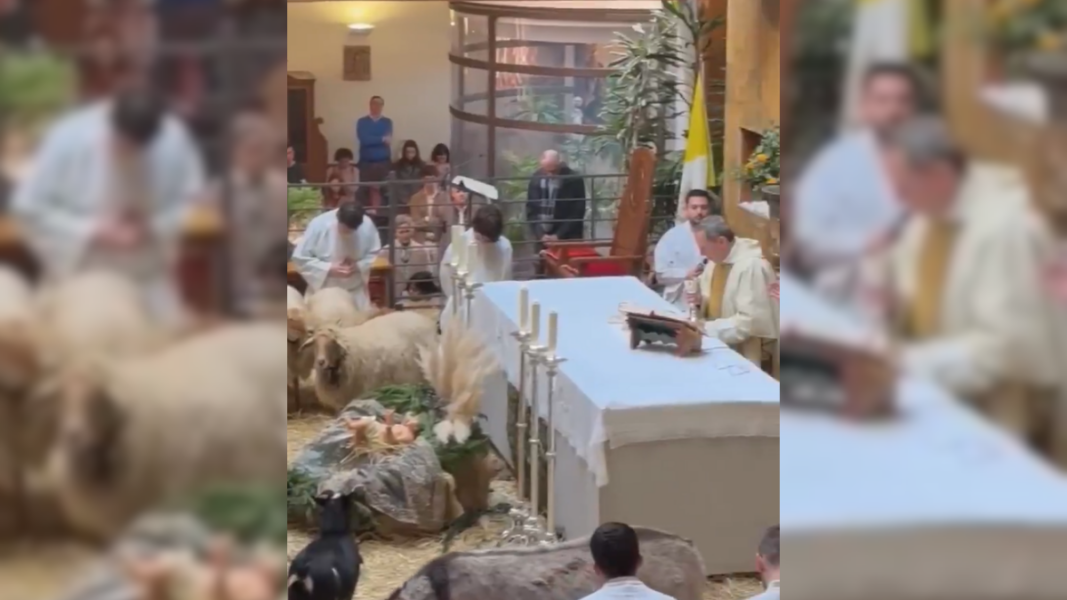
The images disseminated from a parish in Boadilla del Monte have sparked a legitimate debate about the limits of pastoral creativity in the liturgy. In them, one can observe the presence of live animals—sheep, chickens, pigs, and a donkey—placed in the presbytery, surrounding the altar during the celebration of the Mass.
Moreover, this is not an isolated incident. As shown by publications available on social media, the same initiative was already carried out last year, repeating now a practice that has once again generated perplexity among the faithful and observers. At least one of those precedents can be seen in this video shared on Instagram.
The presbytery and its proper meaning
It is advisable to address the issue with serenity and a sense of history. The Church has long known symbolic representations of the Nativity, some of them with animals and even inside temples. However, it has always been aware that the altar is not a representative space, but Calvary, the place where Christ’s Sacrifice is sacramentally renewed.
According to the General Instruction of the Roman Missal, the presbytery is reserved for the altar, the proclamation of the Word, and the exercise of the priestly ministry. Its purpose is strictly liturgical. Precisely for this reason, tradition has always demanded extreme prudence when introducing symbolic elements into the celebratory sphere.
Throughout history, even when devotional representations were incorporated inside temples—especially in the Middle Ages—a clear awareness of spatial limits was maintained. The altar and its immediate surroundings remained protected, clear, and clearly differentiated, to avoid confusion between the devotional and the sacramental.
The presence of live animals in that space, with inevitable behaviors such as unpredictable movements, noises, or excretions, therefore poses an objective problem of liturgical prudence, beyond the good intention that may have motivated it.
Pastoral prudence and the centrality of the altar
The Church’s liturgical tradition has never been iconoclastic or hostile to sensory signs. On the contrary, it has known how to integrate symbols, images, and popular representations. But it has always done so from a guiding principle: nothing must eclipse the centrality of the altar during the Mass.
When the visual and symbolic focus shifts toward an eye-catching scenography, however legitimate it may be in another context, there is a risk of obscuring the central sacramental sign. Pastoral prudence consists precisely in knowing when, where, and how to introduce certain elements without altering the meaning of the celebration.
The Mass is not a staging
In some cases, these initiatives are justified by appealing to their pedagogical or experiential value. However, the liturgy is not a representation or a modern “immersive experience.” It is above all an act of worship, a sacred action that has its own form received and guarded by the Church.
History demonstrates that when representations have been introduced—including medieval ones—they have been done outside the sacramental core of the Mass, precisely to avoid confusing the planes. Prudence does not impoverish the liturgy; it protects it.
Nativity scene and Eucharist: distinct planes
The nativity scene is a legitimate representation deeply rooted in Christian tradition. The Eucharist does not represent: it makes present. Both realities illuminate each other when each occupies its proper place.
In the Middle Ages, even in contexts of great symbolic richness, these planes were not confused. The nativity scene could be in the temple, but it did not invade the presbytery or surround the altar during the Mass. This distinction is not a modern formalism, but a practical teaching from centuries of liturgical life.
That is why there are clear norms, today collected in the Roman Missal, which do not seek to stifle pastoral care, but to guarantee that historical prudence which the Church has always considered necessary.
Pedagogy yes, but with clear limits
The concern to bring the faith closer to children is legitimate and necessary. But Christian tradition has shown that the best liturgical pedagogy does not consist in filling the Mass with external stimuli, but in gradually introducing into the mystery, respecting its proper signs.
An error of prudence, beyond intentions
None of this requires judging intentions or questioning pastoral good will. But it does oblige us to recognize that the introduction of live animals into the presbytery during the Mass is an objective error of liturgical prudence, because it breaks a boundary that the Church has historically cared for with special attention.
Tradition is not preserved only by repeating ancient gestures, but by maintaining the criterion that governed them. And that criterion has always been absolute respect for the altar.
Tradition teaches prudence
The history of the Church shows creativity, symbolic richness, and pastoral closeness. But it also shows a constant concern to safeguard the altar as a holy place. When that prudence is relaxed, depth is not gained, but confusion.
Christian Christmas can and should be expressed with visible signs. The Mass, on the other hand, demands sobriety, clarity, and reverence. Learning from tradition is not imitating everything, but assuming its wisdom.