


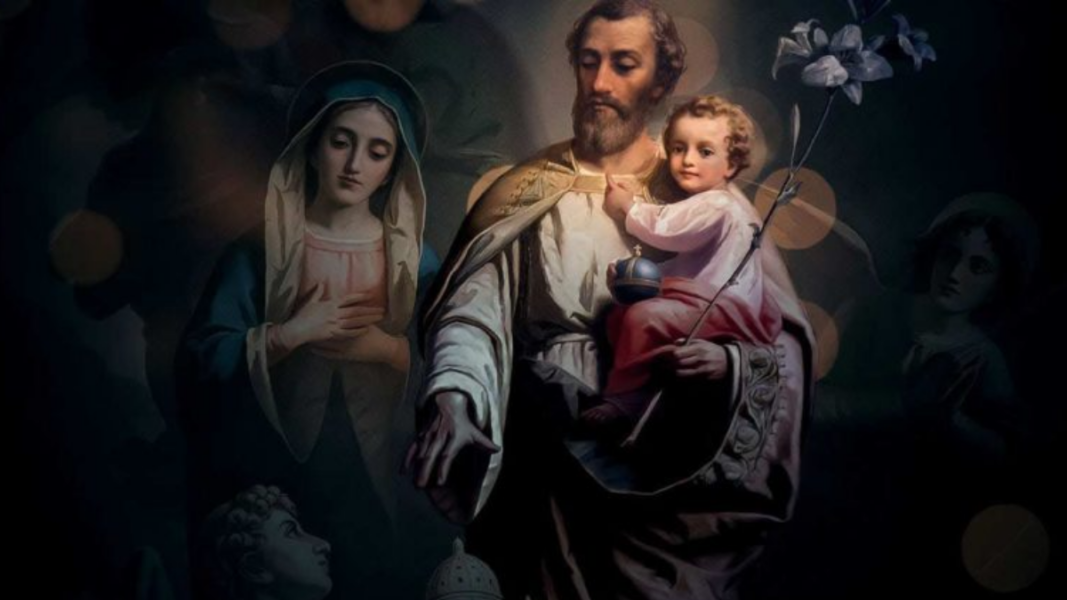
Upon arriving at that place no one had wanted, Mary and Joseph did not look at each other with sadness, but with a smile. They took it as one receives things that are not understood, but are accepted because they come from on High. The cave was poor, but not hostile; it was empty, yes, but precisely for that reason it offered itself as available space, as an open womb for what was already very near.
Joseph surveyed it with his quiet, manly, careful gaze, not thinking of himself, but of Her, of the fatigue accumulated from the journey, and of the cold night that was approaching, and of the Child who was to be born with no more shelter than that improvised covering. And in his heart, faithful and discreet, the desire to have been able to offer more or to have found something better no longer arose: he knew that this was, exactly, what God had granted them.
Mary did not measure the place; she welcomed it. Her steps, as she entered the cave, were not ones of resignation, but of profound consent, which made an echo rebound off the stone walls: fiat! Wherever the young Woman placed her foot, the ground seemed to lose its roughness, as if the earth itself understood that it was about to serve something grandiose and, at the same time, so delicate and small. In the little Virgin there was no complaint, but a serene gratitude, so vast that it even reached those who had closed their doors to Her: she knew that that rejection hid a greater gift.
And without saying anything, with all naturalness, they began to prepare the place. Mary bent down, and Joseph, seeing her, hurried to go ahead, with protective and gentle chivalry. She did not insist; she sat down, exhausted, looking with joy at her husband’s humble gesture: the same simple work as so many other times in Nazareth.
The carpenter’s hands got dirty with dust, and the silence filled with small sounds: the rustle of the cloths and swaddling clothes that Mary took out of the bundle, the movement of the improvised broom, the warm breath of the animals… There was no hurry, but there was attention, and, without words, a profound understanding, born of a shared life and an unwavering trust. That cave, judged unworthy by men, was beginning to transform, not by ornaments, but by the loving care of those who inhabited it.
Without imposing themselves or distracting, the angels were there, without claiming astonishment, they accompanied, as one courts the sacred. Their presence was almost a sigh in the air, a silent respect before the humanity in which God was wrapping Himself.
Joseph lit the fire with the little he carried, and the trembling glow of the flame brought relief to the cold of the night. By the campfire they shared their scant food with quiet joy, without comments. Mary barely took a bite; her body and soul were already gathered, attentive to the Mystery that was approaching with soft steps of firm footfalls. Joseph, as always, respected Her full, modest, regal silence.
When the night grew deeper, Mary, with wifely tenderness, asked Joseph to rest a little. He obeyed, as always, but first he stopped to prepare the manger, as one arranges a throne in a sudden and rickety little cradle: arranging the linens, calculating the space, pressing the hay to soften it, ensuring it would protect from the cold. In that task pulsed all his silent paternity, so original, so unique, so unsurpassable.
He helped Mary to lie down with almost reverent care, and then withdrew to a corner of the stable. He did not sleep. He remained there in prayer, watching without looking, guarding without invading, offering God the only thing he could give at that moment: his faithful presence.
Mary remained gathered, alone and so accompanied! The stable was already prepared, not by celestial splendors, but by the human love of two hearts that had made room for God with humility and absolute abandonment. And in that silence so deep and true, the whole world seemed to hold its breath, on the verge of receiving a God who wanted to be born thus: poor, loved, and ignored.
Mons. Alberto José González Chaves