


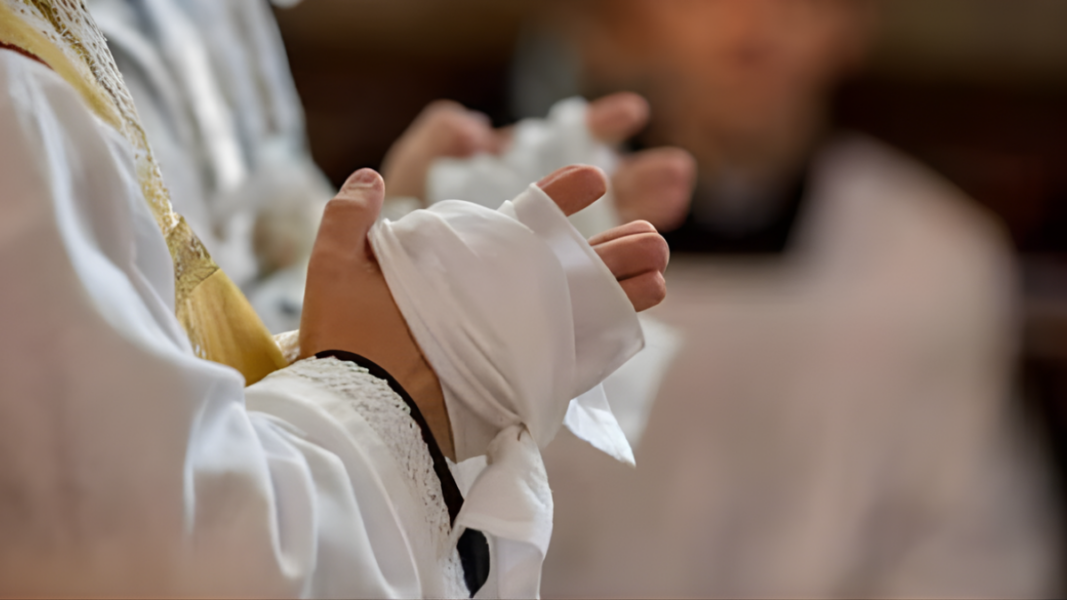
In the context of priestly ordination, there is an ancient custom, now recovered in some areas, that underscores the sacred character of the ministry and the discreet but decisive role of the family in the birth of a vocation: the delivery of the manutergium to the mother of the new priest.
The manutergium is a linen cloth used during the ordination to clean or collect the chrism oil with which the bishop anoints the hands of the ordinand. In the traditional rite, the hands of the new presbyter were even wrapped with this cloth after the anointing, as a visible sign of his consecration for the altar. In the current rite, although this gesture is no longer a stable part of the ceremony, the use of the cloth is maintained in some places as a symbolic element.
The Delivery of the Manutergium to the Mother
From this liturgical object arises a custom transmitted for centuries in the Catholic tradition: the newly ordained priest delivers the manutergium to his mother, who keeps it throughout her life. According to this practice, when the mother passes away, the cloth is placed in her hands in the coffin as a sign of having offered a son to the priesthood.
This gesture is not part of the liturgical rite proper, but it has been adopted as a concrete expression of the silent and persevering offering of many Christian mothers.
Video published by Una Voce on X
Popular Piety and Spiritual Meaning
Popular tradition adds a spiritual meaning to this gesture: in the Particular Judgment, the mother could present the manutergium before God as testimony of having given her son to the service of the Church. This account, widely spread in Catholic piety, does not belong to doctrine or official liturgy, but it symbolically expresses a spiritual truth recognized by the Church: the real cooperation of parents—and particularly of the mother—in the emergence and accompaniment of a priestly vocation.
“Priest Forever”: A Doctrinal Reality
The expression “priest ad aeternum” is understood in the light of Catholic doctrine on the sacrament of Holy Orders. The Church teaches that ordination imprints an indelible spiritual character: the priest is such forever, even when he leaves the public exercise of the ministry.
In this context, the manutergium becomes a visible reminder of a consecration that is not functional or temporal, but ontological.
A Living Tradition in the Society of Saint Pius X
Today, this custom is habitually preserved in environments where the traditional ordination rite is maintained in its entirety. This is the case of the Society of Saint Pius X (FSSPX), where the delivery of the manutergium to the mother of the new priest continues to be practiced as part of a sacramental and familial understanding of the priesthood.
A Sign, Not a Guarantee
It is worth emphasizing that the manutergium has no sacramental value nor does it guarantee anyone’s salvation. It does not constitute a “proof” in a juridical or theological sense before God. It is a sign, a symbol that refers to a life of faith, to a sacrifice offered, and to a vocation sustained in the bosom of a Christian family.
The recovery and preservation of signs like the manutergium highlights two inseparable realities: the dignity of the priesthood and the importance of the family as the first sphere where one learns to listen to and respond to God’s call.