


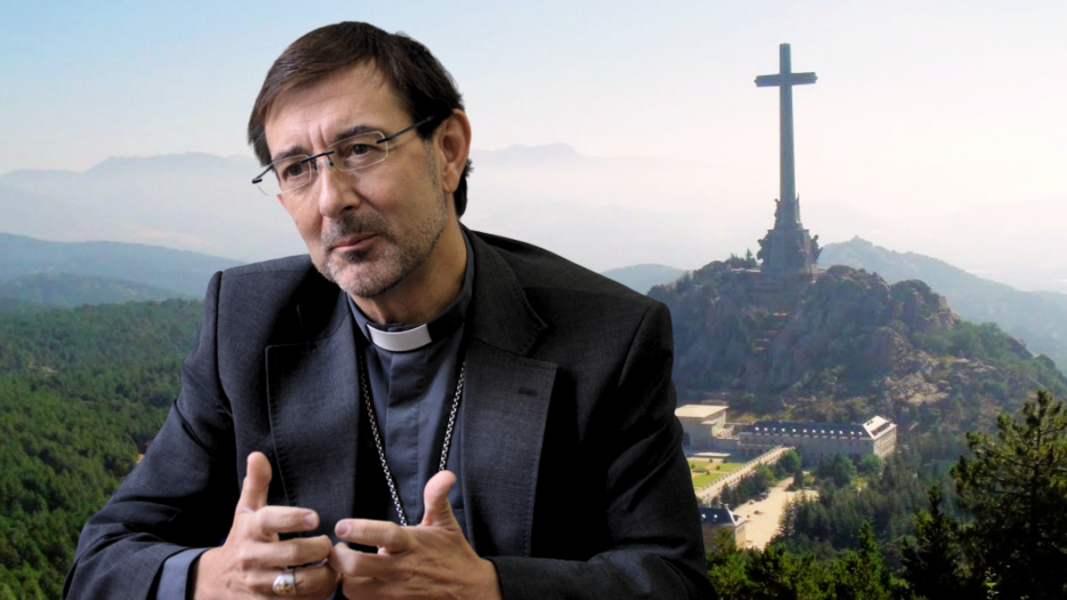
Cardinal José Cobo, Archbishop of Madrid, has once again placed himself at the center of the ecclesial and media debate following his intervention on Herrera en COPE. He has done so, once again, regarding the Valley of the Fallen—officially renamed Valley of Cuelgamuros—and the process of “resignification” promoted by the Government. But this time, in addition, pointing to alleged “pseudomedia” Catholic outlets that he accuses of distorting reality, ideologizing the debate, and even slandering.
It is worth saying it without beating around the bush: when the hierarchy speaks late, poorly, or ambiguously, it cannot be surprised that others fill the void.
In his radio intervention, Cardinal Cobo offers a phased reconstruction of the resignification process: governmental initiative, initial negotiation, public contest, project approval, and finally, a growing role for the monks and the Holy See. According to his account, the Church has not driven the process but has limited itself to “setting a framework” to protect worship, the basilica, the Benedictine presence, and religious symbols.
The problem is not so much what is said now, but when it is said. For months—and years—the Spanish Episcopal Conference and diocesan leaders opted for technical statements, prolonged silences, and deliberately downplayed messages, while the Government advanced without qualms on a project with a strong ideological charge. The result is predictable: distrust among the faithful and a sense of opacity.
The cardinal does not limit himself to defending his role. He goes further and accuses certain media outlets—which he calls “pseudomedia”—of acting as “mercenaries of other interests,” living “off the Catholic without being Catholic,” and using bishops and even the Pope as permanent targets.
Pointing to the messengers allows avoiding serious self-criticism about the Church’s communication strategy in Spain. Because the malaise does not arise from malicious headlines, but from the perception—widespread among many faithful—that too much has been negotiated and too little explained. And when it is finally spoken about, it is to assure that “everything is saved,” without assuming concrete responsibilities or pastoral miscalculations.
The pattern repeats. The Government pushes. The Church “accompanies.” The Episcopal Conference mediates. The archbishop interlocutes. The monks and Rome “will have the last word.” And when the controversy erupts, no one is directly responsible. Everyone has taken a step back at the opportune moment.
Meanwhile, the Valley—a religious, historical, and spiritual symbol for thousands of Catholics—remains subjected to a «resignification» designed from parameters alien to the faith, although now wrapped in guarantees that arrive late and poorly explained.